
Plain-language questions, evidence-backed answers
A sales director types "Which accounts slipped this quarter?" and gets a ranked list with the filters, source tables, and data freshness attached.
How chat with your data AI works, the architectures behind it, a readiness check for your data, and the questions to ask before choosing a solution.
A finance or sales leader should not need to open a ticket every time the next question falls outside an existing dashboard. Yet most business data still sits behind reports, SQL queries, and analysts who are already handling a queue of ad hoc requests.
Chat with your data changes that workflow. A business user asks a question in plain English, while an AI data agent maps the question to approved metric definitions, queries the right systems, validates the query, and returns the answer with evidence that can be checked.
Gemini-SQL2 reached a reported 80.04% execution accuracy on the BIRD text-to-SQL benchmark in June 2026, while BIRD reports human performance at 92.96%. The remaining gap is a reminder that strong SQL generation does not remove the need for schema context, business definitions, validation, and testing against your own data.
A benchmark score should be treated as evidence of model capability, not as a predicted accuracy rate for your ERP or finance database.
This guide covers how the technology works, where projects stall, and how to evaluate a solution.
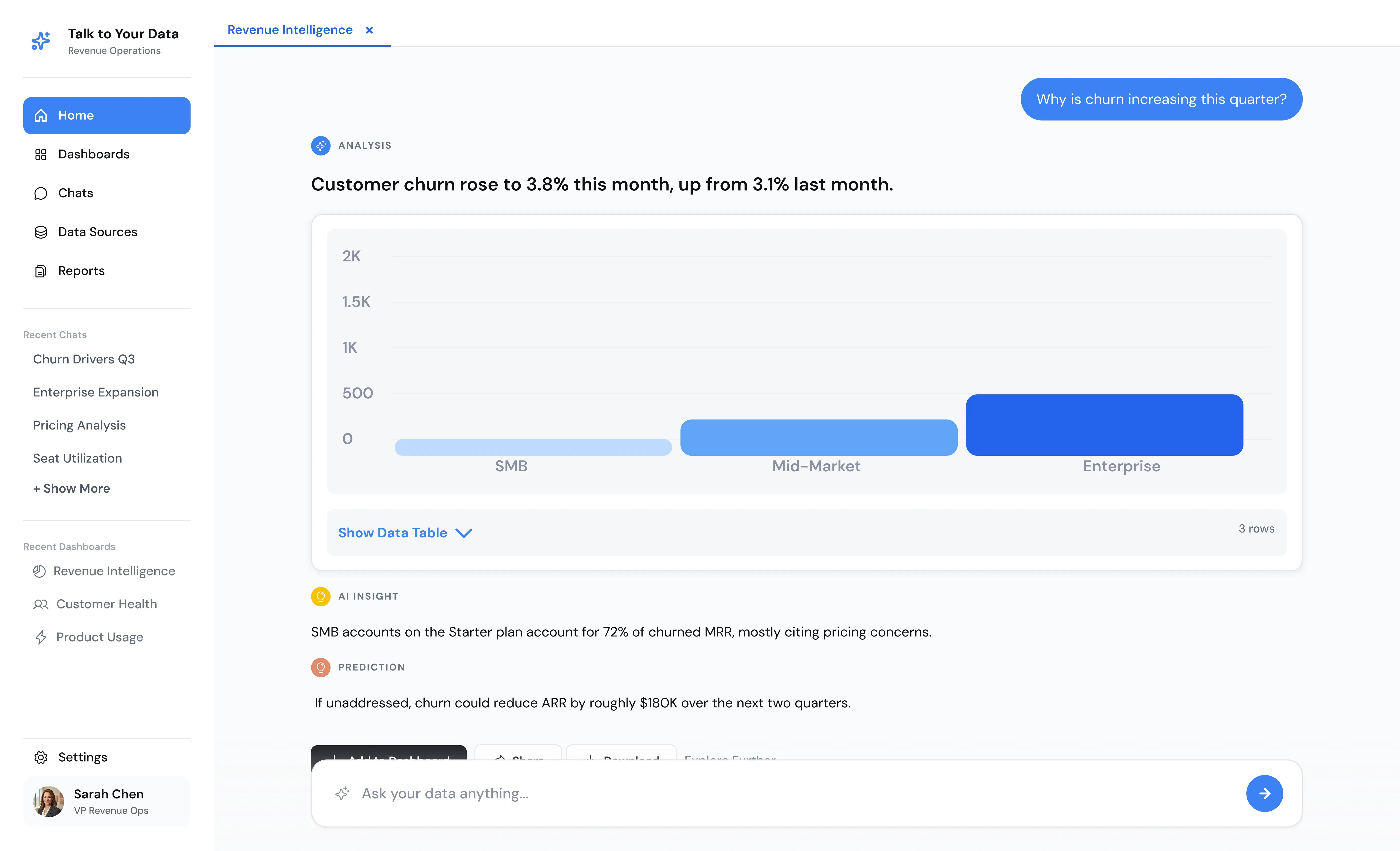
Chat with your data is a conversational layer over approved business data. A user asks a question in natural language, and an AI agent turns it into a query, runs it, and explains the answer with evidence attached.
A sales director types "Which accounts slipped this quarter?" and gets a ranked list with the filters, source tables, and data freshness attached.
Dashboards still track known KPIs on a schedule. Chat handles the follow-up question nobody built a dashboard for, without opening a new report ticket.
Uploading a CSV to a public chatbot analyzes a frozen copy with no access rules. A data agent queries the live source under your permissions.
Answers come from the current state of your ERP, CRM, or warehouse, limited to the sources and fields your team approved for the agent.
| Criterion | Chat with your data (AI data agent) | BI dashboards | Generic AI chatbots |
|---|---|---|---|
| Data freshness | Live queries against approved sources | Fixed refresh schedule | Only the file someone uploaded |
| Question flexibility | Any question the data model supports | Pre-built views and filters only | High, but numbers can be invented |
| Follow-up drill-down | Keeps metric, period and region context | Needs a new filter or report | Keeps chat context, not data context |
| Source transparency | Sources, filters and query logic shown | Visible mainly to report builders | Rarely shows the calculation path |
| Access control | User permissions and data boundaries applied | Row-level security in the BI tool | Not tied to your systems |
| Setup effort | Weeks: connect, model, validate | Ongoing report backlog | Minutes, with no governance |
Vendors sell the same idea under other labels: conversational analytics software describes the chat-first tools, and self-service analytics software covers the wider market, from dashboards to AI agents.
A chat box is the visible part. Behind it sits a seven-step pipeline, and each step exists to stop a specific failure, from misreading the question to returning a number the user should never see.
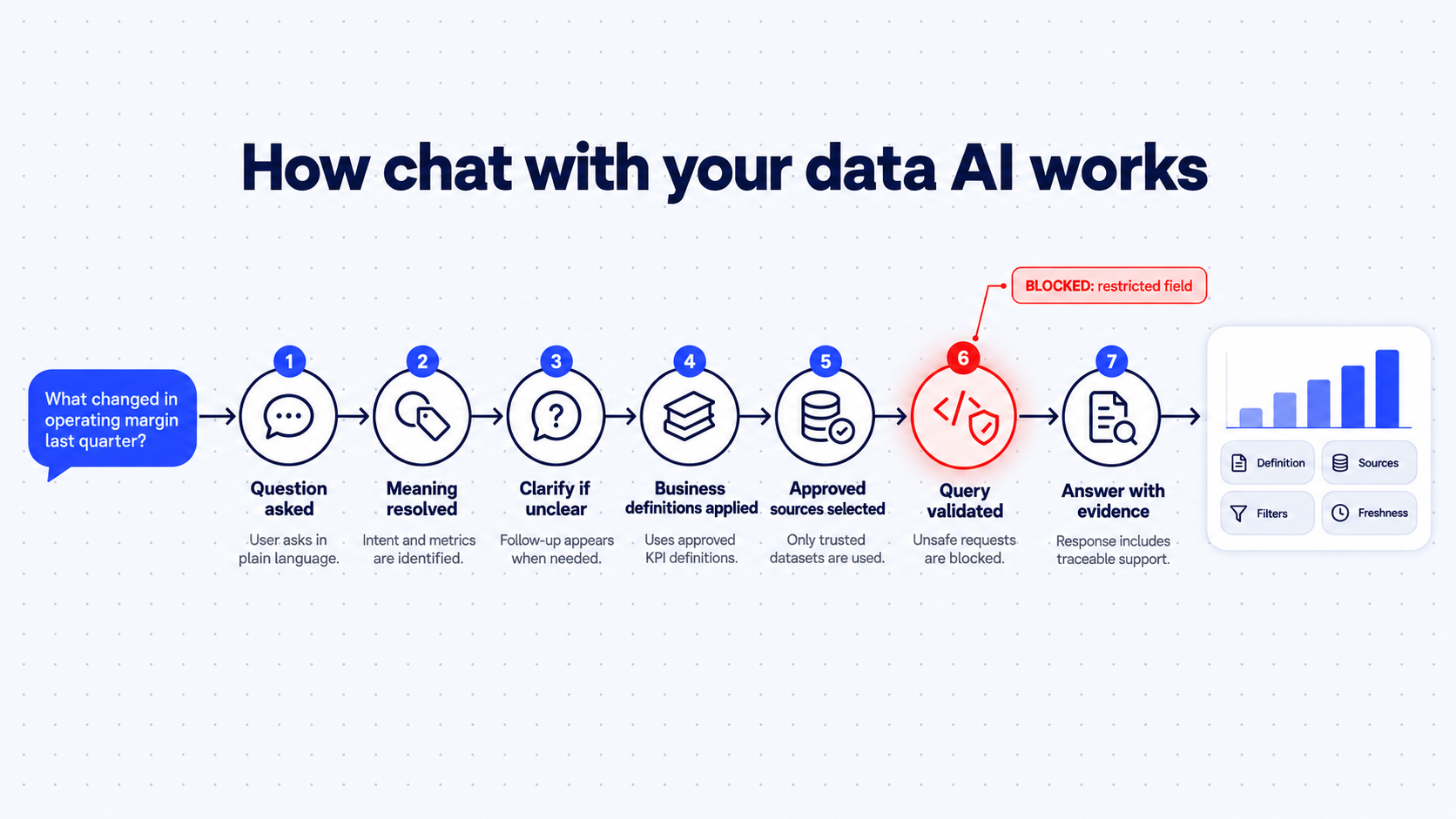
Type "Now split that by region" and the agent keeps the metric and period from the previous turn. A user can drill from a company-wide number to a single account in three or four messages, where the old route meant three separate report requests.
ERP, CRM, finance, operations, custom SQL databases, and approved knowledge content, connected at the database level rather than through a vendor's connector.
Business glossary, metric definitions, entities, schema relationships, data profiles, and sensitivity context that tell the agent what each term means in your company.
Interprets intent, builds a query plan, validates it against approved relationships, and executes it only after the checks pass.
Conversational assistants, executive insight summaries, recurring reports and workflow integrations, all running on the same governed model.
Here is a single question moving through the pipeline. The example mirrors the evidence panel in Talk to Your Data demos. The figures are illustrative, not client data.
User: Why is gross margin declining in the West region?
How the agent resolved the question
Evidence returned with the answer
| Evidence field | Value |
|---|---|
| Business definition | Gross Margin = (Net Sales − COGS) / Net Sales × 100 |
| Sources | Finance ERP, Sales, Returns |
| Filters | West region, previous completed quarter |
| Freshness | Latest approved data refresh |
| Query logic | Approved sales, COGS, freight, and returns data joined by region and period |
Agent: Gross margin in the West region fell 3.8 points (example figure). Revenue stayed broadly flat, while freight expense and return-related costs rose in the same period. Those two cost lines explain most of the decline.
User: Which accounts drove the returns increase?
The agent keeps the West region and the quarter, joins returns to customer accounts, and returns the accounts ranked by return cost. Nobody wrote SQL, and nobody waited for an analyst.
What matters for trust is what the reviewer can check without asking anyone: the formula used, the three systems queried, the filters applied, and how fresh the data was. If any of those look wrong, the error is visible before the number reaches a meeting.
Talk to Your Data is a new Folio3 service, so the proof comes from your data rather than someone else's case study. Every engagement ends Week 3 with a pilot scorecard your team signs off on:
The share of your reviewed question set answered correctly, checked by your business owner against the numbers they already trust.
How often the agent asked instead of guessing on ambiguous questions, and whether those clarifications were the right ones.
Results from users with different roles asking the same questions, confirming each saw only what their role allows.
Minutes per question in the pilot, compared with the Week 1 baseline for the same questions through your current process.
Most products in this category use one of three technical patterns. The pattern decides which questions the tool can answer and where its accuracy breaks.
The model converts a question into SQL and runs it against tables. Best for numeric questions on ERP, CRM, and warehouse data.
Retrieval-augmented generation finds relevant passages in PDFs, policies, and wikis, then writes an answer citing them. Best for "what does the policy say" questions. See RAG development.
An agent plans several steps, queries tables, retrieves documents, and combines the results. Best for "why did this number change, and does the contract explain it" questions.
| Architecture | Best fit | Data types | Main accuracy risk | When to use it |
|---|---|---|---|---|
| Text-to-SQL | Metric and trend questions | Structured tables | Wrong joins and ambiguous metric names | Finance, sales and operations KPIs |
| RAG | Policy, contract and SOP lookups | PDFs, documents, wikis | Retrieves the wrong or outdated passage | Knowledge questions that need a citation |
| Agentic hybrid | Questions that need numbers plus context | Tables and documents | More steps create more failure points | Root-cause and cross-system questions |
No architecture removes these limits. Knowing them up front sets the right scope for a pilot.
If a metric has no agreed definition in the semantic layer, the agent will ask for clarification or decline. It won't invent a formula your finance team never approved.
"Should we cut the West region budget?" needs context the database doesn't hold. The agent shows the numbers behind the decision, and a person still makes the call.
Tools that only offer a locked UI, or exports someone emails each week, can't be queried live until the data lands in a database or warehouse.
Duplicate customers, missing cost codes, and late refreshes come through in the answer. The evidence panel makes these issues visible, but it can't fix them.
Any source the agent can query directly, or that your team can load into a database, is a candidate. The three groups below cover the questions buyers ask about most often.
ERP systems hold the numbers finance and operations teams chase every day, usually behind menus that take several clicks per report.
Company data spans systems that rarely share a login, which is why cross-system questions usually end up as analyst tickets.
Website data becomes chat-ready once it lands in a system the agent can query. Most of it already does.
Most projects that stall had a data problem before they had an AI problem. Score your environment on these six checks before talking to any vendor, including Folio3.
| Check | What "ready" looks like | Quick test |
|---|---|---|
| Core systems have database access | Read access to ERP, CRM or warehouse tables is possible | Can IT grant a read-only database user? |
| Key metrics have one agreed definition | Revenue, margin and churn have one written formula each | Do finance and sales report the same revenue figure? |
| User roles and data boundaries are defined | You know who can see salaries, margins, or customer PII | Is there a role list for your BI tool or ERP? |
| Sensitive fields are identified | Personal, payroll, and pricing fields are tagged | Could you list restricted columns in a day? |
| Data refreshes on a known schedule | Each source has a documented refresh time | Do users know when yesterday's data lands? |
| A business owner can validate answers | Someone can confirm whether an answer is right | Who signs off on the monthly numbers today? |
How to score it: Give one point per check you pass.
5 to 6 points
Pilot-ready. Pick the first dataset and a set of real questions.
3 to 4 points
Workable. The gaps can be closed during the first week of discovery.
0 to 2 points
Start with data groundwork, such as AI data integration, before adding a chat layer.
Scored 3 or higher? Share your ERP, CRM, finance, and operations sources, and Folio3 will identify the first dataset worth validating and confirm access before any build starts.
The demo usually works. The trouble starts in month two, when real users ask messy questions and the answers have to hold up in a finance review.
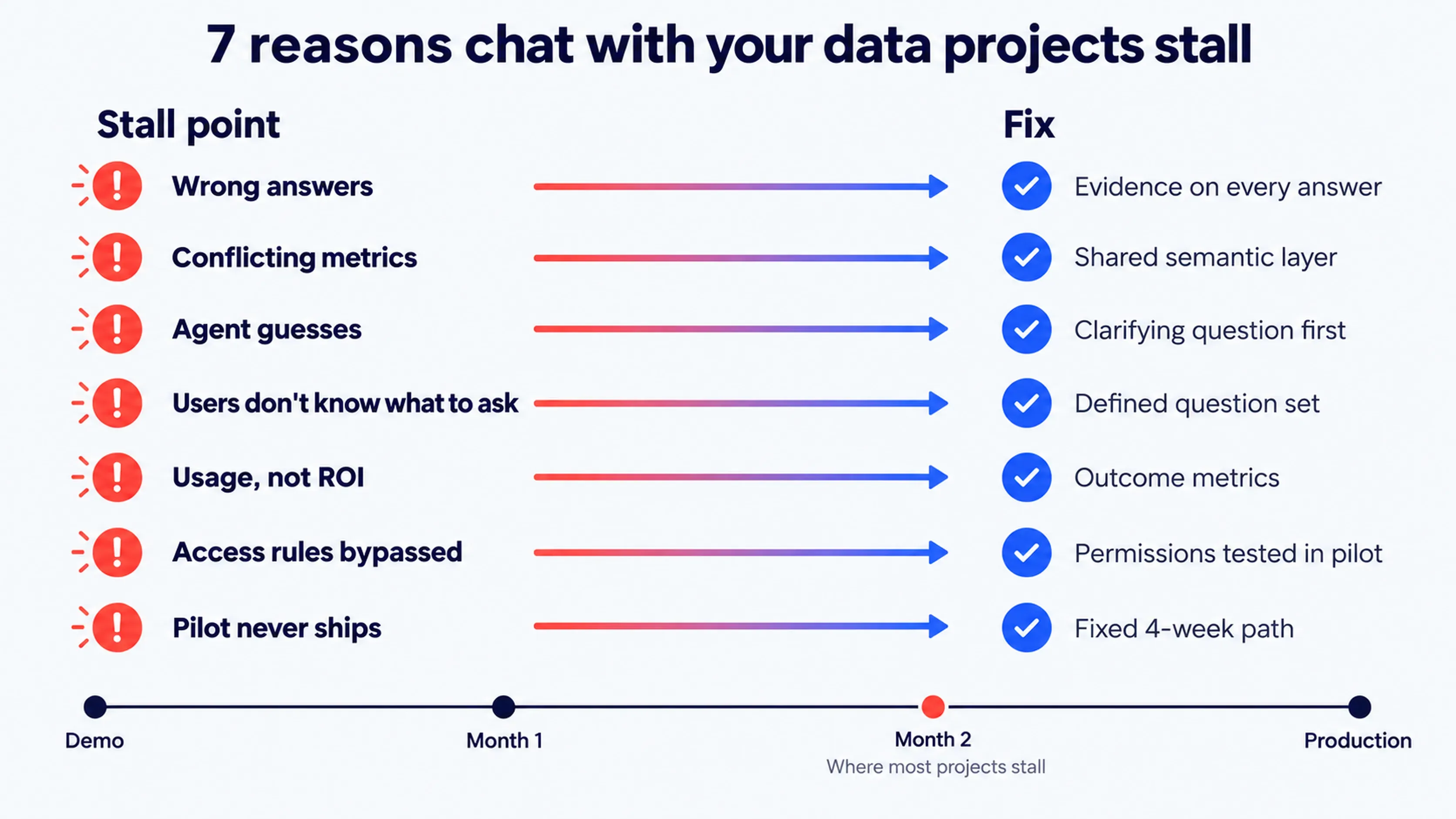
One bad number in a leadership meeting and users go back to spreadsheets.
Fix: show the sources, filters, and query logic with every answer so errors surface early.
Sales counts bookings and finance counts recognized revenue, so "revenue" returns two answers.
Fix: a shared AI semantic layer with one signed-off formula per metric.
"How are we doing in Texas?" has a dozen valid readings.
Fix: the agent asks which metric and period before it queries anything.
Chat is a pull interface, so usage drops once the novelty fades.
Fix: start from a defined question set built with each team during discovery.
"3,000 questions asked" says nothing about value.
Fix: track analyst requests deflected and time to answer instead, as covered in the ROI section below.
A tool that ignores roles will expose payroll or margin data to the wrong people.
Fix: define permissions and data boundaries, then test them during the pilot.
Open-ended pilots drift for months without a decision.
Fix: a fixed four-week path that ends in a production plan and a handoff.
A chat answer only helps the person who thought to ask. The bigger gains come when the same governed data model also pushes information to people on a schedule or inside the tools they already use.
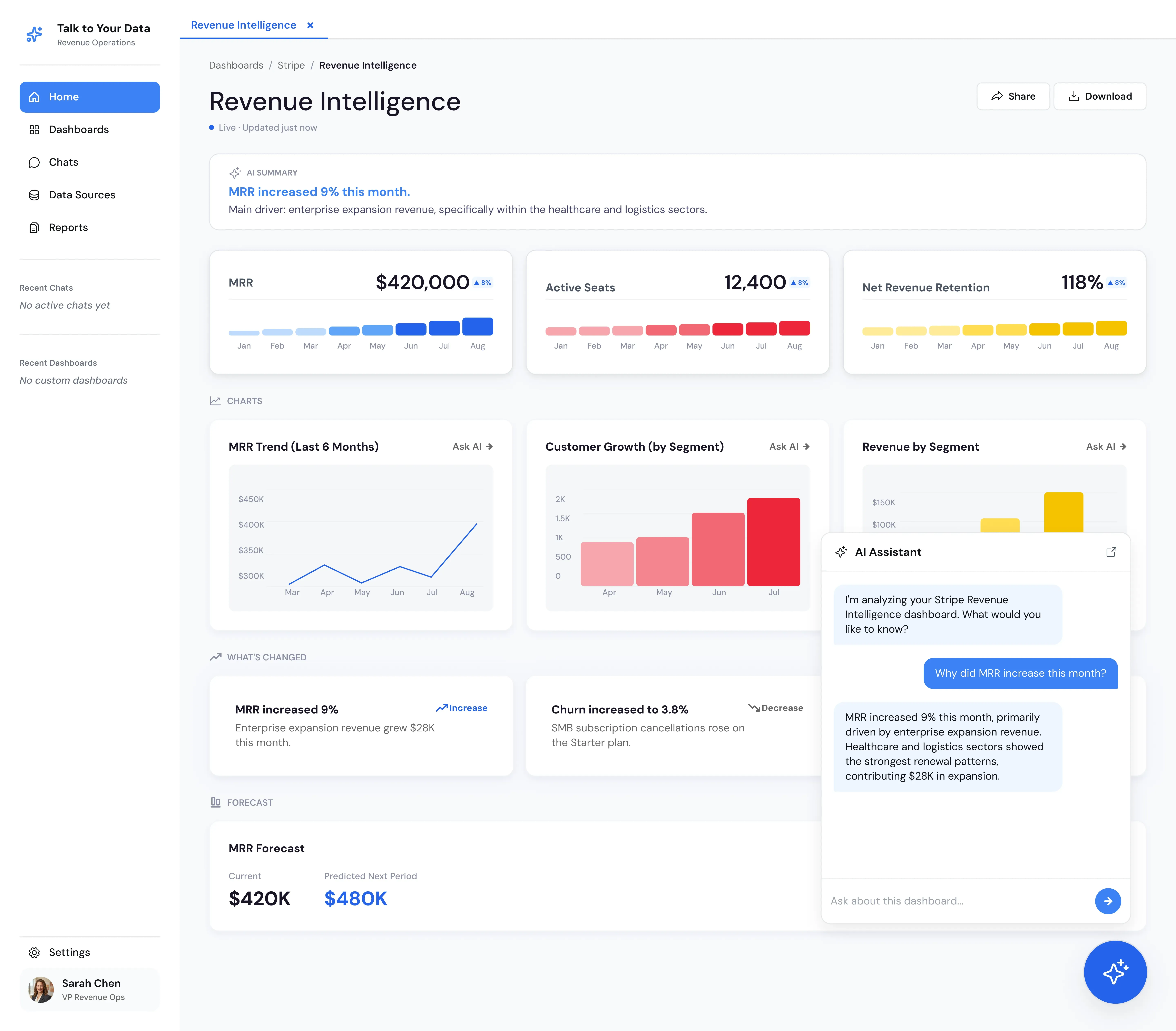
Users ask in plain English, follow up and drill down, with the evidence attached to every response.
A question asked every Monday becomes a scheduled report delivered automatically, built on the same metric definitions as the chat answers.
Leaders receive a short summary of what changed across revenue, margin, inventory, and customer risk, with links to drill further.
Answers feed the systems where work happens, so a flagged account or delayed shipment reaches the owner instead of sitting in a chat history.
The same semantic model serves different roles without forcing every team into one dashboard. These are the questions each team tends to ask first.
| Team | Example question | Typical sources | What it replaces |
|---|---|---|---|
| Finance | "What changed in operating margin, and which cost centers explain it?" | ERP, GL, budget files | Variance analysis spreadsheets |
| Sales and revenue | "Which accounts are slipping, and what changed in their activity?" | CRM, billing, product usage | Weekly pipeline exports |
| Operations | "Where are service delays increasing, and what do the affected cases share?" | ERP, WMS, ticketing | Manual exception reports |
| Executive teams | "What changed this month across revenue, margin, inventory, and customer risk?" | All approved sources | Monthly board pack prep |
“The demo question is never the hard one. The hard one is the fourth follow-up, when someone asks for margin by account excluding intercompany sales. If the semantic layer doesn't know what intercompany means for that client, the agent should stop and ask. That's the behavior we test hardest during the pilot.”
Question counts and adoption charts are activity metrics. ROI comes from time and decisions that change because answers arrive faster, so measure those directly from week one.
| Metric | What it measures | How to capture it |
|---|---|---|
| Analyst requests deflected | Ad hoc data tickets that no longer reach the data team | Compare ticket volume before and after rollout |
| Time to answer | Hours or days from question to trusted answer | Sample 20 questions at baseline and after the pilot |
| Follow-up requests eliminated | Second and third tickets triggered by one question | Count linked or repeat requests per original question |
| Report hours removed | Hours spent building recurring manual reports | Ask report owners for weekly hours spent |
Annual value = hours saved per year × loaded hourly cost − annual runtime cost
The numbers below are assumptions for illustration. Replace them with your own baseline.
Net annual value comes to about $56,000. Against a $20,000 fixed build, payback lands in roughly four to five months.
The bigger number is often decision latency, such as a margin problem caught in week two instead of at quarter close. That is harder to price, so leave it out of the base case.
When to measure: Set the baseline in Week 1 discovery, then review the same metrics after the pilot in Week 3 and again 90 days after rollout.
Every vendor demo looks good on clean sample data. These criteria separate tools that hold up on your schema from tools that only demo well.
Ask for a pilot on your own tables and 20 real questions. Benchmark scores on public datasets don't predict accuracy on your naming conventions.
Check whether the tool queries the database or depends on a connector. Connector-based tools can't answer from fields the connector doesn't expose.
Every answer should show how it was produced. If a reviewer can't trace a number back to its source, finance won't trust it.
Ask the vendor what happens with an ambiguous question. A good agent asks one clarifying question; a weak one guesses silently.
Test a five-question drill-down from company total to single account. Check that the metric and period carry through every turn.
Log in as two users with different roles and ask the same question. The answers should differ wherever their access differs.
The vendor should test with your users and a reviewed question set before rollout, not after the contract is signed.
Ask for monthly runtime cost at your expected query volume. Model the cost at your full user count, since per-seat pricing grows with every team you add.
Confirm you keep the semantic layer, metric definitions, and question sets, and how long removal takes if you stop using the tool.
A working prototype takes a developer a few days with LangChain, a vector database, and an LLM API. Production takes longer, because the prototype skips the parts that make answers trustworthy: a governed semantic layer, query validation, permission testing, an evaluation set of real questions, and monitoring once users arrive.
Build in-house if you have a data engineering team with time to own those pieces. Otherwise, a fixed-scope build gets you there without staffing a new product team.
| Option | Data reach | Evidence shown | Permissions | Setup | Best for |
|---|---|---|---|---|---|
| BI copilots (Power BI Copilot, Snowflake Copilot) | Data already modeled in that platform | Partial, tied to the platform | Platform roles | Fast if the data is already there | Teams fully committed to one BI or data platform |
| Document chat (Microsoft Copilot, ChatGPT) | Files and documents | Citations to documents | File-level access | Fast | Policy and document questions, not live metrics |
| Generic connectors and MCP tools | Fields each connector exposes | Varies | Varies by connector | Fast to start | Simple lookups across SaaS apps |
| DIY build (LangChain, open-source) | Whatever your team connects | Whatever your team builds | Your team builds it | Days to prototype, months to harden | Teams with spare data engineering capacity |
| Custom data agent | Approved databases, queried directly | Sources, filters, query logic | Defined and tested in pilot | 4 weeks to a working agent | Cross-system questions that finance must trust |
Bring five questions your finance or ops team asks every week. Watch Talk to Your Data answer them, with the sources and query logic shown for each one.
Talk to Your Data is a private AI data agent that Folio3 builds on your schema. It answers in plain English across approved ERP, CRM, finance, and operations data, and shows the evidence behind each result.
Custom-built for your tables, metric names, and business rules rather than configured from a generic template.
Queries the data layer itself, so answers aren't limited by what an API, connector, or MCP server chooses to expose.
Your glossary, formulas, and entity relationships are modeled once, so every user gets the same definition of margin, churn, or backlog.
Each response includes the business definition, sources, filters, data freshness, and query logic used to produce it.
Sources, user permissions, and sensitive fields are defined before launch and tested with pilot users before any expansion.
Starts with a small pilot group on one data domain, then extends to more teams, sources, and agents.
The environment plan is agreed in Week 1, so deployment matches your existing cloud and security requirements.
The engagement starts narrow with one high-value data domain, validates real user questions, then expands. Each week ends with defined outputs.
| Week | Phase | Outputs |
|---|---|---|
| Week 1 | Kickoff and discovery | Dataset selected, question set defined, environment plan agreed, ROI baseline captured |
| Week 2 | Connect, model and deploy | Data connected, semantic layer configured, agent deployed |
| Week 3 | Pilot and validate | Pilot users onboarded, Q&A reviewed, rules refined |
| Week 4 | Expand and hand off | Production path, expansion backlog, handoff |
$20,000
Fixed price for the 4-week engagement
$100 to $300
Cloud runtime per month
Under 1 hour
Uninstall if you stop using it
A data agent with database access needs its controls in place before the first user logs in. Each control below is configured during the build and tested during the pilot.
Folio3 operates an ISO 27001 certified information security management system covering how project access, credentials, and client data are handled.
The agent can reach only the systems, schemas, and fields approved during discovery. Anything outside that boundary is unreachable by design.
Payroll, personal, and pricing fields are identified and restricted before any user gets access, so restricted data never appears in an answer.
Pilot users with different roles ask the same questions to confirm each person sees only the data their role allows.
Every generated query is checked against approved table relationships before execution, blocking invalid joins and requests for restricted fields.
Chat with your data works when the answer can be checked. The chat interface is the easy part. The semantic layer, the clarifying questions, the query validation, and the evidence panel decide whether finance trusts the number or goes back to spreadsheets.
Start with the readiness check, pick one data domain and test any vendor against questions your team asks every week. If the tool can't show where an answer came from, it isn't ready for your data.
It means asking business questions in plain English and getting answers from your own systems, such as ERP, CRM, and finance data. An AI agent turns the question into a query, runs it, and returns the result with its sources.
The agent resolves the question's meaning, applies your metric definitions from a semantic layer, and builds a query against approved sources. The query is validated before it runs, and the answer comes back with sources, filters, and query logic.
Yes, if the agent has approved read access to your ERP database or a warehouse holding ERP data. Folio3 confirms source compatibility for systems such as NetSuite and Microsoft Dynamics during discovery.
It can be, provided metrics come from a signed-off semantic layer and every answer shows its evidence for review. Even top text-to-SQL models trail human experts on the BIRD benchmark, so validation and pilot testing are required.
Look at the evidence returned with it: the business definition, source systems, filters, data freshness, and query logic. If any element looks wrong, the error is visible before the number is used.
Yes. Follow-ups keep the metric, period, region, and account context, and unclear questions trigger a clarifying question instead of a guess.
No. Users ask in plain English, while technical teams connect sources, define metrics, and validate the agent during setup.
BI copilots answer within data already modeled in their own platform, and ChatGPT-style tools work mainly on uploaded files or documents. A custom data agent queries your approved databases directly across systems and shows the evidence for each answer.
A prototype is quick to build with open-source frameworks, but production needs a semantic layer, query validation, permission testing, and evaluation sets. Build in-house if your data engineering team has capacity to own those parts long term.
Approved sources, user permissions, data boundaries, and sensitive fields are defined before the agent goes live. Access rules are then tested with pilot users in different roles before usage expands.
Yes, with an agentic hybrid setup that queries tables and retrieves approved documents in the same answer. This suits questions such as why a number changed and what a related contract or policy says.
Yes, once the data sits in a system the agent can query, such as your CRM, product database, or a warehouse holding analytics exports. Help center content can also be added as an approved knowledge source.
Track analyst requests deflected, time to answer, follow-up requests eliminated, and report hours removed against a Week 1 baseline. Convert hours saved into cost using a loaded hourly rate, then subtract runtime cost.
Folio3 delivers a working AI data agent in four weeks, from discovery through pilot validation to handoff. Expansion to more data domains and teams follows from the backlog built in Week 4.
Folio3 offers a fixed-price $20,000 four-week engagement, with cloud runtime of $100 to $300 per month. Final scope depends on the first dataset and access method confirmed in discovery.
Give us one business question your finance, sales, or ops team chases every week. In 30 minutes, you'll see Talk to Your Data answer a question like it live, with the sources, filters, and query logic on screen. You'll leave knowing which of your systems can connect, what the first dataset should be, and what four weeks and $20,000 would get you.
ISO 27001 certified. 22+ years and 950+ projects delivered. 99% client satisfaction. Same-day response.
Written by the Folio3 AI Editorial Team. Technical content on architectures, evaluation criteria, and controls was reviewed by Abdul Sami, Head of AI and Machine Learning at Folio3 AI, in October 2026.
Fill the form below or Contact us at +1 408 365-4638 / email us via contact@folio3.ai
Years of Engineering Excellence
Projects Delivered Worldwide
Client Satisfaction
Build | Govern | Scale
Response Guaranteed

+1 408 365-4638
contact@folio3.ai

6701 Koll Center Parkway, #250 Pleasanton, CA 94566