
AI Agent Development Services
Folio3's AI agent development services start with one costly workflow. We record how it runs today, build a governed agent that works inside your CRM, ERP, and internal tools, and show you the result against that baseline before you scale.
Talk through one workflow with an AI architect. You leave with a shortlist of agent candidates and a scope for a two-to-four-week proof of concept.
Global brands trust our engineering
Companies in automotive, banking, energy, retail, and education have worked with our engineering teams.





An AI agent development company built for production
Most AI agent pilots look fine in the demo. The trouble starts later, when the agent meets real approval chains, messy records, and systems that were never built for automation. We plan for those conditions in the first workshop, so ownership, integrations, and controls are agreed before anyone writes code.
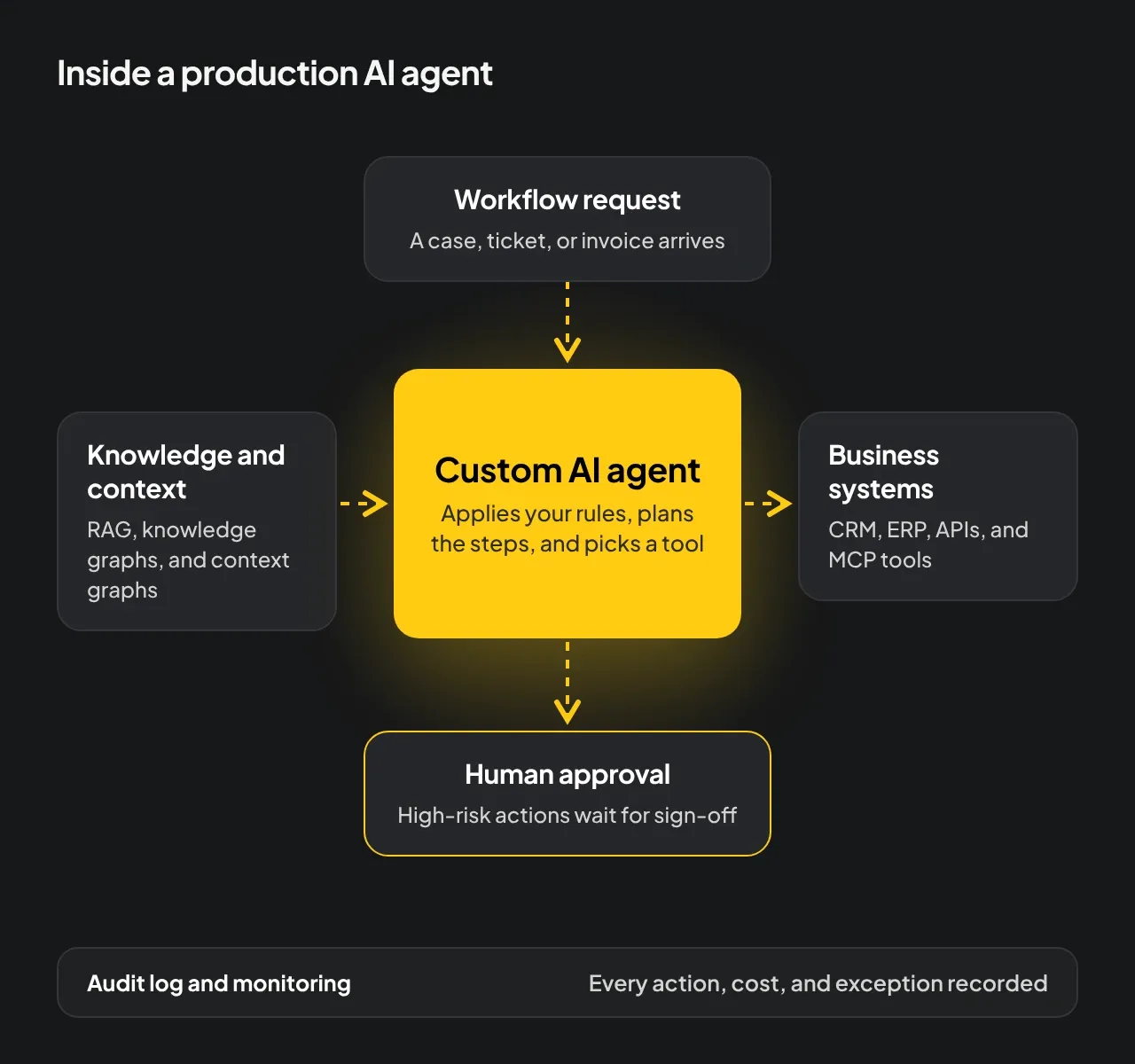
As a custom AI agent development company, Folio3 builds autonomous and human-supervised agents around your workflows. In plain terms, an agent reads from approved knowledge, learns from how past decisions were made, acts inside systems such as your CRM or ERP, and stops for a person when a rule says so. Under the hood, that means retrieval-augmented generation (RAG), knowledge and context graphs, multi-agent orchestration, and tool calls with scoped permissions.
One accountable team carries the work, from AI discovery through deployment, monitoring, and optimization. When your organization needs central control over models, spend, and policy, agents connect to AI Guardian.
AI agent development services for every stage
Hire us for one stage or hand over the full lifecycle. Each service is scoped to the workflow, your data rules, and the amount of autonomy that is safe for it.
AI agent strategy consulting
Rank candidate workflows by value and feasibility, assess data readiness, and leave with a roadmap naming the first agent and the metric it must move.
Custom AI agent development
Build agents around your rules, exceptions, and approval chains, then test them on real cases from your backlog before anyone relies on them.
AI agent architecture and design
Choose the models, memory, retrieval, and orchestration framework, such as LangGraph or CrewAI, that fit your data rules and budget. Each choice is documented so your team can maintain it.
AI agent system integration
Let agents update real records in CRM, ERP, finance, and legacy applications, connected through APIs and MCP servers with scoped permissions for every tool.
AI agent testing and red-teaming
Find failures before your customers do by testing for prompt injection, data leakage, unauthorized actions, and outages, then confirm that each escalation path works.
AI agent lifecycle management
Keep results steady after launch by tracking accuracy, cost, and intervention rates, catching model drift early, and shipping controlled updates as your rules change.
Production-first delivery with two ways to work
Scope stays narrow until the numbers justify more. The first agent proves value against a recorded baseline, and the wider rollout is funded on that evidence.
Build Method
Our team designs, builds, and launches the agent, then hands over the documentation your people need to run it. Pick this when you want one accountable partner and a clear goal.
- Agreed scope and milestones
- We own delivery through launch
- Runbooks and handover at the end
Forward Deployed Engineers
Our engineers join your team and work to your roadmap. Pick this when you want to build internal skills while agents move into production.
- Engineers inside your sprints
- Pairing and code reviews with your developers
- Know-how stays with your team
AI agent case studies with measured results
Four agentic AI development projects in four industries, each measured against how the work ran before.

AI moderation for a values-based social network
AI content moderation, a document-aware chatbot on Azure OpenAI, and safety workflows keep Imprint.Live's networking community safe as it grows.

RFP, contract review and report agents
Three bilingual agents on one in-Kingdom AI core for a Saudi real estate developer, proven first with a working RFP agent.

Guest review intelligence
Agents monitor reviews, draft on-brand replies for one-tap approval on WhatsApp, and surface recurring issues for a luxury resort group.

Prior authorization agent
The agent gathers documentation, checks payer requirements, prepares submissions, and sends incomplete cases to staff for a healthcare organization.
Results come from individual projects. Your outcome depends on your workflow, data, and systems.
Business challenges AI agents solve
Agent programs usually slow down at the same four points. Here is what goes wrong at each one and how we handle it during the build.
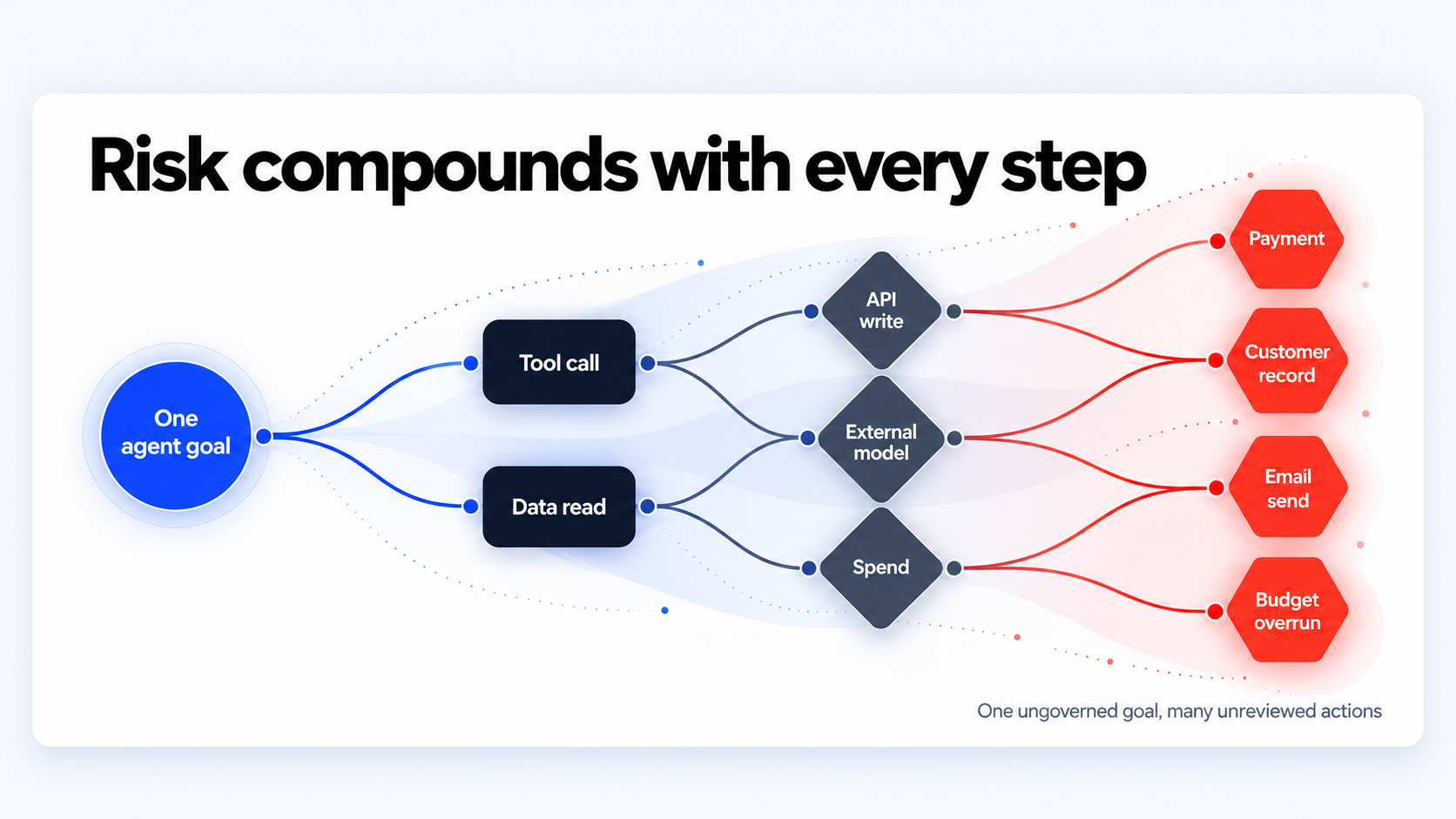
Risk adds up as an agent chains steps together. One wrong lookup early on can turn into a wrong payment or record update three steps later, which is why checks sit at every step, not only at the end.
Moving past the pilot
A demo works in a sandbox, but nobody owns it and it touches no live system.
Each project opens with a production plan covering ownership, integrations, controls, and budget.
Trusting agent decisions
Hallucinations and unexplained actions make risk teams reluctant to approve autonomy.
Agents answer from permission-checked sources, decision traces show how each result was reached, and consequential actions wait for human approval.
Connecting to legacy systems
Agents can talk, but they cannot read the record or update the ticket.
Connections and failure handling are scoped in discovery, including browser automation where no API exists.
Proving ROI and controlling spend
Token costs rise with usage, while the business value stays hard to show.
Baselines, cost per task, and spend limits make the return visible for each agent.
Is your business ready for AI agents?
Answer four quick questions on data, systems, governance, and ownership to see where you stand and what to fix first.
Benefits of AI agents for your business and customers
A well-scoped agent changes two things: what internal work costs, and how quickly a customer's request actually gets finished.
Both show up in the numbers we record at the start of every build: time per case, handoffs per request, and how many requests close without anyone having to step in.
For your business
- Lower cost per taskFewer manual touches on each case, invoice, or ticket as volume grows.
- More capacityTeams absorb peaks because routine steps no longer wait in a queue.
- Fewer errorsRules run the same way on the last case of the month as the first.
- Audit-ready recordsEach action and approval is logged against a person or agent.
For your customers
- Faster resolutionRequests are completed in the conversation instead of passed to a back office.
- Service around the clockApproved actions keep running across time zones, nights, and weekends.
- One consistent answerChat, email, and voice all draw from the same governed knowledge.
- Fewer repeated questionsCase history moves with the request, so customers explain once.
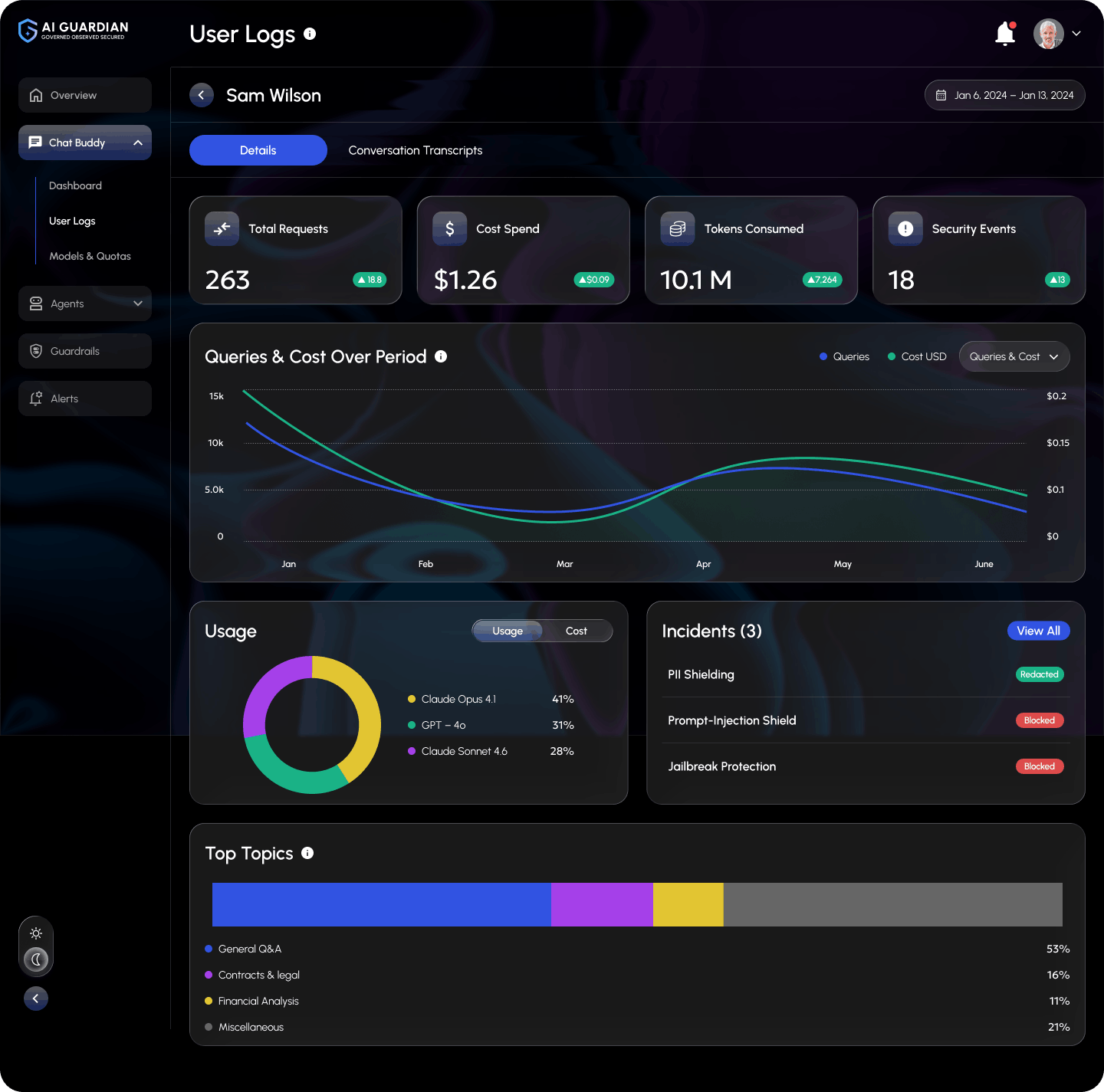
Know what every agent did, and why
Custom and third-party agents can register with AI Guardian, which runs inside your own Azure, AWS, or Google Cloud tenant.
- Identity checks on every agent request
- Sensitive data redacted before it reaches a model
- Spend limits by team or by agent
- Request-level audit logs for reviews and audits
From AI Agent Pilot to Governed Production
A 9-page guide to autonomy levels, governance controls, red-teaming, and measuring ROI.
AI agent development solutions we build
Our AI agent development solutions cover six agent types. Which one fits depends on the task, the risk, and how much autonomy your rules allow.
Workflow automation agents
Carry multi-step back-office processes across systems, from invoice matching to order exceptions, and flag only what breaks the rules.
Conversational AI agents
Handle employee requests or deploy a customer service AI agent across chat, email, or voice, then complete the action inside connected systems.
Multi-agent systems
Divide complex work among specialist agents under a supervisor, with defined handoffs, shared context, and one audit trail.
Knowledge and RAG agents
Give staff cited answers from policies, SOPs, and databases, using RAG pipelines and knowledge graphs that respect existing access permissions.
Decision support agents
Score risk and recommend next steps with evidence attached, using context graphs to draw on how similar cases were decided, while a named approver makes the call.
Browser and computer-use agents
Work through legacy portals and desktop apps that have no API, with each step recorded for review.
AI agent use cases by industry
The build method stays the same in every sector. What changes is the work: the regulations, systems and approvers behind each use case. Here are common first use cases, each with a human approval step.

Banking and finance
- Fraud alert triage
- AML alert investigation
- KYC document review
- Loan application intake

Insurance
- First notice of loss intake
- Claims document review
- Submission intake and triage
- Fraud indicator screening

Healthcare
- Prior authorization preparation
- Claim scrubbing and denial prevention
- Patient intake and registration
- Visit note drafting

Manufacturing
- Maintenance work order triage
- Nonconformance investigation
- Purchase order follow-up
- Order entry from emails and PDFs

Logistics
- Shipment exception management
- Order intake and booking
- Freight document processing
- Freight invoice audit

Hospitality
- Booking and change requests
- Guest questions across channels
- Review and feedback analysis
- Night audit support
How the AI agent development process works
Four stages take one workflow from a recorded baseline to a monitored production agent. You decide whether to continue before each new investment.
Discovery and baseline
Map the current process and agree what success means.
- Workflow map and decision points
- Data and system review
- Risk and compliance requirements
- Baseline metrics and business case
Architecture and POC sprint
Test feasibility on real data in two to four weeks.
- Model, retrieval, and framework selection
- Tool and integration plan
- Working proof of concept
- Go or no-go recommendation
Build, integration, and red-teaming
Deliver the production agent in about two to four months.
- System integrations with scoped permissions
- Human approval steps
- Security and misuse testing
- Evaluation sets for accuracy
Launch and lifecycle support
Go live with monitoring, then expand what the numbers prove.
- Dashboards and audit logs
- Results against the baseline
- Controlled updates and retraining
- Roadmap for the next workflow
Why choose Folio3 as your AI agent development company
Our AI agent development services keep strategy, engineering, integration, and governance with one team, backed by 20+ years of engineering excellence and ISO 27001 certified security practices.
Baseline before build
Every project records how the workflow runs today, so results are compared with real numbers.
One accountable team
The people who scope the agent also build, integrate, and support it after launch.
Governance included
Approvals, audit logs, and spend limits are part of the build, with AI Guardian for central control.
Real system access
Agents connect to CRM, ERP, and legacy tools through APIs, MCP servers, or browser automation.
Meet the team behind this build
Our custom AI agent work is led by specialists in AI architecture, engineering, delivery, and strategy, from agent design through production deployment.
Scroll sideways to meet the full team
AI agent development FAQs
What do AI agent development services include?
They cover use case discovery, architecture, custom development, system integration, testing, deployment, and ongoing monitoring. You can hire us for one stage or the full lifecycle.
What happens in the free AI agent consultation?
You talk through one workflow with an AI architect: how it runs today, the systems it touches, and how ready the data is. You leave with a shortlist of agent candidates and a scope for a two-to-four-week proof of concept.
How long does AI agent development take?
A POC sprint takes two to four weeks, and an MVP usually takes two to four months. A wider rollout runs six to twelve months, depending on integrations and security review.
How much does AI agent development cost?
Cost depends on workflow complexity, connected systems, data readiness, autonomy level, and compliance needs. Folio3 prices each project after discovery, and the AI implementation cost guide explains the main budget drivers.
How do AI agents connect to enterprise systems?
Agents connect to CRM, ERP, finance, and internal tools through APIs and MCP servers, with permissions set for each tool. Browser automation covers legacy applications that have no API.
Can Folio3 support enterprise-wide AI agent rollouts?
Yes. A rollout extends proven agents across teams and systems, adding governance, training, and change management as adoption grows.
How do you keep AI agents accurate and secure?
Agents answer from permission-checked sources, and high-risk actions wait for human approval. Each release is red-team tested, and production tracing flags drift early.
What support is available after an AI agent launches?
We can monitor performance, cost, and exceptions, then ship controlled updates as your rules and data change. Dashboards compare results with the original baseline.
What is a context graph, and does my AI agent need one?
A context graph records how decisions were made, including workflow steps, approvals, and the reasons behind outcomes, so agents can follow precedent. It adds the most value in exception-heavy workflows, while simpler agents often work well with RAG and direct system access.
What is the difference between an AI agent and a chatbot?
A chatbot answers questions inside a conversation. An AI agent can also use tools, update systems, and complete multi-step workflows, with human approval where your rules require it.
Partners and certifications across Folio3
One company with specialist practices across AI, ERP, CRM, commerce, and digital health, backed by the platform partnerships and security standards those teams hold.
 Oracle NetSuite Alliance Partner
 Microsoft Solutions Partner
 AWS Partner
 Salesforce Consulting Partner
 Shopify Plus Partner
 Certified BigCommerce Partner
 Epic Vendor Services Program Member
 HIMSS Member
 NetSuite Partner of the Year 2025
 ISO/IEC 27001 Certified
 ISO/IEC 27701 Certified
Plan your first production AI agent
Request a free consultation to map one workflow, the systems it touches, and what a two-to-four-week POC sprint could prove.

