What Are Vertical AI Agents and How Do You Build One?

Vertical AI agents are trained on one industry's data, rules and tools, so they handle real workflows like claims, prior authorizations and guest reviews. Learn how they work, where they fit and how to build one.

Why Folio3 AI
  • Custom agents built on your data and systems
  • Production agents in insurance, hospitality and logistics
  • Build method or forward-deployed engineers inside your team
  • One team builds your agents and governs them with AI Guardian
  • Folio3 is ISO 27001 certified as a company
Quick answer

A vertical AI agent is an AI system built for one industry's workflow, such as claims intake or prior authorization.

It runs on a foundation model, grounds answers in that industry's data and rules, and acts inside the systems the work already lives in.

High-risk steps wait for human review, so the agent finishes routine cases and hands exceptions to a named reviewer.

Key takeaways

  • A vertical agent owns one industry workflow end to end; a horizontal agent assists many teams at a shallow depth.
  • Accuracy comes from grounding, rule checks and evaluation sets, more than from the model alone.
  • Regulated, high-volume, rule-heavy work is where vertical agents earn their cost first.
  • Most fail at integration and governance, so plan those before the model.

What are vertical AI agents?

Vertical AI agents are AI systems specialized for a single industry or function. They know the domain's terms, rules and exceptions, and they complete tasks inside its software instead of only answering questions about it.

Every vertical agent has three parts:

  • Built on foundation models: a general LLM from OpenAI, Anthropic or Google, or a privately hosted open-weight model.
  • Specialized with industry data: grounded in policy wordings, coding rules, past cases and approved outputs.
  • Acts inside real workflows: reads, checks and updates records through APIs, with the same permissions as the role it serves.
Side by side

Vertical AI vs vertical agents

Vertical AI is any AI built for one industry. A vertical agent is the part of that group that plans and acts on its own.

DimensionVertical AIVertical AI agent
What it isA model or tool built for one industryAn AI system that completes an industry workflow
Typical outputA score, prediction or draftA finished task, such as a routed claim
Acts in systemsNo, a person acts on the outputYes, through APIs and approved tools
Plans multiple stepsNoYes, with checks after each step
ExampleA fraud model that scores transactionsAn agent that scores, holds and escalates a payment

How vertical AI agents work

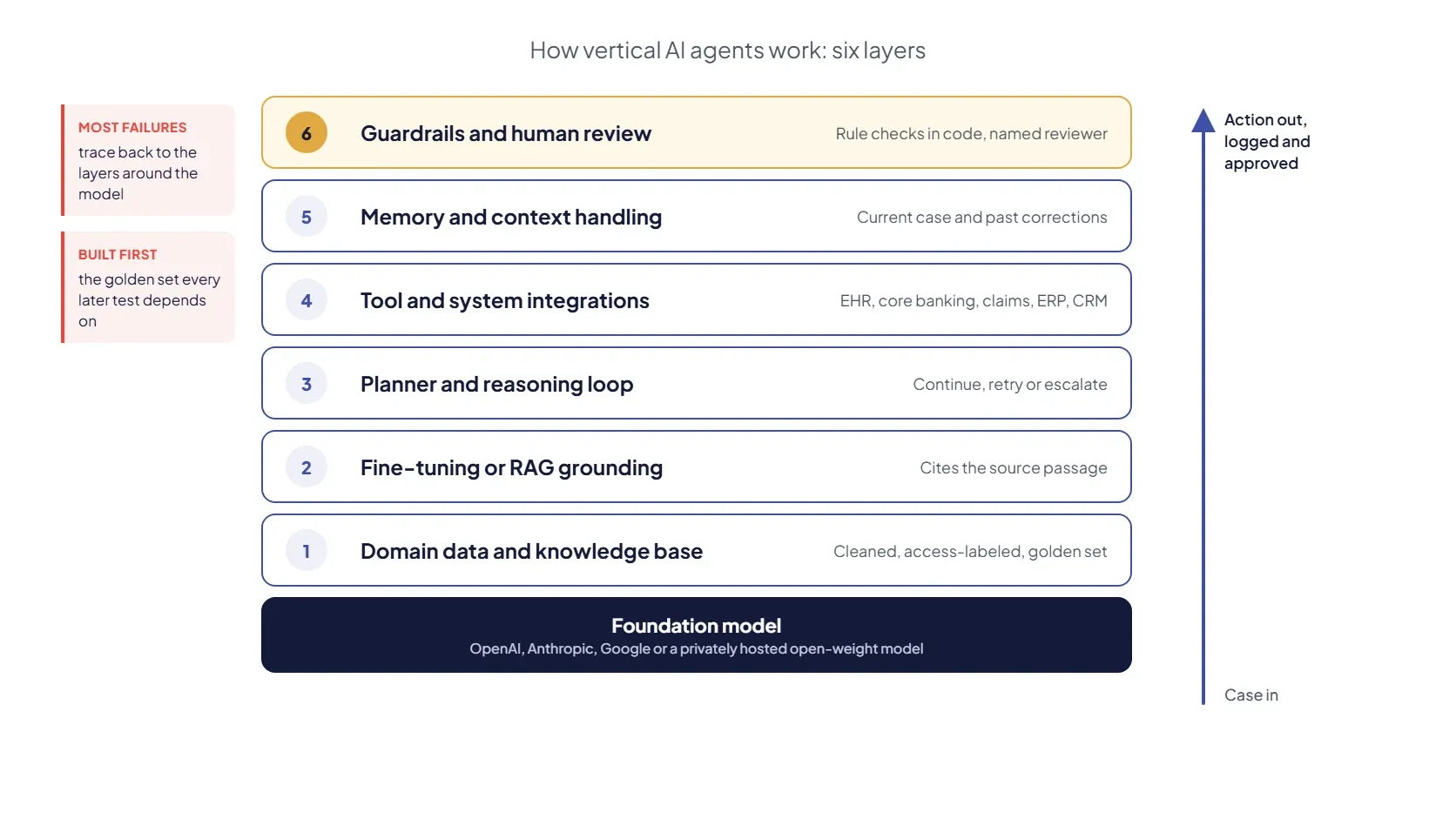
A production vertical agent has six layers. The model is only one of them, and most failures trace back to the others.

Six-layer architecture of how vertical AI agents work, from domain data to guardrails and human review

Domain data and knowledge base

Documents, records and reference rules are cleaned, labeled for access level and indexed. A small golden set of expert-approved answers is built at the same time, because every later test depends on it.

Fine-tuning or RAG grounding

RAG pulls the right passage at answer time, so the agent cites its source and follows rules that change often. Fine-tuning suits outputs that must look identical every time, so most regulated agents start with RAG.

Planner and reasoning loop

The planner breaks a goal into steps, picks a tool for each, checks the result and decides whether to continue, retry or escalate. Each step is logged with its inputs.

Tool and system integrations

Connectors to the EHR, core banking, claims, ERP or CRM system turn decisions into actions. Integration usually takes more build time than any other layer.

Memory and context handling

Short-term memory holds the current case. Long-term memory stores prior cases, user preferences and reviewer corrections, with retention rules set by the data owner.

Guardrails and human review

Rule checks run in code outside the prompt, so the model cannot talk its way past them. High-risk actions wait for a named reviewer.

Worked example

A worked example from P&C claims

Folio3 built this pattern for a P&C insurer whose standard claims took four to six weeks to settle. Five agents share the work on every claim.

  1. 1Supervisor agentRoutes each claim to the right sub-agent.
  2. 2Intake agentReads damage photos, police reports and voice memos.
  3. 3Policy agentChecks coverage, limits and exclusions.
  4. 4Fraud agentAssigns a fraud probability score.
  5. 5Settle or hand offLow-risk claims settle; complex ones go to an adjuster.

Result on the live system: 70% reduction in total processing time.

AI agent development

See How Production Agents Are Built

Every agent Folio3 builds comes with grounding, tool access, guardrails and audit trails, so the pilot you approve becomes the system you run.

Vertical vs horizontal AI agents

The main difference between vertical and horizontal AI agents is depth versus breadth. A horizontal agent helps many teams with general tasks. A vertical agent completes one industry workflow, including its exceptions and compliance rules.

Side by side
CriteriaVertical AI agentsHorizontal AI agents
ScopeOne industry or functionMany teams and tasks
Domain depthDeep, rule-awareGeneral knowledge
Accuracy on niche tasksHighModerate
Setup effortHigher upfrontFaster to start
Compliance fitBuilt for regulationsNeeds added controls
Best forRegulated, repeatable workflowsCross-team productivity

When to choose each

  • Choose horizontal for cross-team tasks. Drafting, search and meeting summaries need breadth across teams more than any single industry's rules.
  • Choose vertical for regulated workflows. Claims, KYC checks and medical coding carry rules and audit duties a general tool will not enforce.
  • Combine both in hybrid setups. A horizontal assistant takes the request, then hands domain cases to a vertical agent that owns the workflow.

McKinsey's 2025 research on agentic AI found that horizontal copilots scaled quickly, while about 90% of vertical use cases remained stuck in pilot mode. The gap is where the value sits, and where the build effort goes.

Vertical AI agent examples by industry

Vertical AI applications already run in most regulated, high-volume sectors. Each example below covers the workflows, what the agent does and the systems it connects to.

Healthcare

Providers use prior authorization agents to match EHR codes and notes to payer criteria for staff review. Coding agents suggest ICD-10 and CPT codes, and scheduling agents fill cancelled slots from waitlists.

Banking and finance

KYC/AML agents screen identity documents against sanctions lists and draft suspicious activity reports for compliance review. Underwriting agents build credit memos, and fraud triage agents rank alerts by risk.

Insurance

Claims intake agents read first notice of loss (FNOL) forms and photos, check coverage and route claims by complexity. Underwriting agents turn loss history and property data into risk summaries.

Manufacturing

Plants run predictive maintenance agents that watch vibration and temperature trends and open work orders before failures. Quality agents hold out-of-spec batches, and supply planning agents adjust ERP reorder points as demand shifts.

Logistics

Carriers use dispatch agents to assign loads in TMS by capacity, hours and location. At weighbridges, ALPR agents read plates and open the matching vehicle record, as Folio3 built for a UK operator.

Hospitality

Hotels use guest review agents to draft on-brand replies for manager approval and flag recurring complaints like slow check-in. Booking support agents answer availability questions and hand complex requests to front-desk staff.

Legal

Contract review agents compare clauses to the firm's playbook and flag non-standard terms with page references. Due diligence agents sort documents by issue type and build issue lists for lawyers.

Retail and ecommerce

Inventory rebalancing agents compare stock and sell-through by store and suggest transfers before items sell out. Catalog enrichment agents fill missing product attributes and check listings against marketplace rules.

Education

Student support agents answer policy, fee and deadline questions from the institution's own documents. Admissions agents track application status in the SIS or CRM and chase missing documents.

Free call

Have a Workflow in Mind for Your Industry?

Share the process, the systems it touches and the rules it follows. Folio3's team will map where a vertical AI agent fits and what it would take to build.

Vertical AI agents vs vertical SaaS

Vertical SaaS gives an industry team software to operate. A vertical AI agent operates part of that software for them.

Side by side

The table places agents next to the tools buyers already know.

DimensionCopilotRPA botVertical SaaSVertical AI agent
Who does the workThe user, with suggestionsThe bot, on fixed stepsThe user, inside the softwareThe agent, with approval on risky steps
Handles exceptionsUser decidesBreaks or stopsUser decidesYes, within set rules
Domain knowledgeSupplied in each promptHard-coded stepsBuilt into screens and fieldsGrounded in industry data and rules
Typical pricingPer seatPer bot or licensePer seatPer outcome, usage or hybrid
Best forPersonal productivityStable, rule-only tasksRunning an industry's recordsVariable, rule-heavy workflows

Will agents replace SaaS?

Not soon. An agent needs a system of record to read from and write to, and in most industries that system is a SaaS product: the EHR, the policy admin system, the hotel PMS. What changes is how people use it. Fewer users log in to click through screens, more work arrives already done for review, and per-seat revenue gets harder to defend. Vendors that offer clean APIs and price on results keep their place. Vendors that depend on screen time lose ground to agents that sit on top of them.

Benefits of vertical AI agents

The benefits come from narrow scope. An agent that knows one workflow well can be measured, governed and improved in ways a general assistant cannot.

  • Higher accuracy on domain tasks. Grounding in approved sources and rule checks cuts errors on the edge cases general models miss.
  • Compliance rules built in. Policy checks run as code on every case, so rules are applied the same way each time.
  • Shorter cycle time per case. Agents work queues around the clock, so cases stop waiting for the next free person.
  • Less manual review work. Staff review flagged exceptions instead of every case.
  • Works inside existing systems. Agents act through current tools, so teams keep their software and their data stays in place.
  • Expert knowledge stays captured. Reviewer corrections feed the evaluation set, so experience stays when people move roles.

Pre-built vs custom vertical AI agents

Pre-built agents launch fast on standard processes. Custom agents fit proprietary data, deep integrations and your own rules. The right choice depends on how standard your workflow really is.

Side by side
CriteriaPre-built agentsCustom-built agents
Time to launchWeeksOne scoped workflow first
Fit to your workflowGenericExact
Data ownershipVendor termsFully yours
Integration depthLimited connectorsFull system access
Long-term costRising per-use feesLower at scale
Competitive edgeSame as rivalsUnique to you

When to buy or build

  • Buy when workflows are standard. Password resets or appointment reminders rarely justify custom work.
  • Build when data is proprietary. Your claims history or underwriting rules are the advantage, and a shared model will not learn them.
  • Build when integrations run deep. If the agent must write to a legacy core system, off-the-shelf connectors usually stop short.

How to build a vertical AI agent step by step

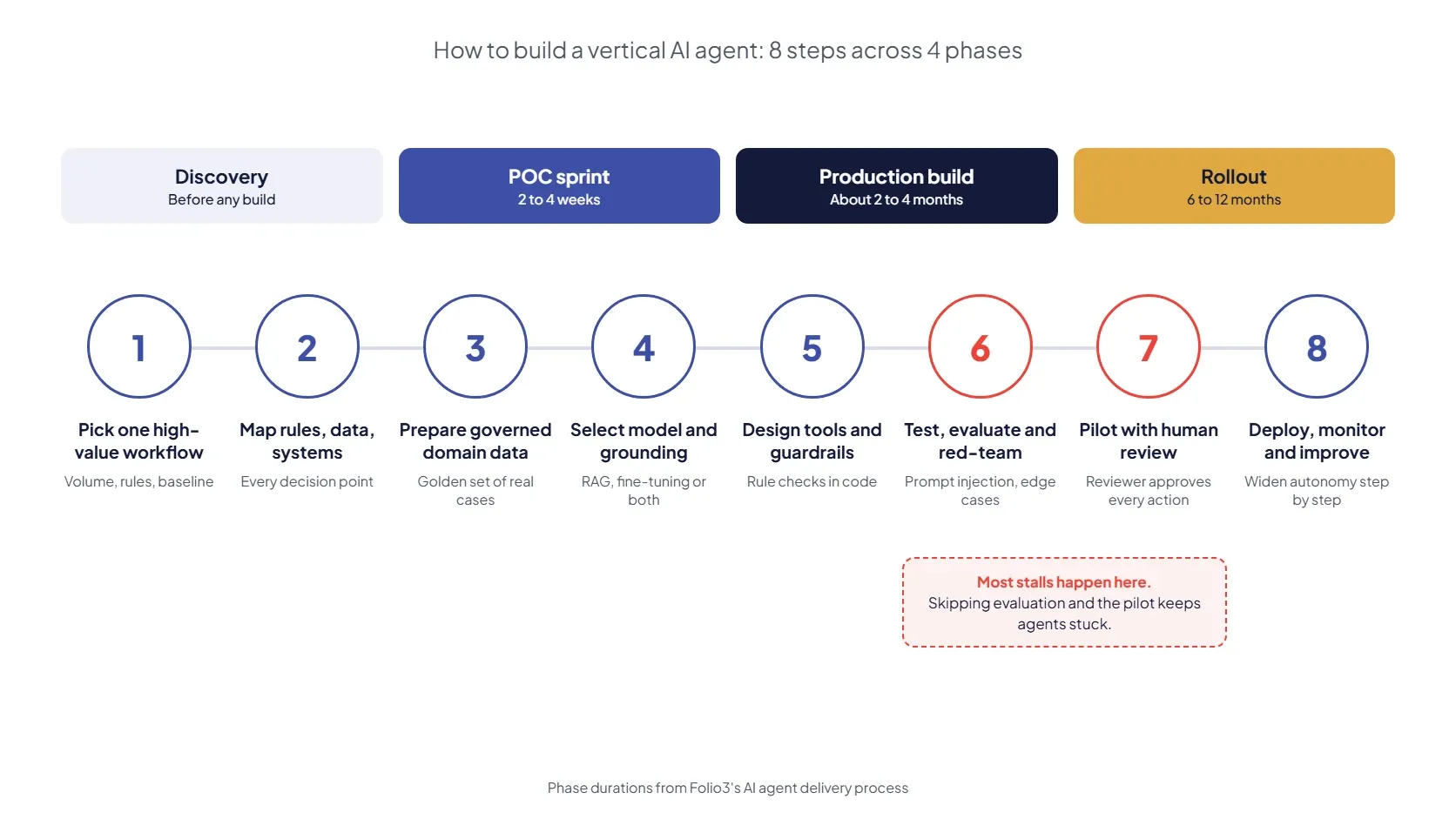
Building a vertical AI agent takes eight steps, from picking one workflow to monitoring it in production. Skipping the evaluation and pilot steps is the most common reason agents stall.

Eight-step roadmap showing how to build a vertical AI agent, from discovery and POC to production build and rollout

Step 1: Pick one high-value workflow

Choose a workflow with hundreds of cases a month, written rules behind most decisions, past cases you can legally use, system access and a known baseline for time and errors.

Step 2: Map rules, data, systems

Document every decision point, the rule behind it, the data it needs and the system that holds that data. Gaps found here cost less than gaps found in testing.

Step 3: Prepare governed domain data

Clean and label source documents, set access levels by role, and build a golden set of real cases, approved by domain experts, that every later release is scored against.

Step 4: Select model and grounding

Pick the model on accuracy against your golden set, cost per case, latency and data residency. Then choose RAG, fine-tuning or both, based on how often your rules change.

Step 5: Design tools and guardrails

Give each tool the narrowest permission it needs, write rule checks in code outside the prompt, and decide which actions run automatically and which wait for approval.

Step 6: Test, evaluate and red-team

Score the agent against the golden set, then attack it with prompt injection, malformed files and rare edge cases, using guides such as the OWASP Top 10 for LLM Applications.

Step 7: Pilot with human review

Run the agent on live cases with a reviewer approving every action. Compare cycle time, accuracy and escalations against the baseline before widening scope or autonomy.

Step 8: Deploy, monitor and improve

Widen autonomy one action type at a time. Track accuracy, drift and escalation rates on a dashboard, and feed reviewer corrections back into the golden set and prompts.

Build Method or FDE

Turn One Workflow Into a Production Agent

You can pick the build method, where Folio3 delivers the full agent, or forward deployed engineers who work inside your team. Both paths start with one scoped workflow.

What drives vertical AI agent cost and ROI

Vertical AI agent cost depends on scope, data readiness and integrations more than on the model. Folio3's typical path is a two to four week proof of concept, about two to four months of production build, then a six to twelve month rollout.

Cost drivers

  • Workflow scope and complexity. More decision points and exceptions mean more rules, tests and review paths to build.
  • Data preparation effort needed. Scanned, unlabeled or scattered sources take far longer to clean than structured records.
  • Number of system integrations. Each connector adds build and test time, and legacy systems without APIs add the most.
  • Model and inference usage. Long documents and high case volume raise the model cost per case.
  • Compliance and audit requirements. Data residency, retention rules and explainability add architecture and documentation work.
  • Ongoing monitoring and retraining. Fast-changing rules or products mean more frequent retesting after launch.

ROI metrics to track

  • Hours saved per workflow
  • Cycle time reduction rate
  • Error and rework rate
  • Cost per processed case
  • Human escalation rate trend

Measure each one before the pilot starts. Without a baseline, ROI becomes an opinion.

How to evaluate and govern vertical AI agents

Governance for a vertical agent means every action is measured, permitted, logged and reversible where possible. Compliance rules belong in the architecture, not in a policy document beside it.

  • Task success rate benchmarks. Score every release against the golden set before it goes live, and block deployment if accuracy falls below the agreed threshold.
  • Grounding and hallucination checks. Each answer must cite the source passage it came from. Answers with no supporting source are blocked or sent to a reviewer.
  • Audit trail for every action. Log the input, retrieved sources, tool call, output and approver for each step, so any decision can be replayed during an audit.
  • Role-based data access controls. The agent inherits the permissions of the role it serves, so a claims agent cannot read payroll data or records outside its queue.
  • Clear human escalation rules. Low-confidence answers, high-value cases and new case types go to a named reviewer, with the agent's summary and sources attached.
  • Mapping to HIPAA, GDPR, AML. Retrieval follows HIPAA's minimum necessary rule, GDPR Article 22 limits fully automated decisions with legal effect, and AML agents draft SARs for officers to file.

Autonomy tiers by action risk

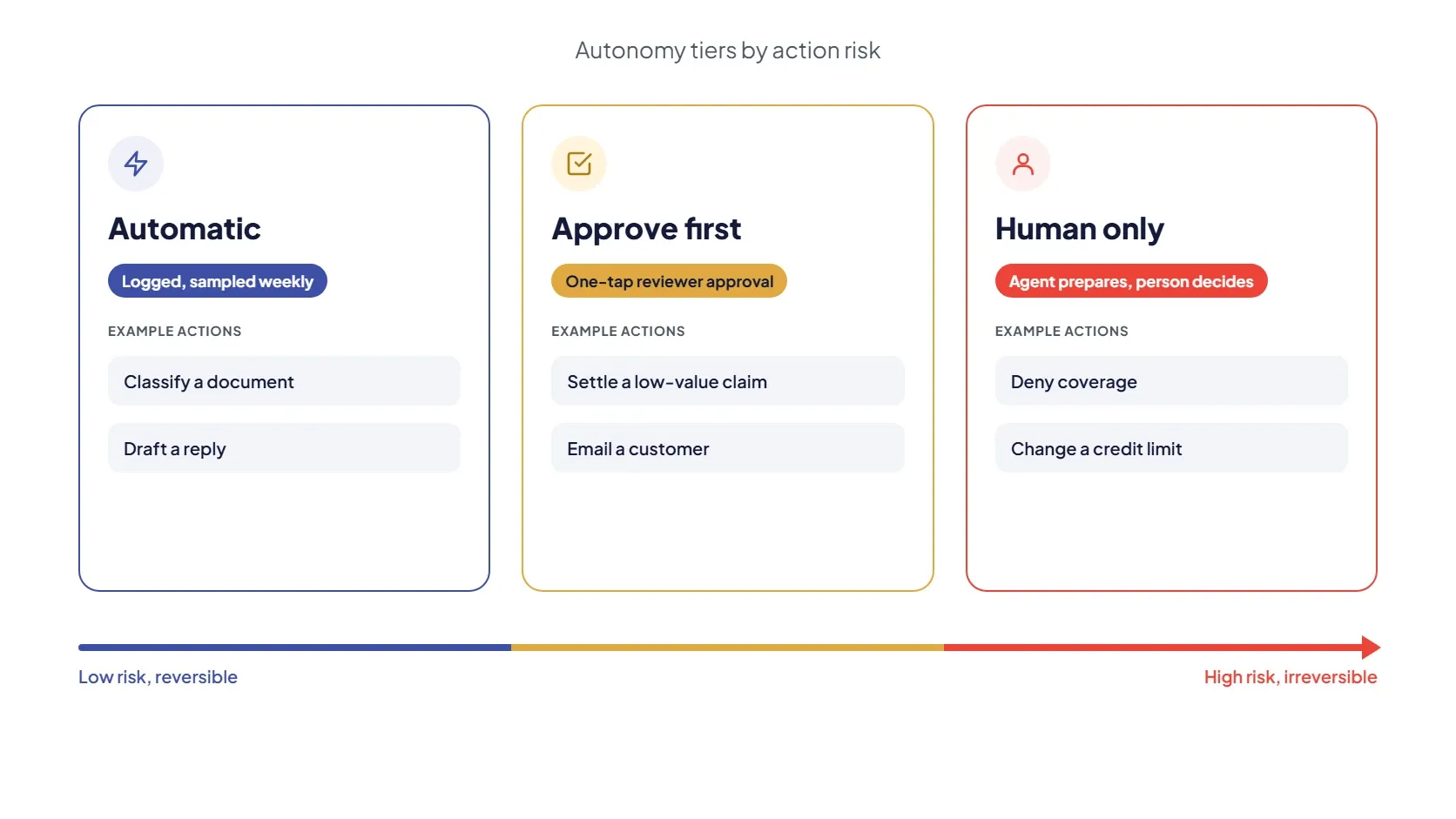
Set autonomy per action, not per agent. Rank each action by how easily it can be reversed and how much harm a wrong call would cause.

Autonomy tiers for governing vertical AI agents: automatic, approve first and human only actions
  1. Automatic: low-risk, reversible actions such as classifying a document or drafting a reply run on their own, with weekly sampling by a reviewer.
  2. Approve first: actions with money or customer impact, such as settling a low-value claim or emailing a customer, wait for one-tap approval.
  3. Human only: denying coverage, filing a suspicious activity report or changing a credit limit stays with a person. The agent prepares the case and evidence.

Challenges and limitations of vertical AI agents

Gartner predicts over 40% of agentic AI projects will be canceled by the end of 2027 because of rising costs, unclear value or weak risk controls. Vertical agents face the same risks, and these six cause most of them.

  • Scarce, messy domain data. Past cases are often scanned, incomplete or locked in old systems, so data cleanup can take longer than building the agent itself.
  • Narrow scope by design. An agent built for claims intake will not handle subrogation or underwriting. Each new workflow needs its own rules, data and tests.
  • Legacy system integration friction. Older core systems may expose only a screen, with no API, so the agent needs browser automation or a custom connector to act.
  • Model drift over time. New products, rule changes and unfamiliar case types lower accuracy quietly, so the agent needs retesting on a schedule and after every change.
  • Vendor lock-in with platforms. Prompts, workflows and evaluation sets stored inside a vendor's tool are hard to export, which makes switching providers slow and costly later.
  • Low staff trust early. Reviewers distrust agent output until they see the sources behind each answer and a track record on cases they already know.

How to choose a vertical AI agent partner

Choose a partner on production evidence, not demos. Use this checklist in vendor calls.

Vertical AI agents in action

These Folio3 agents each started with one workflow and one baseline metric.

P&C claims processing: 70% less processing time

  • Challenge: a standard claim took four to six weeks to settle, and only about 10% of claims went through without a person.
  • Solution: a supervisor agent coordinating intake, policy validation, fraud scoring and auto-settlement, with complex cases handed to adjusters.
  • Result: 70% reduction in total processing time, 40% lower manual administrative costs and a 50% rise in straight-through processing.
Read Full Case Study

Luxury resort reviews: 98% response rate

  • Challenge: manual dashboard checks delayed review replies, brand voice varied by property, and guest feedback stayed buried in text.
  • Solution: agents that monitor Google reviews, draft on-brand replies for one-tap approval on WhatsApp and surface recurring facility issues.
  • Result: 98% response rate, 90% less manual administrative time and a 0.5-star rating increase within six months.
Read Full Case Study

UK weighbridge: no manual plate entry

  • Challenge: staff typed each registration into the weighbridge search, which slowed weighings and risked typos that opened the wrong record.
  • Solution: an on-premise ALPR agent built on fine-tuned YOLOv8 and PaddleOCR that reads plates, checks UK formats and opens the matching record.
  • Result: no manual plate entry, no change to the existing weighbridge software, and video and plate data kept on site.
Read Full Case Study

Expert insight

"The model is rarely what decides whether a vertical agent works. The evaluation set is. If your domain experts cannot agree on what a correct answer looks like for 200 real cases, the agent will not agree with them either. Start there."
Abdul Sami, Head of AI Development, Folio3 AI
Free consultation

Want Results Like These in Your Operations?

Each of these agents started with a single workflow and a clear metric. Start with yours and get a scoped plan for your first vertical AI agent.

The future of vertical AI agents

Vertical agents are moving from single tasks to agent teams, with pricing tied to results and firmer EU rules.

Multi-agent teams per industry

One supervisor agent routes work to specialist agents for intake, checks and payment, the same pattern used in the P&C claims example above.

Outcome-based pricing gains ground

Buyers will compare vendors on cost per resolved case rather than cost per seat, as Zendesk and Intercom already price their AI agents.

Agents working across verticals

A logistics agent will hand customs checks or invoice disputes to other specialist agents through shared agent-to-agent protocols instead of custom integrations.

EU AI Act obligations

Under the Digital Omnibus, Annex III high-risk duties, covering uses such as credit scoring and life and health insurance pricing, apply from 2 December 2027.

Where to start with vertical AI agents

A vertical AI agent is worth building when one workflow is high in volume, heavy in rules and measurable today.

Your first three moves
  1. 1Recap definition and fitIt is an industry-trained agent that acts inside your systems, best suited to regulated, repeatable work.
  2. 2Start with one workflowPick the one that passes the checks in Step 1.
  3. 3Measure before you scaleRecord today's cycle time and error rate, then widen autonomy only as results hold.

FAQs

What are vertical AI agents?

Vertical AI agents are AI systems built for one industry's workflows, such as claims intake or medical coding. They combine a foundation model with industry data, rule checks and system access, so they complete tasks instead of only answering questions.

What is vertical AI?

Vertical AI is artificial intelligence designed for a single industry or function rather than general use. It includes predictive models, document AI and agents trained on that industry's data, terminology and regulations.

What is the difference between vertical and horizontal AI agents?

Horizontal agents handle general tasks across many teams, like drafting and search. Vertical agents complete one industry workflow end to end, with its rules and exceptions, and connect directly to that industry's systems.

What are examples of vertical AI agents?

Examples include prior authorization agents in healthcare, KYC/AML screening agents in banking, claims intake agents in insurance, predictive maintenance agents in manufacturing and guest review agents in hospitality.

Will vertical AI agents replace SaaS?

Agents will replace some manual screens, but not the systems of record behind them. Most agents read from and write to SaaS products, so SaaS increasingly becomes the data layer agents act on.

Should you build or buy a vertical AI agent?

Buy when the workflow is standard and the vendor's connectors cover your systems. Build when your data is proprietary, your rules are unique or the agent must write deep into legacy systems.

How long does it take to build a vertical AI agent?

A focused proof of concept takes two to four weeks. A production build usually takes about two to four months, followed by a six to twelve month rollout with monitoring.

What does a vertical AI agent cost?

Cost depends on workflow scope, data preparation, the number of integrations, inference volume and compliance needs. A scoped proof of concept on one workflow is the most reliable way to get a real estimate.

Are vertical AI agents safe for regulated industries?

Yes, when controls are part of the architecture. That means role-based data access, rule checks in code, audit logs for every action, human approval on high-risk steps and data residency that matches regulations like HIPAA, GDPR or PDPL.

Free AI agent consultation

Put Your First Vertical AI Agent Into Production

Skip the generic chatbot. Get an agent trained on your industry's data, connected to your systems and governed from day one.

By the Folio3 AI Editorial Team. Technically reviewed by Abdul Sami, Head of AI Development at Folio3 AI, in November 2026.

Contact

Let's get in touch

Fill the form below or Contact us at +1 408 365-4638 / email us via contact@folio3.ai

This site is protected by Google reCAPTCHA
  • 5000+

    Projects Delivered

  • 700+

    Global Employees

  • 1000+

    Companies Served

  • 20+

    Global Awards Won

Support

Contact Info

+1 408 365-4638
contact@folio3.ai

Map

Visit our office

6701 Koll Center Parkway, #250 Pleasanton, CA 94566