
Phase Zero: Discover How Work Actually Happens
Phase Zero is our AI Process Discovery solution for understanding how work really moves across your organization. It analyzes approved operational evidence from emails, tickets, CRM notes, platform logs, case records, and database exports to reconstruct real workflows, expose bottlenecks and hidden handoffs, and identify where AI, automation, integration, or process change can improve operations.
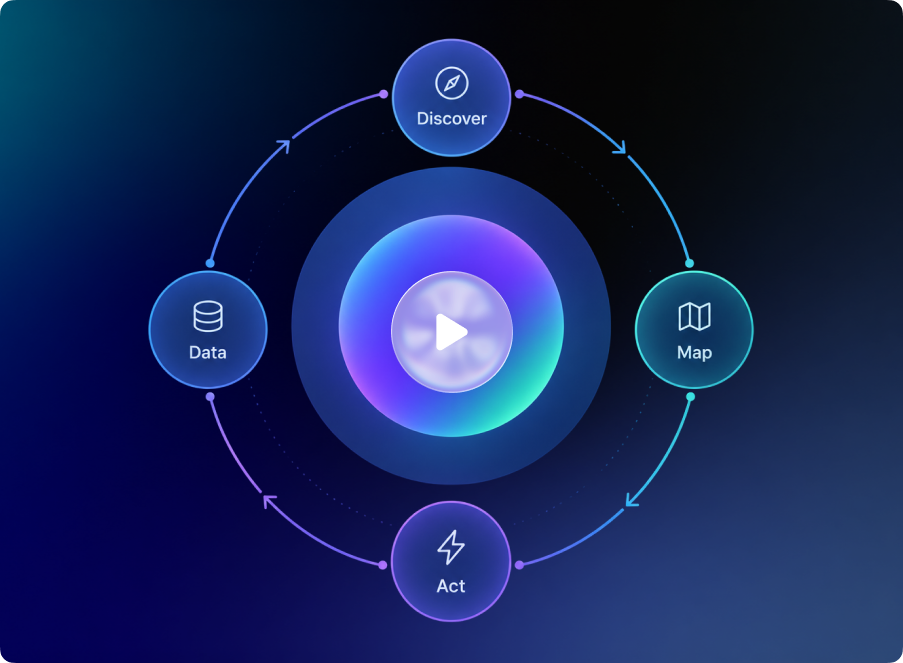
- Starts with operating evidence
- Maps how work actually moves
- Moves from insight into action
- Commercial lending92.9%Causal prediction accuracy for deal completion after analyzing 6,979 email threads.
- Customer service~49,700CSR-hours per year modeled to be freed across a 43-person team.
- Network operations58.6%Of repair-time variance explained by detection time in the analyzed trouble-ticket process.
- Finance operations10 → 2Day monthly close target, down from 10 days.
Your Real Process Hides Between Systems
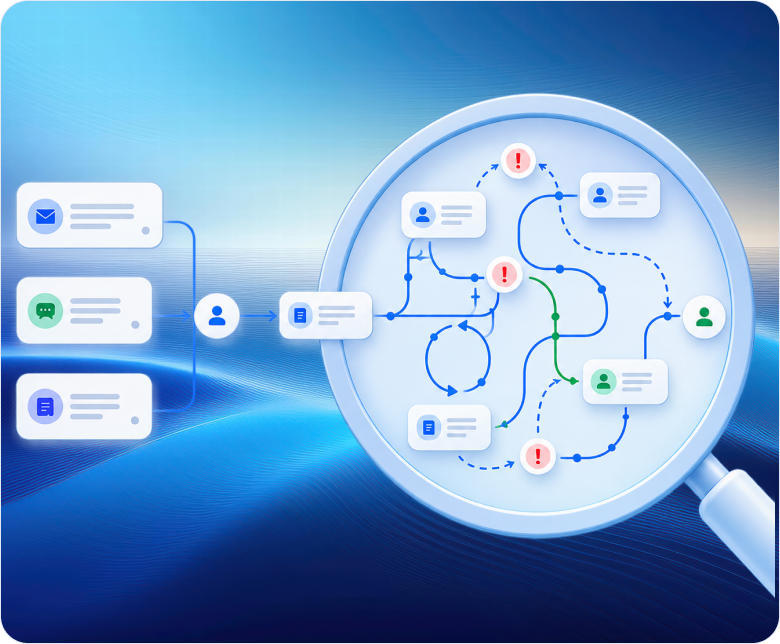
Phase Zero uses AI Process Discovery to analyze the operational evidence left behind by real work, revealing hidden handoffs, loops, delays, bottlenecks, and workarounds that traditional process maps often miss.
Documented workflows show how work is supposed to happen. Phase Zero shows how it actually happens across people, systems, and handoffs, so teams can see where work slows down, repeats, breaks, or depends on manual effort.
For example
- Decisions wait inside email threads before the next process step begins.
- Tickets change hands repeatedly without appearing as formal workflow stages.
- Manual workarounds repeat every day but remain invisible in official process maps.
Five Steps From Evidence To Action
Phase Zero follows one practical AI Process Discovery flow: ingest approved operational evidence, analyze real activity, reconstruct the process, surface improvement opportunities, and turn the findings into action.
-
STEP 01
Data Ingestion
Bring together the approved operational evidence already created by the business.
- Emails, tickets and CRM notes
- Logs, records & exports
- Relevant system context
-
STEP 02
AI Analysis
Use AI to detect patterns, process signals, repeated sequences, & friction.
- Pattern recognition
- Semantic understanding
- Sequence and driver analysis
-
STEP 03
Workflow Mapping
Reconstruct how the process actually moves, including hidden stages and bottlenecks.
- Handoffs and wait states
- Loops and workarounds
- Operating ground truth
-
STEP 04
Smart Recommendations
Identify the process issues, automation candidates, and improvement opportunities.
- Improvement opportunities
- AI vs. process fixes
- Recommended next move
-
STEP 05
Take Action
Move validated process findings into implementation instead of stopping at a process map.
- Design the intervention
- Build or integrate the solution
- Operational improvement
AI Process Discovery does not assume every process needs AI.
Phase Zero may reveal an AI opportunity, workflow change, integration need, data improvement, policy adjustment, or system fix depending on what the evidence supports.
Process Discovery Across Real Business Operations
These examples show how AI Process Discovery reconstructs real workflows across lending, customer service, manufacturing, network operations, and finance using the operational data each process already produces.
Moving monthly close from 10 days toward a 2-day target
How we found it
Our Process Discovery Agent mapped Folio3’s monthly billing close end-to-end and identified the fixes in under a week. Phase Zero connected Email, SQL / RM, and ERP, analyzing thousands of time-stamped events across 20,000 emails, 1,335 invoices and payments, and 338 team members.
What it revealed
Hours submission was a key source of delay. The typical person submitted 2–3 days late, the slowest 10% took 17–38 days, and 15% never submitted. Just 27 people, or 8% of submitters, drove half of all late-days, pointing to a targeted fix rather than a company-wide one. Invoicing added a second delay: typically four more days after hours were in, and up to 30 days for the slowest 10%.
What this changes
Following the recommendations, Folio3 built an invoicing and delay-management AI-powered platform for its finance, product, and delivery teams using Claude Code. A fully functional prototype was built in approximately two weeks, with AI-based workflows and actions performed under strict guardrails.
- PM uploads SOWAI extracts project features, milestones, pricing, and billing cadence.
- Automated remindersA tiered escalation engine nudges the PM, then escalates to their director and Finance.
- Role-based dashboardProject views for PMs, VPs, Finance, and executives, at division and organization levels.
- Invoice request flowPMs raise invoice requests; Finance accepts or rejects them. Every action is tracked with an audit trail.
Outcome: Monthly business close moved from 10 days toward the 2-day target, with no added headcount and no retraining.

Why do some deals progress while others stall?
How we found it
Semantic workflow analysis reconstructed the process from raw email threads, then causal analysis tested which workflow signals moved with completion. The resulting model included 47 stable causal edges validated through bootstrap testing.
What it revealed
Workflow breadth was the strongest causal driver, long duration reduced completion probability, and 37% of lender outreach formed self-loops with no forward progress.
What this changes
Teams can target stalled deals using process signals associated with completion instead of relying only on pipeline labels.

Where should AI be used inside a 43-person service operation?
How we found it
The analysis reconstructed task types, routing paths, handoffs, and workflow volume from five representative inboxes, then connected friction to actual CSR throughput.
What it revealed
Internal waits, not customer response time, created most stalls in the highest-volume workflow. AI automation also showed a much larger modeled capacity opportunity than training and process changes alone.
What this changes
Leadership gets a sequenced process improvement roadmap tied to measurable operating capacity, showing where automation, workflow changes, or other interventions can have the greatest operational effect.

What actually drives repair time?
How we found it
One ticket export with 452 raw columns was enriched into 19 features and evaluated with four causal discovery algorithms inside a workflow-constrained model.
What it revealed
Detection time was the strongest lever and was confirmed by three of four independent causal algorithms. Long repair tails were also connected to fiber cuts, site-access delays, and repeated handoffs.
What this changes
Teams can focus process improvements on faster detection, fewer handoffs, and targeted action against predictable high-cost delays instead of treating field capacity as the only lever.

Turn Process Findings Into Real Improvements
Once Phase Zero has identified the process issue and the right intervention, Folio3 AI can move directly into solution design and delivery.
Evidence→Process Map→Opportunity→Implementation
-
01
AI Agents
Build agents around the workflows and decisions that the analysis shows are worth automating.
-
02
Workflow Automation
Remove repeated routing, manual handoffs, and routine process work where automation is the right intervention.
-
03
System Integration
Connect fragmented systems and operational context when integration gaps are creating the friction.
-
04
Process Improvement
Address workflow, data, policy, or system issues when AI is not the most effective answer.
What Leaders Ask Before Getting Started
Phase Zero is designed to give teams a fact-based view of how their processes actually operate before they decide what to automate, redesign, integrate, or improve. These are the questions teams typically ask before starting AI Process Discovery.
What is Phase Zero?
Phase Zero is Folio3 AI’s AI Process Discovery solution. It analyzes approved operational evidence to reconstruct how work actually happens, uncover hidden handoffs and bottlenecks, identify automation and process improvement opportunities, and create a clear path from discovery to implementation.
How is AI Process Discovery different from traditional process mapping?
Traditional process mapping documents expected workflows. AI Process Discovery analyzes approved operational evidence to reveal how work actually moves across people, systems, and handoffs.
What operational data can be analyzed?
Approved emails, tickets, CRM notes, platform logs, case records, database exports, and relevant system context can be analyzed.
What does Phase Zero identify?
Hidden handoffs, loops, delays, bottlenecks, repeated workarounds, and opportunities for automation or process improvement.
Does every discovery engagement lead to an AI solution?
No. The evidence may support workflow changes, integration, data improvements, policy adjustments, or system fixes.
What happens after the process is discovered?
Validated findings can move into solution design and delivery, including AI agents, workflow automation, system integration, or process improvements.
Can this approach be used across different business functions?
The examples shown cover commercial lending, customer service and manufacturing, and network operations.
Revolutionizing Customer ExperienceWorldwide with Build, Sale & Scale

- 5000+
- Projects Delivered
- 700+
- Global Employees
- 1000+
- Companies Served
- 20+
- Global Awards won
Interested In Soaring HighAnd Thriving With Success?
Start Your Success Journey With Folio3 Today!