
AI Agents
Best Production ROI AI Agent Firms, Compared on Real Results
Ten AI agent firms rated on production proof, measured ROI and payback using public evidence, plus a simple method to calculate AI agent ROI before you sign.
Industrial AI agents now come from automation vendors, agent platforms, niche specialists and custom build partners. This guide maps where to look, who leads each job and when a custom build pays off.
Industrial firms find AI agents in six places: automation platforms, horizontal agent platforms, RPA and integration suites, specialist industrial AI vendors, directories and custom build partners.
Pick the job first, then the source that covers it.
Before you sign, prove the agent can read from and act on your plant and ERP systems.
An industrial AI agent is software that reads plant and business data, decides on a next step and takes it inside your systems, within limits your team sets.
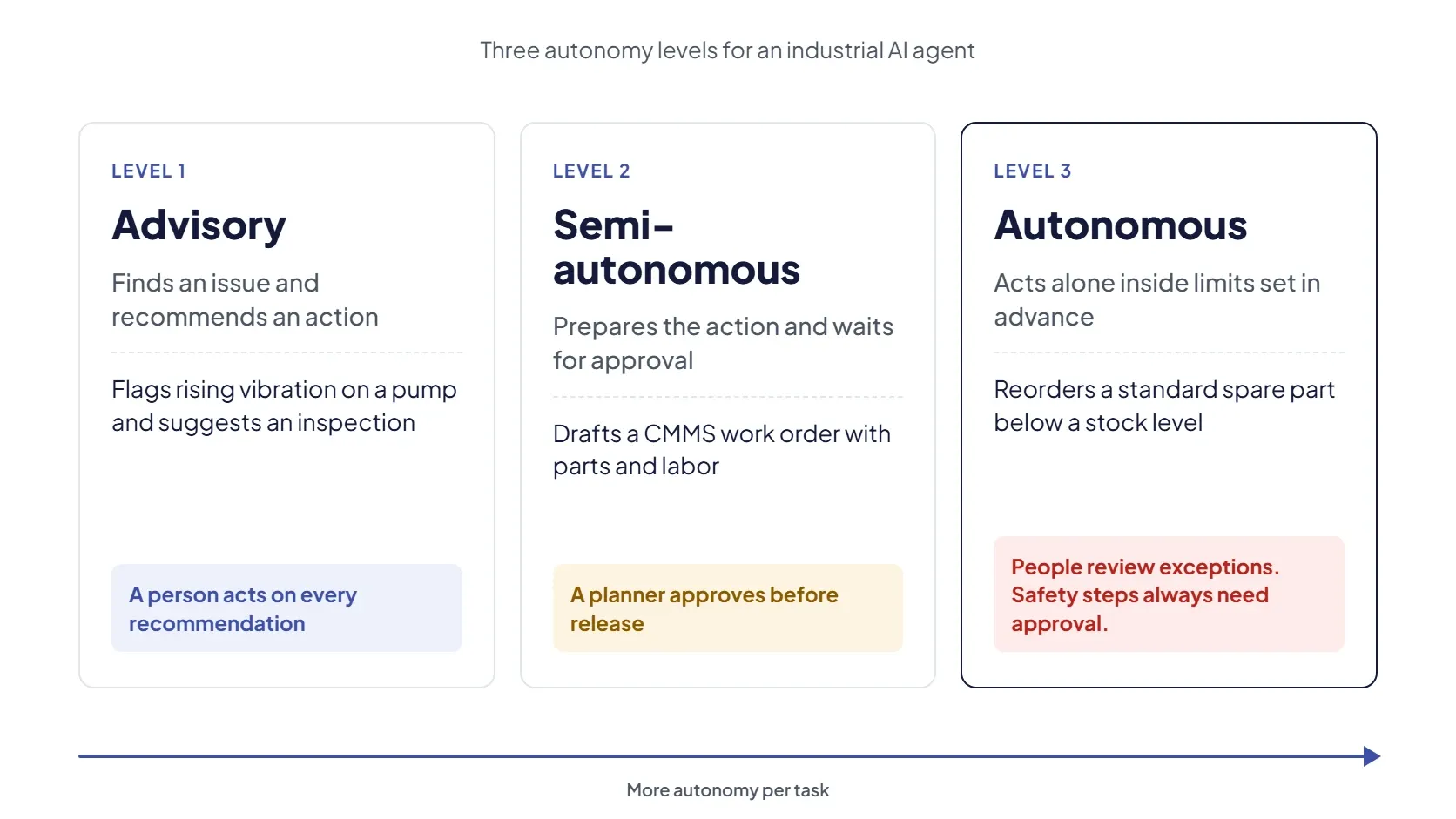
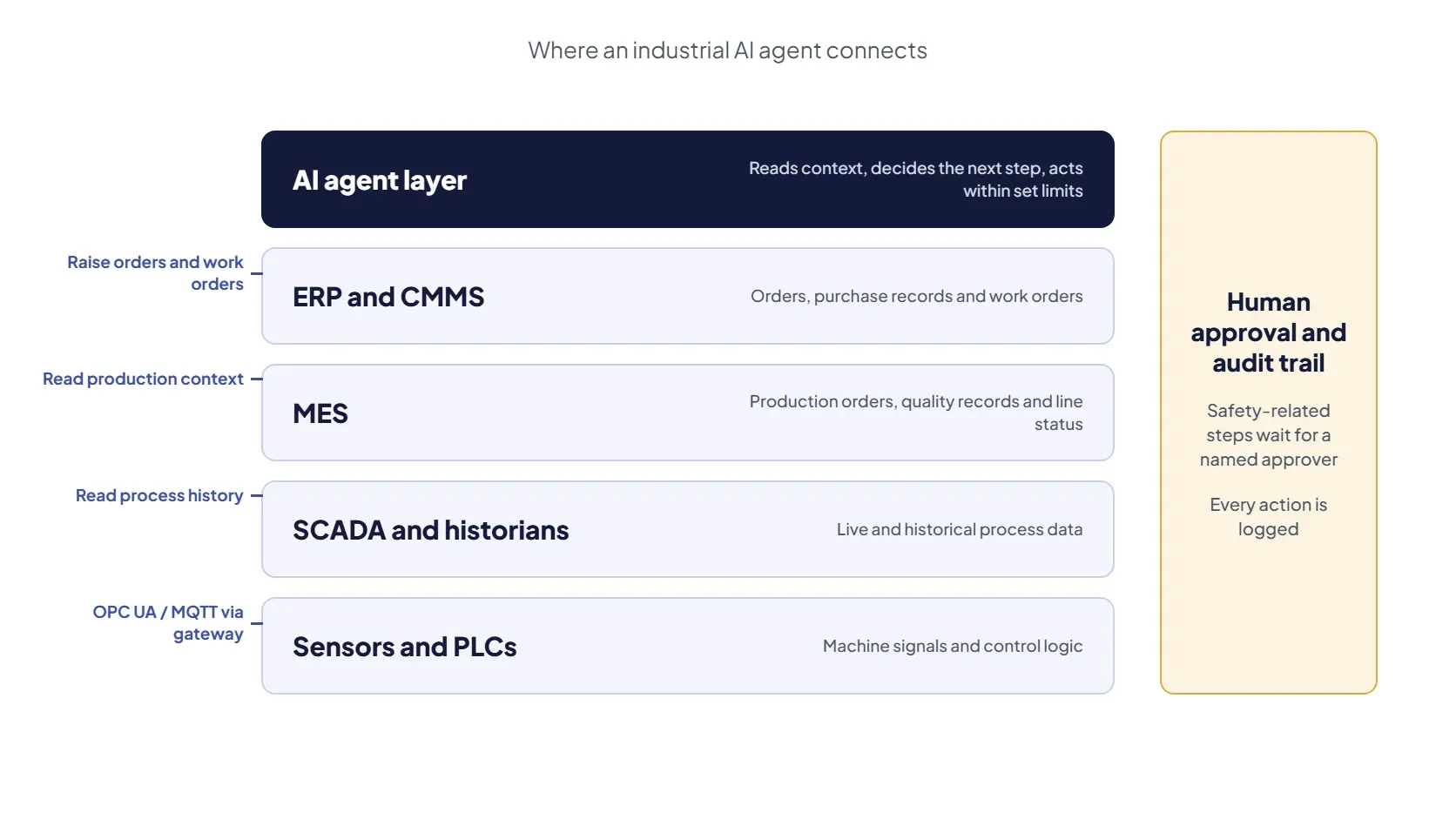
Three traits separate it from a dashboard or a chatbot. It acts instead of only advising. It connects to plant systems such as SCADA, MES and historians as well as ERP. And it stops for human approval on any step that touches safety.
Agents also differ in how much they do alone, and most plants set that level task by task:
Agentic AI is moving from pilots to plant floors.
Industrial AI agents handle six main jobs, from maintenance to compliance, and each needs different data and autonomy.
Agents read sensor data and work order history to spot failing assets and draft repair jobs.
Optimization agents tune setpoints for yield, throughput or energy use within limits engineers approve.
Inspection agents check images and test data for defects and open a quality record when a batch drifts.
Procurement agents chase supplier updates, check orders against contracts and flag shortages early.
Field service agents match technicians, parts and time slots to open service orders.
Compliance agents pull records, logs and sign-offs into audit-ready reports.
Folio3 maps 18 detailed use cases across six plant functions in its manufacturing AI agents guide.
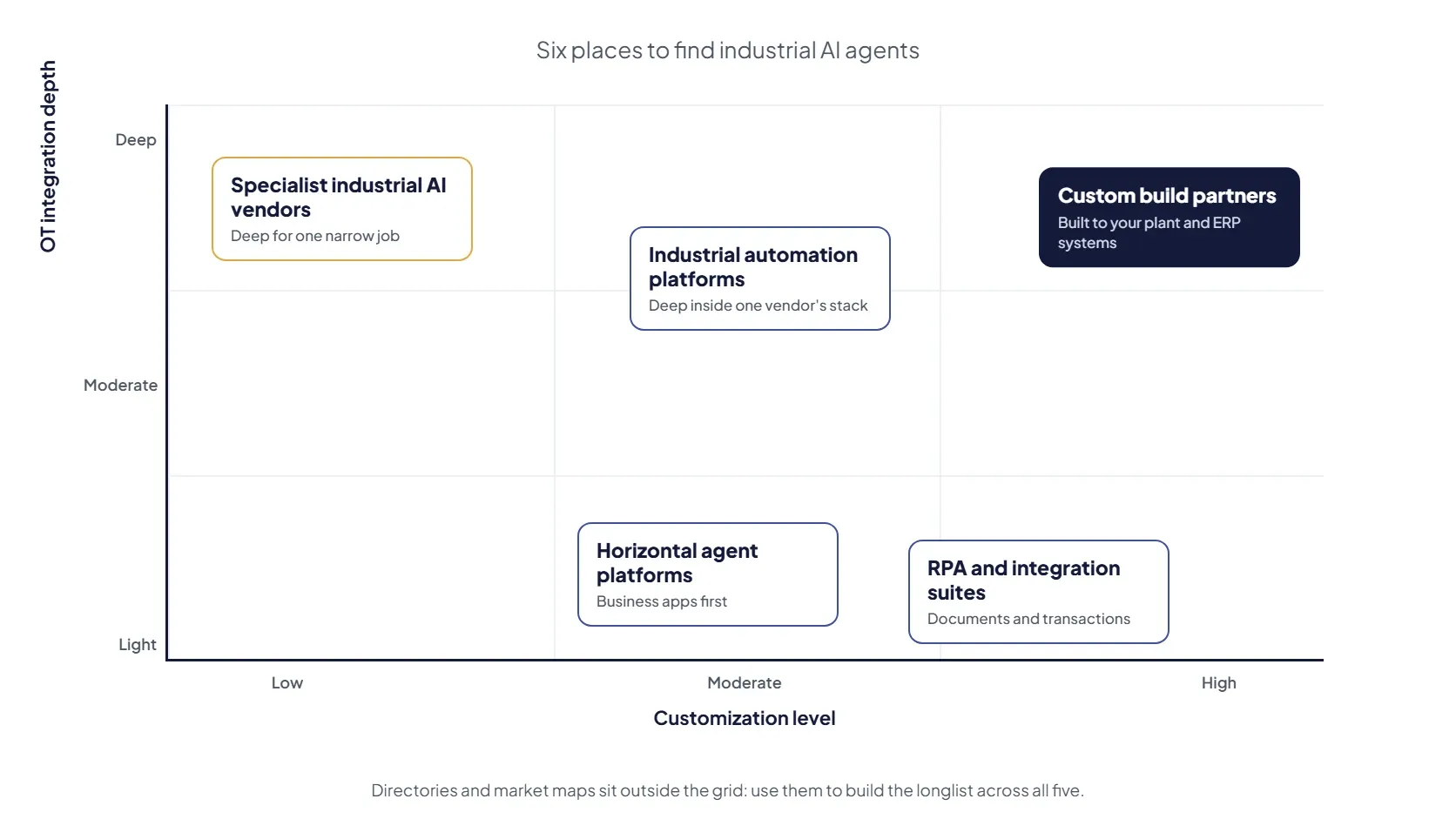
Industrial AI agents come from six kinds of sources. Each one trades off OT depth, customization and lock-in in a different way.
How we picked the examples: each vendor named here publishes an agent product for industrial or back-office work, checked in November 2026. No vendor paid to be included, and none is ranked. Folio3 appears only under custom build partners.
The six sources differ most in how deeply they reach plant systems and how far you can shape the agent.
| Source | Example vendors | Best for | OT integration depth | Customization | Pricing model |
|---|---|---|---|---|---|
| Custom build partners | Folio3 AI and other build firms | Proprietary process data | Built to your systems | High | Project quote, then support |
| Industrial automation platforms | Siemens, Rockwell Automation, ABB | Single-vendor plants | Deep within the vendor's stack | Moderate | Quoted by the vendor |
| Horizontal agent platforms | IBM watsonx Orchestrate, Gemini Enterprise | Back-office workflows | Light | Moderate | Subscription tiers |
| RPA and integration suites | UiPath, Automation Anywhere, Workato | Document and transaction flows | Light | Moderate | Consumption or credit based |
| Specialist industrial AI vendors | Augury, Imubit, Phaidra, Cognite | One high-value plant job | Deep for one job | Low to moderate | Quoted by the vendor |
| Directories and market maps | CB Insights, G2, Clutch | Building a longlist | Not applicable | Not applicable | Free listings or research subscription |
Share the workflow, the systems it touches and the safety rules it follows. Folio3 will tell you whether an off-the-shelf agent fits or a custom build will pay back faster.
Your plant's profile points to the right source faster than any vendor list.
| Plant profile | Start with | Why |
|---|---|---|
| One automation vendor across most lines | Industrial automation platform | Agents read that vendor's data with little integration work |
| Back-office load is the main pain | Horizontal platform or RPA suite | Prebuilt connectors cover ERP, procurement and finance apps |
| One costly job, such as pump failures or furnace energy | Specialist industrial AI vendor | Narrow tools go deep on one asset or process |
| Mixed equipment and plant-specific rules | Custom build partner | Agents are built on your data, systems and safety rules |
| No clear owner or use case yet | Directories, then a scoped discovery | A longlist and one priority workflow come before any vendor |
Folio3 AI builds custom agents for industrial teams that need one agent to work across plant data and business systems.
See how Folio3 scopes, builds and governs agents on its AI agent development page.
The leading AI agent companies for the industrial sector differ by job. Match the job you need done to the vendors that publish agents for it.
Products change quickly, so confirm each vendor's current features and pricing on its own site before you shortlist.
Buy an off-the-shelf agent when the workflow is standard. Build custom when the value sits in your own process data, spans several systems or follows plant rules a product cannot model.
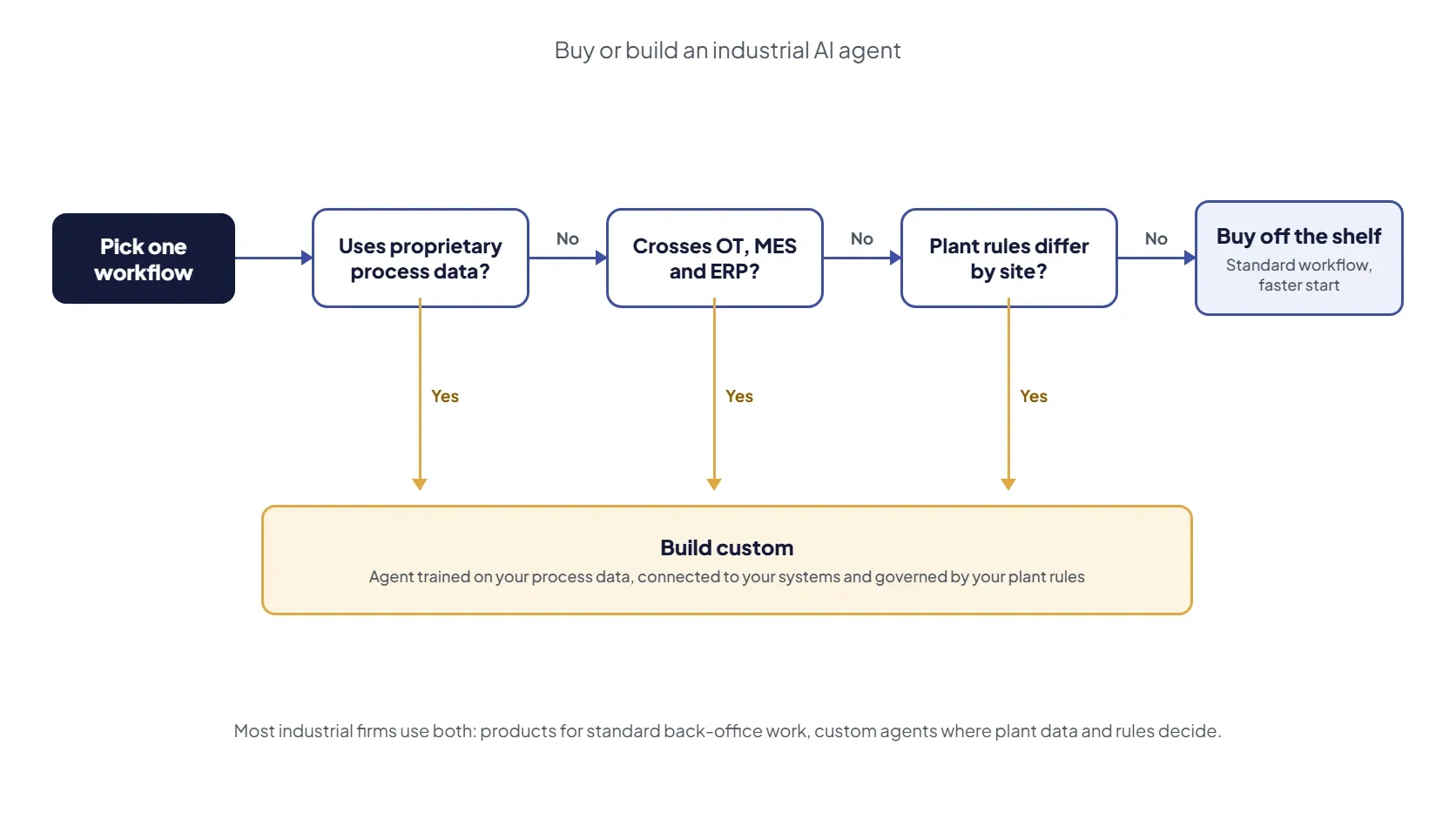
Off-the-shelf agents win on standard work, such as invoice matching, where a product already connects to your ERP.
A custom build wins in three cases. The value sits in your own process history, which generic models do not know. The workflow crosses OT, MES and ERP, so one product would need several others stitched around it. Or safety and OT rules differ by site, and a product's fixed rules cannot follow them.
Most industrial firms end up with both. To see how agents plug into existing systems, read our guide to AI agent integration, and for agents built around one industry, our guide to vertical AI agents.
Off-the-shelf agents fit standard workflows. Folio3 builds agents trained on your process data and connected to the systems your teams already run.
Before you buy, check that the agent can read from and write to the systems your plant runs.
Plant agents need tighter limits than office agents, because a wrong action can stop a line or put people at risk.
Set advisory, semi-autonomous or autonomous for each task, not for the agent as a whole.
Any step that changes setpoints, isolates equipment or affects people waits for a named approver.
Give read access by default, and write access only to named tags or systems. Keep agents away from safety instrumented systems.
Log every reading, decision, approval and action with a time and an identity. For the model calls an agent makes, Folio3's AI Guardian adds PII redaction, model access by team, and usage and cost tracking.
Deploy agents inside the zones and conduits defined under the ISA/IEC 62443 series, the standard for industrial automation and control system security.
Four sourcing mistakes sink most industrial agent projects, and each is cheap to avoid before you sign.
Comparing platforms before naming the line, the metric and the baseline leaves no fair way to judge a demo.
A pilot on curated data hides gaps in historian tags, asset names and missing sensor readings.
Agents that touch control systems need plant engineering and OT security sign-off from the first week.
An agent that acts before its advisory calls are checked creates work orders and purchase orders nobody trusts.
Evaluate industrial agent vendors on proof inside plants like yours, then on how they test, price and hand over.
"Most industrial agents fail at the plant boundary, not in the model. Ask the vendor to show the agent reading your historian and writing a work order into your CMMS. If they can't, you are looking at a demo."
Industrial agent cost depends less on the model than on the plant around it. Six drivers set most of the budget.
Measure industrial agent ROI with plant metrics your finance and operations teams already trust.
| Metric | What it proves |
|---|---|
| Unplanned downtime hours | Maintenance agents catch failures earlier |
| OEE per line | Availability, performance and quality improve together |
| Energy cost per unit | Optimization agents cut energy without cutting output |
| Mean time to repair | Diagnostics and work orders reach technicians faster |
| Procurement cycle time | Supplier and order work moves without manual chasing |
To turn these metrics into a payback figure, use the formula and calculator in our guide to the best production ROI AI agent firms.
Pick the process that costs the most downtime or manual hours. Folio3 will scope a pilot, set the baseline and map the path to production.
The fastest way to a working industrial agent is one job, one plant and one measured baseline.
In six places: industrial automation platforms, horizontal agent platforms, RPA and integration suites, specialist industrial AI vendors, directories and market maps, and custom build partners. Start from the job, then the source.
It depends on the job. For maintenance, look at Augury and Rockwell Automation; for process and energy, Imubit and Phaidra; for engineering and asset data, Siemens and Cognite; for supply chain, Blue Yonder and Pactum; and for field service, ServiceMax.
Among industrial AI companies, automation vendors such as Siemens, Rockwell Automation and ABB bring the deepest plant-floor integration, specialists such as Augury, Imubit and Cognite go deepest on single jobs, and custom build partners fit where process data and plant rules are unique.
An industrial AI agent is software that reads plant and business data, decides on a next step and takes it in systems such as a CMMS, MES or ERP, within limits people set. It can advise, act with approval or act alone on low-risk tasks.
Buy when the workflow is standard and a product already connects to your systems. Build when the value depends on proprietary process data, the workflow crosses OT and ERP, or plant rules differ from what a product supports.
Yes, usually through industrial protocols such as OPC UA and MQTT, historian interfaces or an edge gateway. Most plants give agents read access first and allow writes only to approved systems, never to safety functions.
They can be when each task has a set autonomy level, safety-related steps wait for human approval, access is limited and every action is logged. OT security should follow the ISA/IEC 62443 series.
A focused pilot often takes six to twelve weeks after discovery and planning. Rollout across sites then depends on integration work, data quality and the number of plants.
Track downtime hours, OEE, energy cost per unit, mean time to repair and procurement cycle time against a pre-pilot baseline, then compare the savings with build and run costs.
Skip the vendor maze. Get an agent built for your process data, connected to your plant and ERP systems, and governed from day one.
By the Folio3 AI Editorial Team. Technically reviewed by Abdul Sami, Head of AI Development at Folio3 AI, in November 2026.
Fill the form below or Contact us at +1 408 365-4638 / email us via contact@folio3.ai
Projects Delivered
Global Employees
Companies Served
Global Awards Won

+1 408 365-4638
contact@folio3.ai

6701 Koll Center Parkway, #250 Pleasanton, CA 94566