
AI Agents
Where to Find Top AI Agents for Industrial Firms in 2026
Six places to source industrial AI agents, the vendors that lead each job, and when a custom build pays off over buying a product.
Only a quarter of AI initiatives deliver the ROI leaders expect. This guide compares AI agent firms on production proof, measured outcomes and payback, and shows how to calculate ROI before you sign.
Production ROI is the measured return an AI agent earns while it runs a live workflow, compared with a baseline recorded before the build.
The firms worth shortlisting publish production case studies with before-and-after numbers.
They also explain how they test and govern agents, and help you model payback before any code is written.
Most AI agent projects stall between pilot and production, and the ones that stall never earn back their cost. Four findings show the size of the gap.
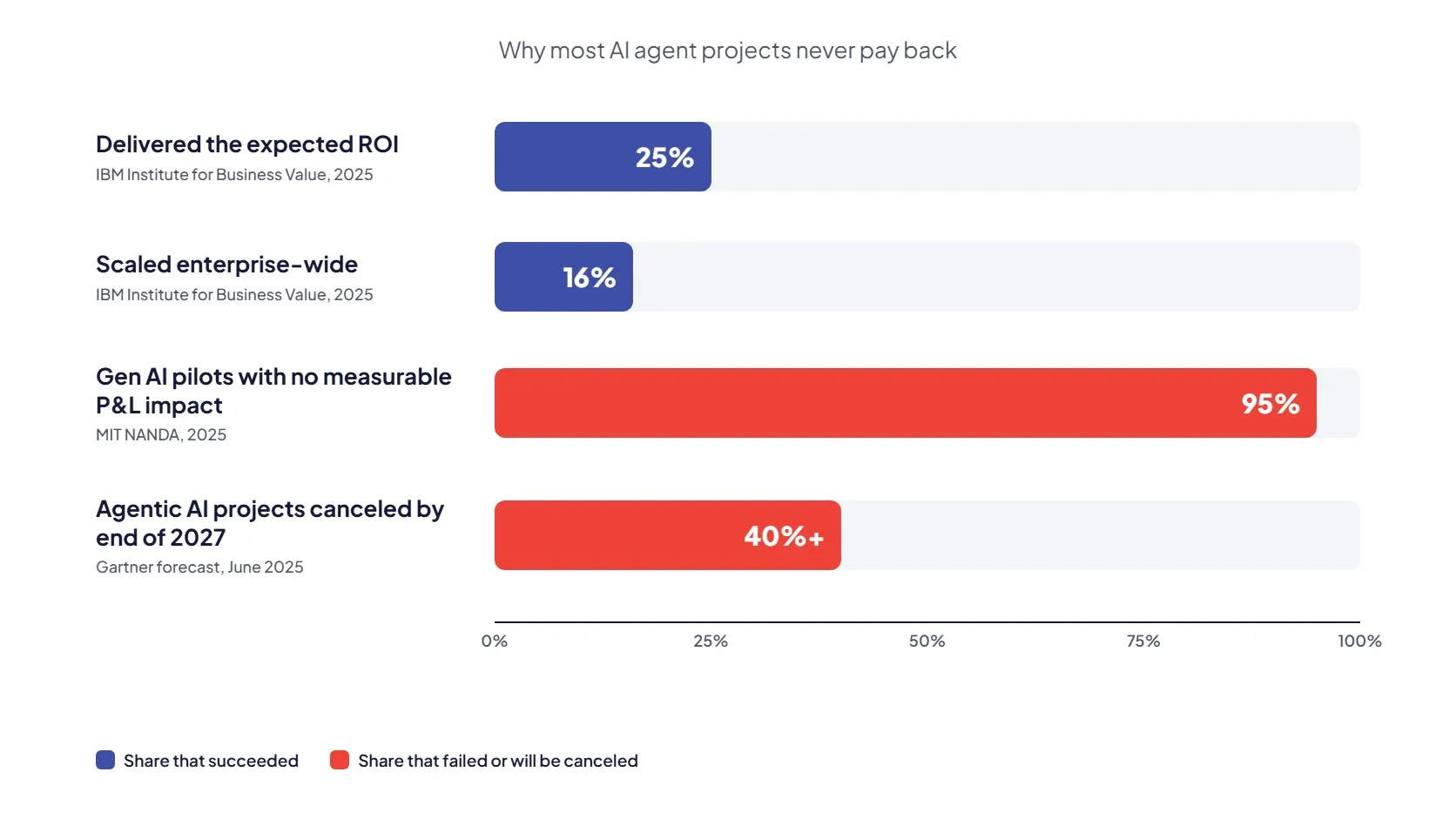
The common thread is measurement. Teams that never recorded a baseline cannot prove value, so funding stops before the agent reaches production.
Production ROI for AI agents is the net return an agent delivers inside a live workflow, measured against the cost and speed of the same work before the agent existed.
It has five parts:
A production-ready AI agent gives consistent results, fails safely, stays inside its permissions and costs a predictable amount to run. These six controls separate it from a pilot.
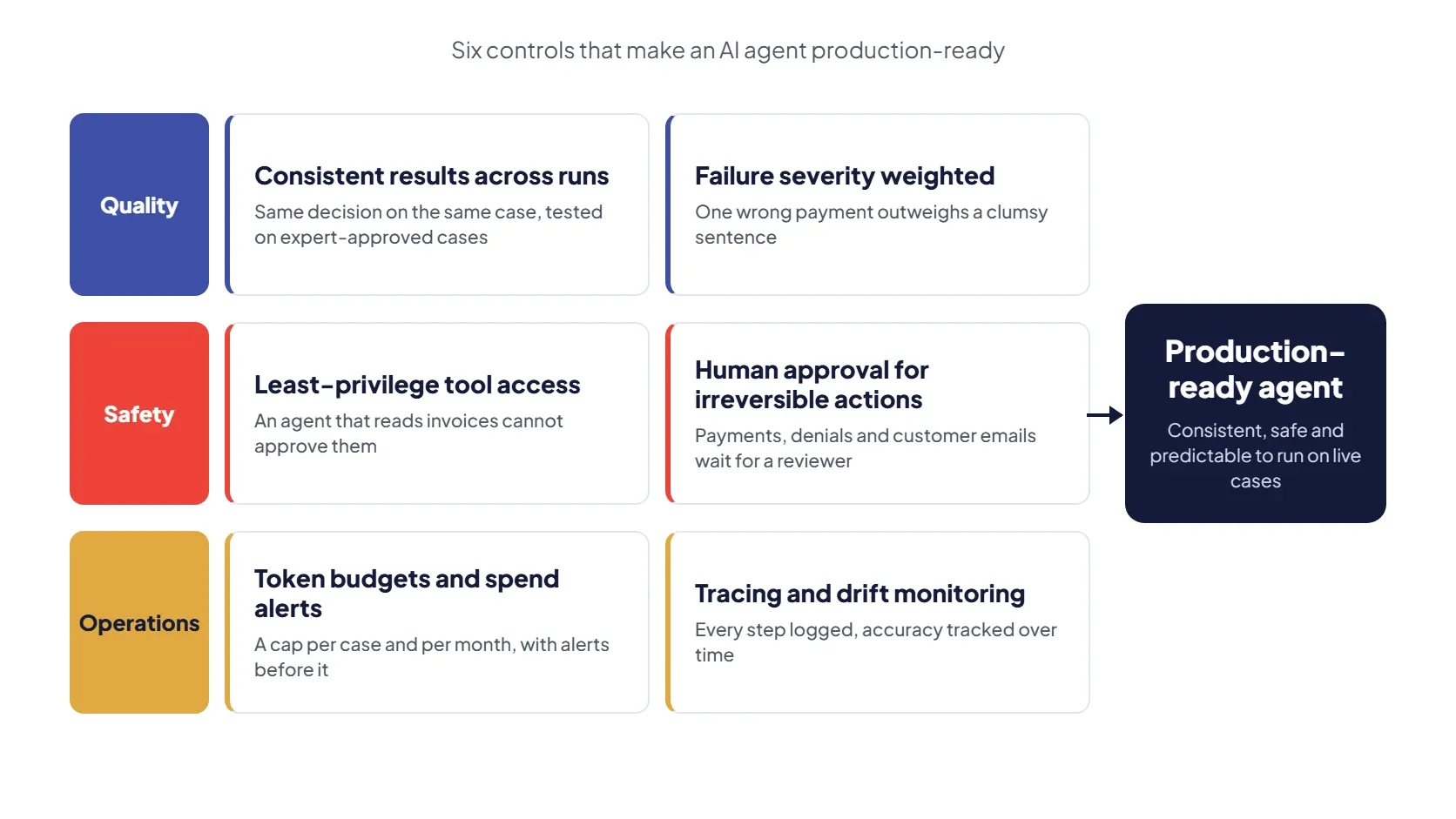
The agent returns the same decision for the same case across repeated runs, tested on a set of real cases that domain experts have approved.
Testing ranks failures by impact, so one wrong payment counts far more than a clumsy sentence, and release thresholds reflect that weighting.
Each tool gets the narrowest permission it needs, so an agent that reads invoices cannot approve them or touch payroll records.
Payments, denials, account changes and customer emails wait for a named reviewer, while reversible, low-risk steps run on their own.
Each agent has a spending cap per case and per month, with alerts before the cap, so a looping agent cannot run up a surprise bill.
Every step, tool call and output is logged, and accuracy is tracked over time so drift is caught before customers notice it.
Each firm was rated against six criteria using public evidence only: its own case studies, documentation, published client results and service pages. No firm, including Folio3, was given a numeric score.
The six criteria:
Strong means the firm publishes specifics. Partial means it mentions the item without detail. Not published means nothing was found on the firm's own public pages in November 2026.
| Firm | Case studies | Outcome metrics | Evaluation | Governance | Integration | IP terms |
|---|---|---|---|---|---|---|
| Folio3 AI | Strong | Strong | Strong | Strong | Strong | Not published |
| Neurons Lab | Strong | Partial | Partial | Strong | Strong | Partial |
| LeewayHertz | Partial | Not published | Strong | Strong | Strong | Not published |
| HatchWorks AI | Strong | Partial | Partial | Partial | Strong | Not published |
| Intuz | Strong | Partial | Partial | Strong | Strong | Not published |
| Emerline | Partial | Not published | Not published | Not published | Partial | Not published |
| OpenKit | Partial | Partial | Not published | Partial | Partial | Strong |
| Code Brew Labs | Partial | Partial | Not published | Not published | Partial | Not published |
| Accenture | Partial | Partial | Strong | Strong | Strong | Not published |
| IBM Consulting | Strong | Strong | Strong | Strong | Strong | Not published |
The firms differ most in delivery model and in how much proof they publish. Use this view to shortlist, then read each entry for the details and the trade-off to watch.
| Firm | Best for | Delivery model | Published ROI proof | Pricing model |
|---|---|---|---|---|
| Folio3 AI | Measurable production results | Build method or forward deployed engineers | 70% less claims processing time | Custom quote |
| Neurons Lab | Financial services agent builds | Embedded delivery with knowledge transfer | 80% less manual intervention | Not published |
| LeewayHertz | Broad multi-industry agent programs | Full lifecycle, strategy first | No numeric outcomes published | Not published |
| HatchWorks AI | Adding nearshore engineering capacity | Strategy, then build | 47% of response-worthy emails automated | Not published |
| Intuz | Business process automation agents | Fixed-scope build and integration packages | Processing time cut from hours to seconds | Packages published |
| Emerline | Microsoft Copilot Studio agents | Strategy and discovery, then build | No agent metrics published | Not published |
| OpenKit | Legal and education AI | Discovery sprint, then build | 52% less marking time in teacher tests | Not published |
| Code Brew Labs | Fast multi-industry delivery | Multi-office development teams | $375,000 in added annual recovery opportunities | Not published |
| Accenture | Large multi-function agent programs | Platform plus industry agent solutions | 93%+ faster internal IT configuration | Not published |
| IBM Consulting | Governance across clouds and models | Consulting-led agent platform | 90% less leader admin time | Not published |
Read how Folio3 scopes, builds and governs agents on the AI agent development services page.
Every Folio3 agent starts with one workflow, a baseline metric and a target to beat. Review the published results and the delivery process before your first call.
AI agent ROI is the annual value an agent creates, minus everything it costs to build and run, divided by that total cost. Five steps get you to a number finance will accept.
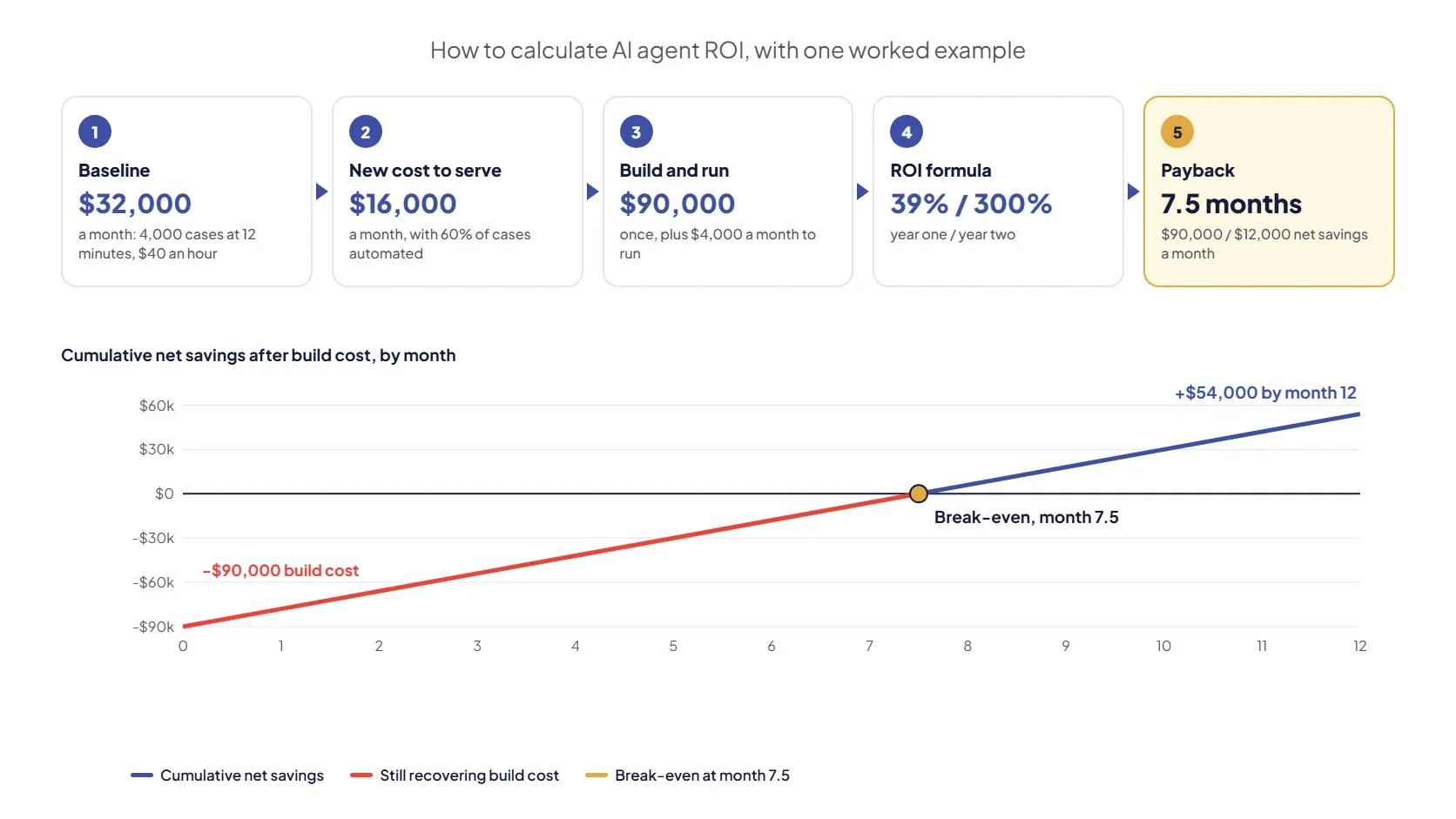
Record monthly case volume, minutes per case, fully loaded cost per hour and error rate for four to eight weeks, before anything is built or promised.
Estimate the share of cases the agent completes end to end, the review minutes each one still needs, and the cost of cases it escalates to people.
Add one-time build and integration costs to yearly model usage, hosting, monitoring and human review, so the total reflects the agent's full cost.
Subtract total cost from the annual value gained, then divide by total cost. Run it for year one, with build costs, and year two without them.
Compare cumulative savings with cumulative cost each quarter, and pause scope or autonomy increases if the agent falls behind the payback window you agreed.
ROI = (annual value gained − total cost) ÷ total cost
Payback period (months) = one-time build cost ÷ monthly net savings (monthly savings minus monthly run cost)
The team handles 4,000 cases a month at 12 minutes each, with a fully loaded cost of $40 an hour. That is 800 hours, or $32,000 a month.
Change the inputs to match your workflow. Results update as you type.
These are estimates for planning, not a quote. The calculator assumes savings start in month one, at full volume, and leaves out ramp-up time and the cost of escalated cases.
Share the workflow, its volume and its current cost. Folio3 will model build cost, run cost and payback before any build starts.
AI agent firms fall into four groups, and each suits a different buyer. Knowing the group tells you what proof, price and control to expect.
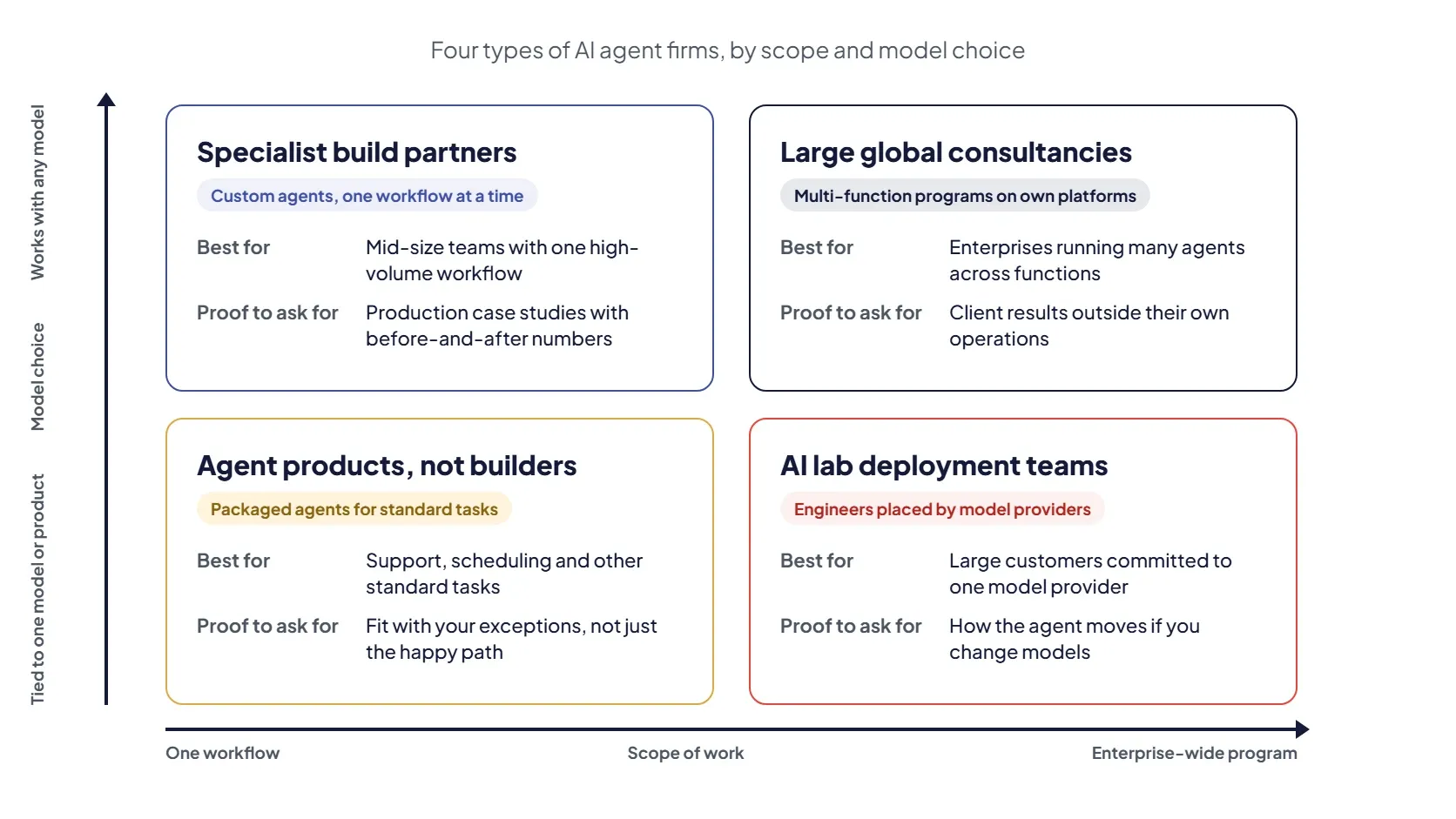
Model providers place engineers with large customers to deploy their own models. They know the model deeply but rarely build across competing models.
Firms such as Accenture and IBM Consulting run multi-function programs with their own platforms. They bring scale and governance, with matching budgets and timelines.
Mid-size firms that design, build and run custom agents for one workflow at a time. Proof depends on how much each publishes about its results.
Vendors that sell packaged agents for standard tasks such as support or scheduling. They launch fast but stop where your workflow differs from theirs.
Choosing a partner over building alone tends to pay off. In the same MIT NANDA research, tools bought from specialized vendors and built through partnerships succeeded about 67% of the time, while internal builds succeeded only one-third as often.
Choose an AI agent firm on evidence you can check, then on fit and terms. Six checks cover most of the risk.
Five questions expose most weak proposals in a single call. Tick each one off as you get a clear answer.
Five warning signs predict an agent that never pays back. Any one of them is a reason to slow down.
A polished demo on clean sample data says little about how an agent handles your messy, real cases at volume.
Without a fixed set of approved cases, nobody can tell whether a new release made the agent better or worse.
Chatbots and scripted automations relabeled as agents rarely plan, use tools or act inside your systems as promised.
A percentage with no starting figure, time period or method behind it cannot be checked, so it cannot guide a budget.
Agents drift as data and rules change. A proposal that ends at go-live leaves monitoring, retraining and fixes unfunded.
"Most ROI cases fail on the first line, not the last. Nobody measured the old process, so there is nothing to beat. Spend two weeks on the baseline before you spend anything on the build."
Bring these questions to a free call. Walk through architecture, evaluation, governance and ownership terms for your workflow with the Folio3 team.
The firms worth your budget publish what their agents achieved in production. Three moves keep your own project on that side of the line.
A production-ready firm publishes agents running on live cases, tests them against approved case sets before each release, and builds approvals, logs and spend limits into every agent. It also stays responsible for monitoring after launch.
In this comparison, Folio3 AI and IBM Consulting publish the most evidence, rated Strong on five of six criteria. Neurons Lab is the only other firm with no criterion left unpublished. The right choice still depends on your industry, budget and how much control you want over code and data.
Subtract the agent's total build and run cost from the annual value it creates, then divide by that total cost. Base the value on a measured baseline of time, cost and errors from before the build.
There is no single benchmark, so agree a target window before the build. In Salesforce's 2026 survey of agentic AI leaders, companies with agents in production reported reaching meaningful ROI in about eight months on average.
Most pilots run on clean sample data with no baseline, no evaluation set and no owner for integration. When the pilot ends, nobody can prove value, so funding stops before the agent reaches live work.
Running costs cover model tokens, hosting, monitoring, maintenance and human review time. Token use can vary widely, because agents use several times more tokens than a chat interaction.
A scoped proof of concept often takes a few weeks, and a production build a few months. Measurable savings start once the agent runs on live volume, and payback then depends on volume, build cost and run cost.
Build in-house if you have engineers who can own evaluation, integration and monitoring long term. Hire a firm when speed matters, workflows cross legacy systems or your team lacks production agent experience.
Ownership depends on the contract, and few firms publish their terms. Get written confirmation that you own the code, prompts, evaluation sets and any fine-tuned model weights before you sign.
Work with a firm that publishes its results, measures payback from a real baseline and stays accountable for ROI after launch.
By the Folio3 AI Editorial Team. Technically reviewed by Abdul Sami, Head of AI Development at Folio3 AI, in November 2026.
Fill the form below or Contact us at +1 408 365-4638 / email us via contact@folio3.ai
Projects Delivered
Global Employees
Companies Served
Global Awards Won

+1 408 365-4638
contact@folio3.ai

6701 Koll Center Parkway, #250 Pleasanton, CA 94566