
AI Agents
Best Production ROI AI Agent Firms, Compared on Real Results
Ten AI agent firms rated on production proof, measured ROI and payback using public evidence, plus a simple method to calculate AI agent ROI before you sign.
Supplier files arrive in every format, attributes go missing and each channel wants its own schema, so finished products sit unpublished. AI agents for PIM read those files, fill the gaps, write channel-ready copy and flag errors before launch.
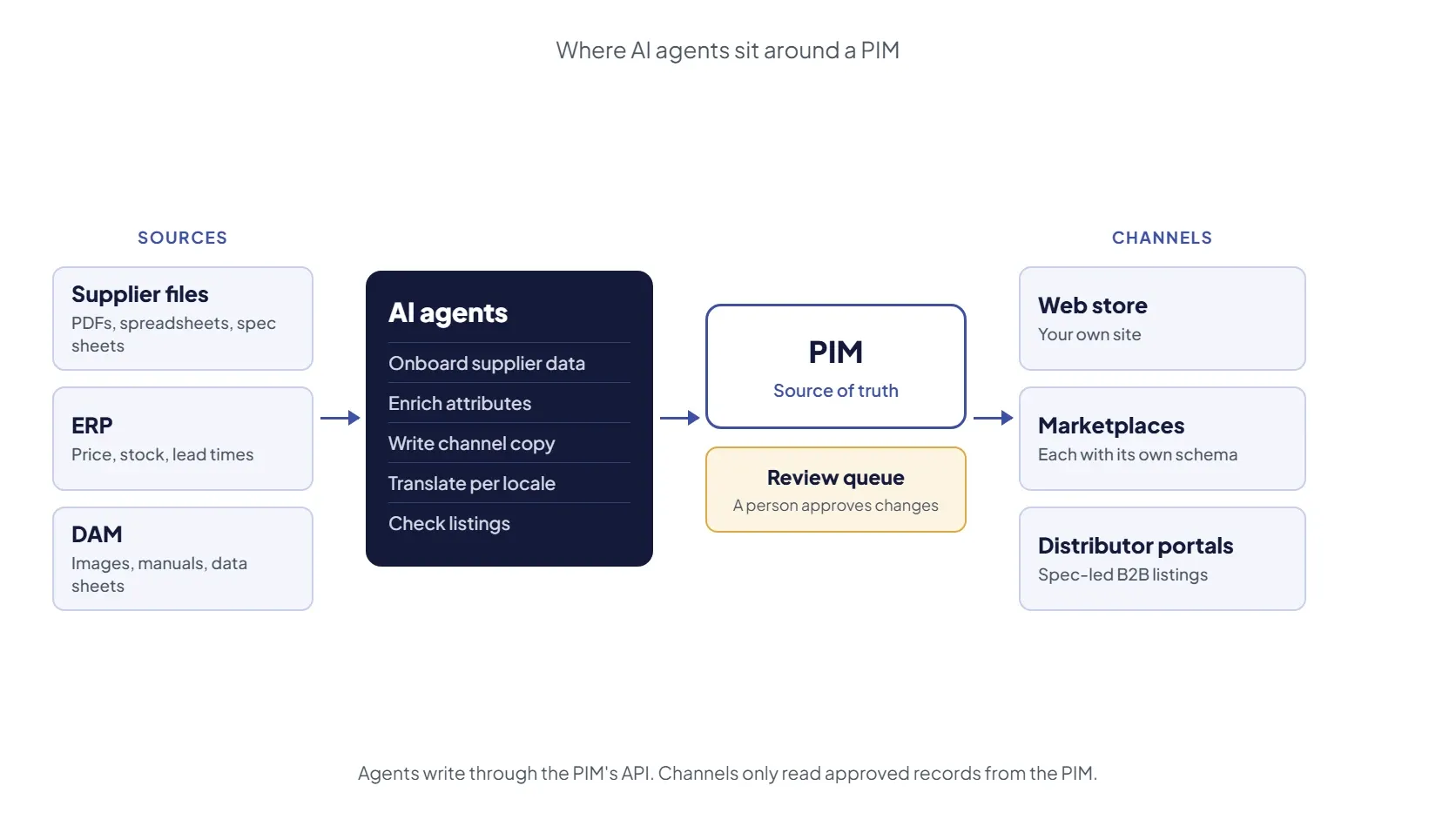
AI agents for PIM (product information management) are AI programs that work on top of your PIM system. They onboard supplier data, fill missing attributes, write AI product descriptions and check listings, and a person approves changes before they publish.
Your PIM stays the source of truth.
Agents read supplier files, ERP and DAM data, then write the results into the PIM through its API.
Changes they are unsure of go to a reviewer, and nothing reaches a channel until a person approves it.
PIM (product information management) is software that stores the descriptive data for every product you sell and sends the right version of it to each sales channel.
A PIM is not an ERP or a DAM. The ERP owns transactional data such as price, stock and orders. The DAM stores the files. The PIM holds the product story and combines it with ERP and DAM data into a listing for each channel.
Most PIMs also run completeness rules, so a product cannot publish to a channel until its required fields are filled. Those rules tell your team what is missing. Someone still has to fill it, and that is the work AI agents take on.
AI agents for PIM are software agents that take a catalog goal, such as "get these 400 new SKUs ready for the marketplace," plan the steps and carry them out across your PIM and connected systems. They read sources, write field values and copy, and send any change they are unsure of to a person.
Rules work when inputs are predictable. They break when one supplier PDF lists "Ø 12 mm" in a spec table and "0.47 in" on the cover.
| Criteria | Rule-based PIM automation | Agentic AI |
|---|---|---|
| How it works | Fixed if-then rules your team writes | Reads context and plans the steps |
| Inputs it handles | Predictable, structured fields | PDFs, free-text spreadsheets, images |
| Unit or naming mismatch | Fails or needs a new rule | Converts units and maps "Navy/Wht" to navy and white |
| When it is unsure | Applies the rule anyway or blocks | Flags the case for a person |
| Systems it touches | One PIM | PIM, ERP, DAM and channel feeds |
In one task, an agent can read a supplier spec sheet, check ERP stock, match a DAM image and write the result into the PIM. Every write goes through the PIM's API, so channels still read one record.
Built-in PIM AI, the feature set most vendors sell as AI powered PIM, helps one user on one product screen. AI agents for PIM run multi-step jobs across the systems your catalog depends on.
| Criteria | Built-in PIM AI | AI agents for PIM |
|---|---|---|
| Scope | Inside one PIM | PIM, ERP, DAM, marketplaces |
| Typical tasks | Single-field suggestions | Multi-step catalog workflows |
| Data sources | Mostly data already in the PIM | Supplier files, PDFs, images |
| Customization | Vendor-defined prompts and settings | Your rules and voice |
| Roadmap | Set by the PIM vendor | Set by your team |
Product data breaks because catalog volume grows faster than the team: every supplier, locale and channel multiplies the fields to fill and check.
Suppliers send PDFs, free-text spreadsheets and email attachments, each with its own units, field names and layout. Someone on your team maps or retypes every file by hand before it reaches the PIM.
"Blue," "navy" and "midnight" end up as three filter values for one color. Missing dimensions or compatibility details leave buyers guessing, which leads to support tickets and product returns.
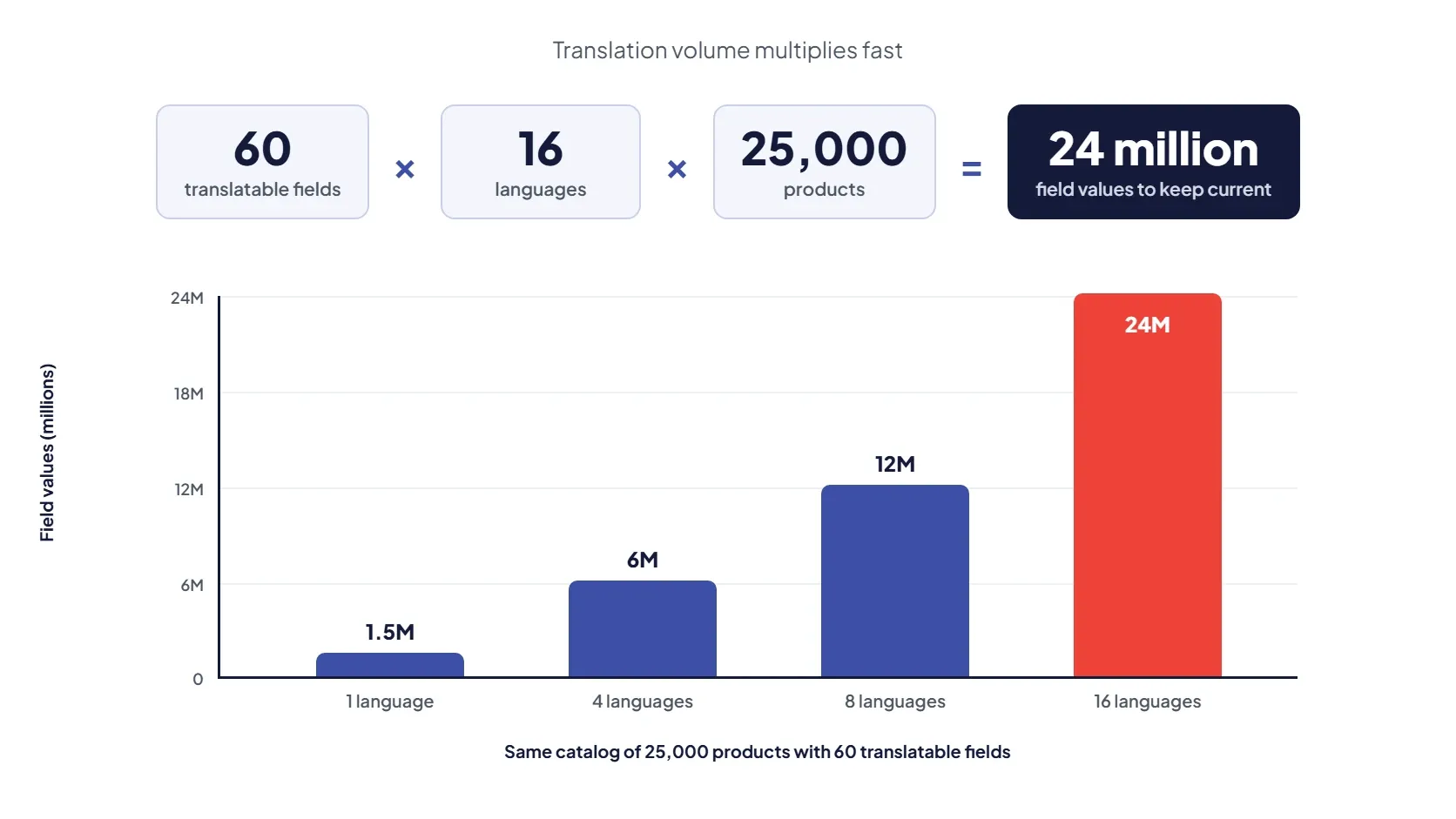
Take a catalog of 25,000 products with 60 translatable fields in 16 languages. That is 24 million field values to create, and every source-text change restarts the cycle for each locale.
Each marketplace and portal wants its own fields, title lengths and category trees. Google Merchant Center's product data specification caps titles at 150 characters and descriptions at 5,000.
When reviewers check every field instead of only the risky ones, approvals queue up. Finished products then sit complete in the PIM without reaching a single web store, marketplace or portal.
In AI catalog management, agents take on the repetitive steps between receiving supplier data and keeping a live listing correct. Most teams start with one of these nine.
Reads supplier catalogs and spec sheets, maps attributes to your fields and units, and sends uncertain mappings to a reviewer with the source page.
Handles AI product data enrichment from supplier specs and manuals, and leaves a field empty when no source supports a value.
Writes AI product descriptions, titles and bullets per channel from verified specs. Google Merchant Center has structured fields for AI-written text.
Uses computer vision to suggest color, pattern, finish or shape from product images, pre-filled for a person to confirm.
Translates copy per locale with your approved glossary, and holds regulated phrases and claims for review in that market.
Maps each product to your hierarchy and every channel's category tree, and flags products that fit more than one category.
Checks claims and documents against your market rules, including EU Digital Product Passport data, mandatory for certain batteries from 18 February 2027.
Runs pre-publish checks per marketplace on required fields, formats, title length and images, fixes what it can and lists the blockers.
After launch, checks live listings for dropped attributes, wrong prices or rejected items, and opens a fix task in the PIM.
Share how product data reaches your PIM today and where it slows down. Folio3 will map which agent removes that bottleneck first and what it takes to build.
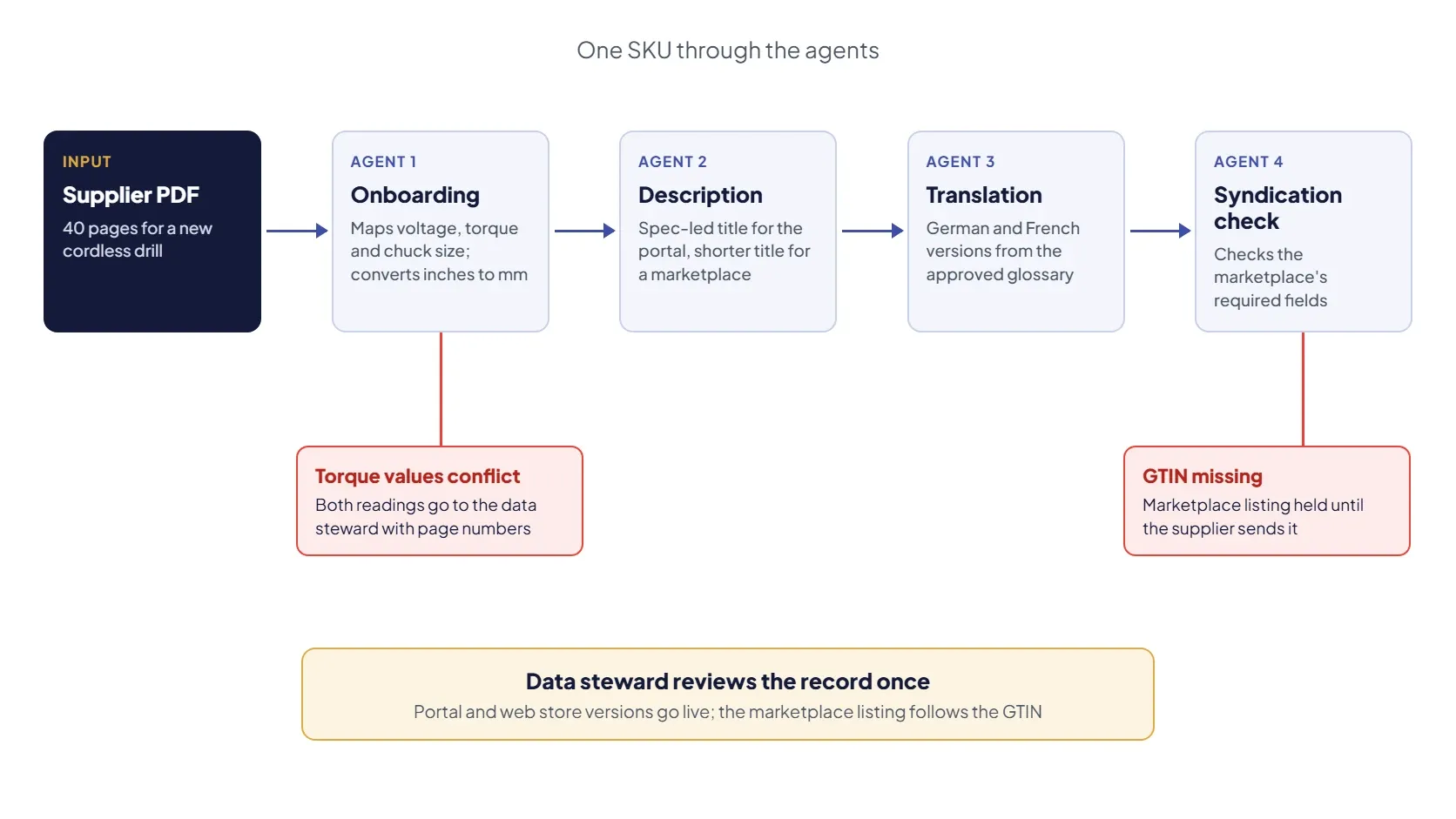
Here is how one new product could move from a supplier file to live listings when four agents share the work.
Agents connect through APIs and events rather than screen scraping. A typical setup touches seven points.
If your PIM has no API for a step, that step stays manual or runs through a file import. Check this before you scope a build.
Folio3 AI builds custom agents that work on top of the PIM you already run.
AI for PIM is rarely all built-in or all custom. Use built-in AI when the work stays inside one PIM. Consider custom agents when the work crosses systems or needs rules the vendor's features can't hold.
Cost depends on how much variety the agent has to handle, not on SKU count alone.
No platform migration needed. Folio3 can build agents that read your supplier files, enrich records in your PIM and hold every change for review before publishing.
Roll out in six steps, starting with one high-volume task on one channel, so you measure before widening scope.
Six controls make an agent's catalog changes safe to publish.
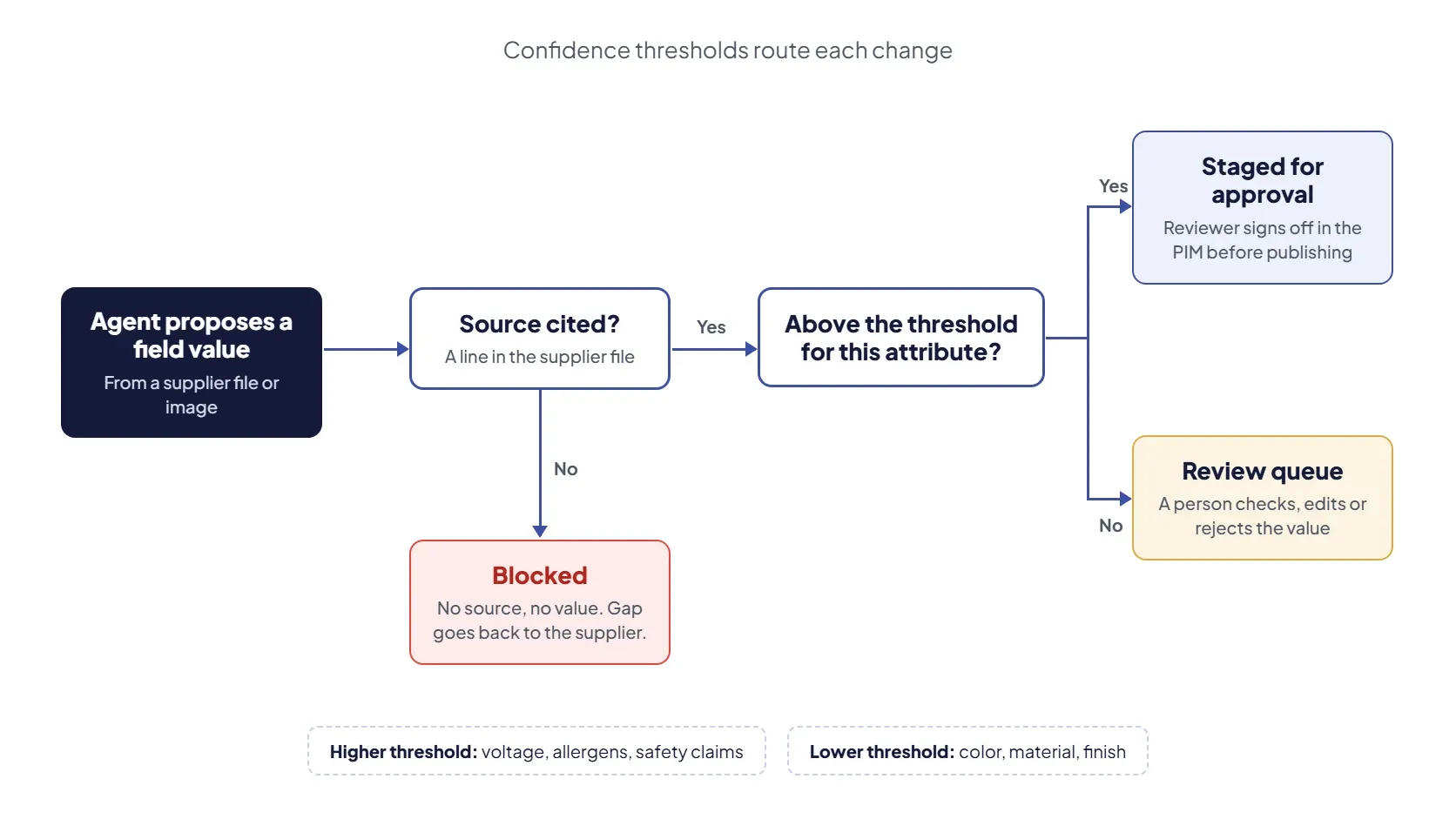
"The quickest way to lose trust in a catalog agent is to let it guess a spec. Make it cite the source line for every attribute it fills, and send anything it can't cite to a person. Teams accept the speed once they can check the work."
Measure six numbers before and after the pilot. Payback comes from faster launches and fewer rejected or returned products, not copy volume.
| Metric | How to measure |
|---|---|
| Time to market per SKU | Days from supplier file to live listing |
| Attribute completeness rate | Share of required fields filled per family and channel |
| Enrichment cost per SKU | Staff hours plus translation and agency fees, per SKU |
| Marketplace listing rejection rate | Rejected or suppressed listings divided by listings submitted |
| Returns from bad product data | Returns coded "not as described," wrong size or wrong fit |
| Translation turnaround time | Days from a source-text change to all locales live |
To compare AI agent partners on payback, see the guide to AI agent firms with the best production ROI.
Folio3 can baseline your enrichment time, completeness and rejection rates with you before any build, so you see the target numbers before committing.
Over 40% of agentic AI projects will be canceled by the end of 2027, Gartner predicts, because of rising costs, unclear value or weak risk controls. In PIM, five problems come up most often.
An agent can't fill a field that no source supports. Send the gap back to the supplier instead of letting the agent invent a value.
Language models can write specs that sound right and are wrong. Require a source reference for every spec field and block any value that has none.
Copy slowly moves away from your style as models and prompts change. Score samples against your style guide on a schedule and re-test after every model change.
Quality varies by language pair and category. Use native reviewers for top locales and glossaries for technical terms.
Rules and prompts built inside one vendor's AI feature stay behind if you change PIM. Keep rules, prompts and test sets in a repository you control.
Three shifts are underway: native agents inside PIMs, AI shopping tools reading catalogs, and machine-readable product data becoming a sales requirement.
Several vendors announced AI PIM and AI powered PIM features with native agents in 2025 and 2026, some still in preview. Cross-system work needs connected agents.
Nearly all business buyers, 94%, use AI during their buying process, Forrester reports. Those tools only compare products whose data they can parse.
Complete attributes, consistent units and structured data on product pages decide whether an AI assistant can match your product to a buyer's question.
Agentic PIM extends a PIM rather than replacing it.
AI agents for PIM are AI programs that bring AI product information management into an existing PIM system. They work on top of it to onboard supplier data, fill attributes, write channel copy and check listings. People approve their changes before anything publishes.
AI in PIM, or PIM AI, usually means built-in features that suggest a value or a description for one field when a user asks. AI agents plan and complete multi-step catalog jobs across the PIM, ERP, DAM and channel feeds.
Agentic PIM is a setup where AI agents carry out catalog work, such as onboarding, enrichment and pre-publish checks, instead of only suggesting edits. The PIM remains the system of record, and people approve what the agents change.
Yes, if your PIM exposes an API for reading and writing products, attributes and workflow states. Steps without API access stay manual or run through file imports.
In AI catalog management, agents can handle supplier onboarding, enrichment, descriptions, image attributes, translation, categorization, compliance checks, syndication readiness and listing monitoring. Most teams start with one task.
AI product data enrichment accuracy depends on source data quality and field type. Agents are most reliable when every value must cite a source and low-confidence values go to review.
No. AI for PIM works on top of the system: agents need the PIM as the single record of product data and write into it through its API and workflows.
Timing depends on API access, source data quality and how many systems the agent connects to. An AI PIM pilot on one task and one category is much faster to set up than a multi-channel rollout.
Track time to market per SKU, attribute completeness, enrichment cost per SKU, listing rejection rate, returns from bad product data and translation turnaround. Measure each one before the pilot and again after it.
Get agents that onboard supplier data, enrich every record and prepare listings for each channel, with your team approving what goes live.
By the Folio3 AI Editorial Team. Technically reviewed by Abdul Sami, Head of AI Development at Folio3 AI, in November 2026.
Fill the form below or Contact us at +1 408 365-4638 / email us via contact@folio3.ai
Projects Delivered
Global Employees
Companies Served
Global Awards Won

+1 408 365-4638
contact@folio3.ai

6701 Koll Center Parkway, #250 Pleasanton, CA 94566