Updated November 2026 · By the Folio3 AI Editorial Team · Reviewed by Abdul Sami, Head of AI Development
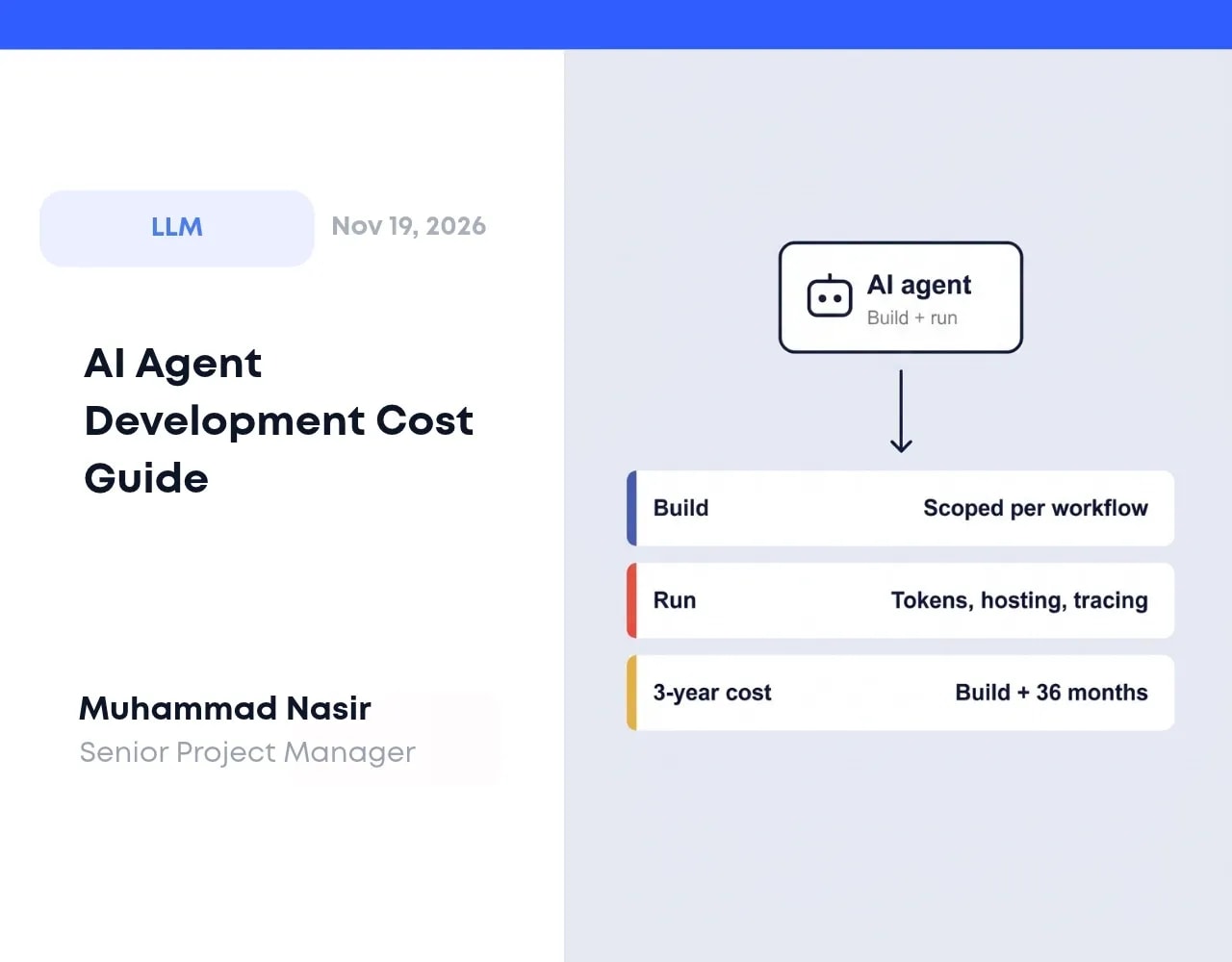
Pricing an AI agent is harder than pricing most software. The build is a one-time project, but the agent keeps spending money on every conversation, tool call and model update for as long as it runs.
This guide breaks cost down by stage, agent type and phase, then covers running and hidden costs, so you can check any quote from an AI Agent Development Company line by line.
How much does an AI agent cost in 2026?
Worldwide spending on AI agents and assistants is set to nearly double in 2026, as the chart below shows. For a single project, cost rises with each stage, from proof of concept to multi-agent system.
(Source: Gartner AI spending forecast, September 2026)
Proof of concept costs
A proof of concept tests one task on sample data, with no live integrations and an evaluation set. It is the cheapest stage and should answer one question: can the agent do this job reliably?
MVP agent development costs
An MVP puts the agent in front of real users with one or two integrations, basic guardrails and simple monitoring. Cost grows with each connected system and the number of users you support.
Production-grade single agent costs
A production agent adds full integrations, evaluation suites, role-based access, audit logs and live monitoring. This stage costs far more than an MVP, because testing and security work grow faster than new features.
Large multi-agent system costs
Multi-agent systems split work across specialist agents that hand off tasks and check each other. Every extra agent adds prompts, tests, coordination logic and token spend, so this is the most expensive stage to build.
What would your first AI agent cost?
Most teams get quotes that cover the build and miss the monthly bill. Share your use case and get a phased estimate with build, running and three-year costs. Call +1 408 365-4638 or email contact@folio3.ai.
Get an Estimate
What is AI agent development?
AI agent development is the work of building software that uses a language model to plan steps, call tools and act inside business systems toward a goal, within limits that people set and can audit.
AI agent development cost by agent type
Agent type sets the baseline before integrations or compliance are added. Simple reactive agents sit at the bottom of the range, while agents that plan, retrieve and coordinate with other agents cost the most.
Rule-based and reflex agents
These agents react to fixed conditions, such as routing tickets by keyword. They are the cheapest to build because there is little model work, but they break when inputs fall outside their rules.
A task agent reads a request and calls a few tools, such as a CRM lookup or a refund API. Each tool adds integration work, permission rules and test cases, so cost rises per tool.
RAG-based knowledge retrieval agents
Retrieval agents answer from your own documents through a vector database. Much of the budget goes to cleaning content, splitting it into chunks and testing whether answers match the source every time.
Goal and utility-based agents
These agents plan several steps and weigh trade-offs, like rebooking freight against cost and delivery date. Planning logic, rollback paths and human approval for risky actions make them far costlier than task agents.
Multi-agent orchestration system costs
Orchestrated systems coordinate specialist agents through frameworks such as LangGraph or CrewAI. Review companies that build multi-agent systems before shortlisting a vendor, since coordination bugs are costly to fix later.
AI agent development cost breakdown by phase
A build moves through seven phases, from discovery to the admin dashboard. Integrations and data preparation often take the most effort, so they deserve the closest look in any quote you receive.
Discovery and solution design
Discovery maps the workflow, success metrics, connected systems and risks before any code is written. It is a small share of the budget, and skipping it usually means automating the wrong steps.
Data preparation and pipelines
This phase cleans documents, labels examples and builds pipelines that keep the agent's knowledge current. Scattered files, duplicate records and missing labels all stretch it, and testing cannot start properly until it is done.
Model selection and prompting
The team compares models on accuracy, latency and token price, then writes prompts and builds retrieval. Picking the smallest model that passes your tests is the single biggest lever on later running costs.
Integrations are often the largest line in a build. Each connected system needs authentication, error handling and clear rules for what the agent may read, change or delete, and legacy systems take longest.
Evaluation, testing and guardrails
Test sets, red-teaming and guardrails catch wrong answers and unsafe actions before users do. The AI guardrails implementation cost guide breaks this layer down, and it is the last place to cut corners.
Deployment and AgentOps setup
Deployment covers hosting, CI/CD pipelines, tracing and cost dashboards. Good tracing shows every failed step and its token spend from day one, which makes later fixes and budget reviews much faster.
UI and admin dashboard
Users need a chat window, sidebar or API, and admins need screens to review logs and approve actions. Reusing an existing interface, such as Slack or a helpdesk, keeps this phase small.
Key factors that affect custom AI agent development cost
Six factors move most quotes up or down. Scope and autonomy set the size of the build, while model choice, integrations, data quality and compliance decide how much extra work each step needs.
Workflow scope and complexity
A narrow task costs a fraction of a branching process. Every extra decision point needs its own logic, test cases and fallback, which is why scope creep is the fastest way to inflate a budget.
Level of agent autonomy
An agent that suggests actions costs less than one that acts alone. Full autonomy needs stricter permissions, more testing, human approval steps for risky actions and a tested way to roll changes back.
LLM choice and token pricing
Model choice changes running cost sharply, and prices keep falling. The Stanford AI Index 2025 found the cost of GPT-3.5-level inference fell more than 280-fold in about 18 months, so recheck prices every quarter.
Number of system integrations
One or two modern APIs connect quickly. Older ERPs, custom databases and systems without APIs take far longer, because the team must build connectors, map messy fields and test every failure mode.
Data readiness and quality
Clean, labeled data shortens the build and the testing that follows. Scattered documents, outdated policies and duplicate records push cost up, and cleaning them often uncovers process gaps nobody had documented before.
Security, compliance and governance needs
Regulated data adds audit logs, access controls, data residency and outside reviews such as HIPAA or SOC 2 audits. Some model providers also charge more for regional processing, which belongs in the running budget.
Ongoing AI agent operating costs after launch
Running costs last as long as the agent works, and they grow fastest at scale. Only about two in ten McKinsey State of AI 2026 respondents have reached that scaling phase with AI agents.
LLM usage and token spend
Token spend rises with conversations, context length and tool calls. Agentic models use 5 to 30 times more tokens per task than a standard chatbot, so price models on full tasks, not single prompts.
Model | Input per 1M tokens | Output per 1M tokens |
Claude Opus 5.5 | $4.00 | $20.00 |
Claude Haiku 5.5 (prompts up to 100K tokens) | $0.10 | $0.50 |
GPT-6.2 Astra | $8.00 | $40.00 |
GPT-6.2 Sol | $2.00 | $10.00 |
(Source: Anthropic API pricing and OpenAI API pricing, November 2026)
Cloud hosting and vector databases
Hosting covers servers, storage and the vector database that holds your documents. Pinecone's Standard plan starts at a $50 monthly minimum with pay-as-you-go usage above it, while hosting scales with traffic.
Tracing tools show each step and failure. LangSmith's Plus plan costs $39 per seat a month with 10,000 base traces, yet only 44% of leaders in Deloitte's State of AI survey track per-unit inference cost.
Prompt tuning and model updates
Prompts drift as users, data and models change, and security patches never stop. Budget a fixed yearly amount for retuning prompts, rerunning evaluations and updating integrations, and review it after the first quarter live.
Average monthly running cost
Companies surveyed in July 2026 run about 11 agent workflows each, and those with cost visibility spend an average of $117,558 a month on inference and orchestration. Two in three overshot budget by over 10%.
(Source: IDC agent cost governance study, August 2026)
Hidden costs most AI agent budgets miss
These costs rarely appear in a first quote, yet they decide whether a project survives. Over 40% of agentic AI projects are forecast to be canceled by 2027, often over escalating costs or unclear value.
Hallucination control and red-teaming
Agents can invent facts or take wrong actions with full confidence. Red-teaming and grounding checks cost money upfront, and can AI go rogue explains why skipping them is a costly risk.
Edge cases and exception handling
Real users send half-finished requests, wrong order numbers and mixed languages. Handling these cases, plus clean handoffs to people, often takes as much effort as building the main path itself.
Model and API deprecations
Model providers retire versions and change APIs on their own schedule. Each forced migration means updating prompts, rerunning evaluations and retesting integrations, so leave room for it in every yearly budget.
Change management and user adoption
An agent nobody trusts saves nothing. Training, internal champions and phased rollouts cost time, but they turn a working build into a tool people actually use in their daily work.
Expert insight
“Most agent budgets that reach us were written for the demo, not year two. Tokens, evaluations and API fixes decide whether an agent pays back. Cost the run first, then size the build to fit it.”
Abdul Sami, Head of AI Development, Folio3 AI
AI agent development cost by industry
Regulation and the age of connected systems move cost most. The list below shows what typically raises the bill in each sector, which is why industry quotes vary so widely.
- Financial services: audit trails, model risk reviews and core banking integrations.
- Healthcare: HIPAA controls, EHR integrations and clinical review of answers.
- Insurance: claims and policy system integrations plus fairness checks; see custom AI agents for insurance.
- Legal: citation accuracy and strict confidentiality; compare legal AI agent providers.
- Manufacturing and supply chain: legacy ERP, warehouse and logistics data.
- Retail and ecommerce: order, inventory and helpdesk integrations at high volume.
AI agent development pricing models explained
How you pay matters as much as what you pay. Custom builds are usually fixed-price or billed by the hour, while ready-made agents charge per user, per conversation or per resolved outcome.
Fixed-price custom build contracts
You agree on scope and pay a set price in milestones. It suits stable requirements and clear success criteria, but later changes need paid change requests, so lock the scope before you sign.
Time and materials billing
You pay for hours worked at agreed rates, often with a monthly cap. It suits projects where requirements will change, but it needs weekly reporting so spend stays visible and tied to progress.
Per-seat SaaS agent subscriptions
Vendors charge a monthly fee per user. Microsoft 365 Copilot is listed from $30 on Microsoft's pricing page, and costs climb with headcount while customization stays limited to what the platform allows.
Usage-based and outcome-based pricing
Salesforce Agentforce charges $2 per conversation, and Intercom charges from $0.99 per Fin outcome. Pilots stay cheap, but a busy month can surprise finance, so agree volume caps before launch.
Custom vs off-the-shelf AI agents: cost comparison
Buying is faster for common tasks, while building pays off when the workflow is specific to you. The right answer depends on how standard your process is and how much control you need.
When off-the-shelf agents work
Ready-made agents suit common tasks such as meeting notes, basic support replies and FAQ answers. If your process looks like everyone else's, buying is usually faster and cheaper than a custom build.
When custom builds pay off
Custom builds pay off when the workflow is specific to you, touches internal systems or carries regulatory risk. You also keep control of your data, your running costs and your product roadmap.
In-house vs outsourced team costs
The US Bureau of Labor Statistics puts the median software developer wage at $135,980 (May 2025), before benefits and specialist premiums. Outsourcing swaps hiring time for a vendor rate, so compare total cost per feature.
How to build an AI agent development cost estimate: step by step
A defensible estimate starts with one workflow and ends with a three-year total. Follow these seven steps in order, and check each figure against published vendor prices before you sign.
- Define one measurable use case with a baseline.
- Map workflows and integrations, flagging legacy systems.
- Pick the autonomy level and smallest workable model.
- Estimate build effort by phase.
- Model monthly token spend from volume and published rates.
- Add compliance work and contingency.
- Calculate the three-year total with running costs and maintenance.
Worked example: customer support agent cost
Here is how the steps apply to a customer support agent at a SaaS or ecommerce company. The same method works for any agent: price the build, model the monthly run, then add three years.
Build cost
The build covers helpdesk, CRM and order system integrations, a cleaned help center for retrieval, refund and escalation rules, and an evaluation set of real past tickets. Integration count moves this figure most.
Monthly running cost and token math
Multiply daily conversations by tokens per conversation, including tool calls and retrieved context, then by 30 and the model's published rate. Add hosting, vector storage and tracing fees from the vendor pricing above.
Three-year total cost of ownership
Add the build cost to 36 months of running costs and yearly maintenance. At high volume, running costs can overtake the build, which is why the run should be costed first.
Need a support agent costed for your volumes?
Conversation volume, integrations and model choice change the numbers fast. Folio3's AI agent developers can scope your agent and model its token spend before you commit. Call +1 408 365-4638 or email contact@folio3.ai.
Talk to AI Agent Developers
How to reduce AI agent development costs
Most savings come from smaller scope, cheaper models for simple steps and fewer repeated calls. Each of these tactics cuts either the upfront build or the monthly bill without lowering answer quality.
Start with a narrow MVP
Launch one workflow for one team first. A narrow MVP proves accuracy and adoption early, so you only pay to scale what works and avoid funding features nobody uses after launch.
Mix open-source and proprietary models
Open-source models handle classification, extraction and routing cheaply when self-hosted at steady volume. Keep frontier models for hard reasoning, and test both on the same evaluation set before choosing the final mix.
Route tasks to cheaper models
A router sends simple requests to small models and hard ones to large models. Small models cost a fraction of frontier rates, and an AI Gateway Solution applies routing rules and spend caps automatically.
Cache prompts and repeated responses
Repeated system prompts and shared context can be cached and billed at a small share of the normal input rate. Paired with batch jobs, LLM cost optimization like this cuts the cost of repeat calls.
Common AI agent budgeting mistakes
These mistakes show up again and again in agent budgets. Each one is cheap to avoid during planning but expensive to fix once the agent is live and real users depend on it.
- Budgeting only for the build: running costs never stop.
- Ignoring token costs at scale: pilot bills grow with every user.
- Skipping evaluation and guardrails: saved weeks become months of fixes.
- Automating a broken process: an agent only speeds up a bad workflow.
- No production success metrics: without a baseline, nobody can prove payback.
How Folio3 AI can help
Folio3 AI builds custom agents that start with one costly workflow and report results against its baseline before scaling. For several agents, Folio3's AI Transformation Services rank workflows by likely payback.
Budgeting an AI agent you can actually run
A reliable AI agent budget covers three years, not just the build. Start with one measurable workflow, price each phase against published vendor prices and model token spend at full volume before signing anything.
Ready to price your AI agent properly?
A budget that covers three years keeps your agent running after launch. Book a consultation to map one workflow, its costs and its payback. Call +1 408 365-4638 or email contact@folio3.ai.
Book a Consultation
FAQs
How much does it cost to build an AI agent?
Build cost depends on scope, integrations, autonomy and compliance work, so a proof of concept costs a fraction of a regulated multi-agent system. Scoping one workflow and pricing each phase gives the most reliable figure.
How much does an AI agent cost per month to run?
Monthly cost covers tokens, hosting, vector storage and monitoring, so it scales with traffic and model choice. Small models cost a fraction of frontier models per token, which makes routing the biggest saving.
How long does it take to build an AI agent?
A focused proof of concept on one workflow usually takes a few weeks. Production agents with several integrations, evaluation suites and compliance reviews take several months, and multi-agent systems take longer still.
Is it cheaper to build or buy an AI agent?
Buying is cheaper for common tasks that ready-made agents already handle well, such as FAQ replies. Building pays off for specific, integrated or regulated workflows where you need control of data and costs.