Updated October 2026 · By the Folio3 AI Editorial Team · Reviewed by Abdul Sami, Head of AI Development
Based on Folio3’s planning model, implementing AI guardrails costs roughly $15,000 to $75,000 a year for a startup, $150,000 to $350,000 for a mid-market company, and $500,000 to $2.5 million or more for an enterprise. Your final number depends on request volume, how many policies you run, and how much compliance evidence you need. Compare that with IBM’s 2025 figures: an average US breach costs $10.22 million, and high shadow AI usage adds about $670,000 more per breach.
This guide covers what guardrails cost, the pricing models and techniques behind the bill, hidden costs, build vs buy, and a simple formula to estimate your own budget. To see a working setup, visit our AI Guardrails Platform.
What is the average cost of implementing AI guardrails?
Costs vary widely, but most organizations fall into predictable bands based on how many AI apps they run and how regulated their industry is.
Quick answer: typical cost ranges
Using Folio3’s planning model, a startup running one or two AI features in 2026 can expect to spend $15,000 to $75,000 per year on guardrails. Mid-market companies land around $150,000 to $350,000. Large enterprises with multiple production AI systems can exceed $1 million annually once platform licensing, personnel, audits, and infrastructure are added.
Cost ranges by company size
Company size | Platform fees ($) | Implementation ($) | Usage fees ($) | Annual total ($) |
Startup (1-2 apps) | 2,000-8,000/mo | 10,000-25,000 | 500-3,000/mo | 15,000-75,000 |
Mid-market (5-15 apps) | 8,000-20,000/mo | 40,000-120,000 | 3,000-12,000/mo | 150,000-350,000 |
Enterprise (20+ apps) | 20,000-80,000/mo | 150,000-500,000 | 12,000-60,000/mo | 500,000-2,500,000+ |
How we estimated these ranges
These are Folio3 planning estimates, not industry benchmarks. They combine:
- published cloud usage pricing, such as AWS Bedrock Guardrails, where available
- assumed request volumes
- assumed number of policies per request
- illustrative engineering rates
- implementation effort assumptions
- estimated ongoing monitoring and maintenance
Actual pricing varies materially by architecture and vendor. Figures marked “Folio3 planning assumption” throughout this guide come from the same model.
One-time vs recurring costs
One-time costs cover discovery, policy design, integration, and initial red teaming. In our planning model, these run 20% to 40% of the first-year budget (Folio3 planning assumption). Recurring costs include platform subscriptions, usage-based inference, monitoring, audit retainers, and the people who maintain all of it. Plan for recurring costs to make up the bulk of year two and beyond.
What will AI guardrails cost for your setup?
Tell us about your models, user count, and the data your teams handle, and we'll help you scope a realistic budget and timeline before you commit to a build or a platform. Call +1 408 365-4638 or email contact@folio3.ai.
Get a Cost Estimate
What AI guardrails costs actually cover
A guardrail bill is rarely one line item. It is usually six layers of protection running side by side, and each layer is priced on a different unit: characters scanned, models hosted, seats, tool calls, or gigabytes stored. That is why two quotes for “AI guardrails” can differ several-fold, and both still be honest. Knowing which layer drives your bill tells you where to negotiate and where to optimize.
Input filtering inspects every prompt before it reaches the model. It catches:
- direct prompt injection
- indirect injection hidden inside retrieved documents, emails, or web pages
- jailbreak patterns
- requests that break your acceptable-use policy
The cost depends on how detection works:
- Keyword and regex rules cost almost nothing to run.
- A small injection classifier adds little latency and very little compute.
- An LLM-based classifier brings its own inference bill on every request.
The detail most budgets miss is retrieved context. In a RAG application, a 200-character user question can pull 6,000 characters of documents into the prompt. Indirect injection hides in exactly that content, so it needs scanning too, and per-character pricing bills all of it.
Main cost driver: characters scanned per request, including retrieved context.
Output and content moderation
Output moderation checks every response before the user sees it. Typical checks include:
- toxicity and bias
- off-topic answers
- brand safety and competitor mentions
- grounding, meaning whether the answer is supported by your source documents
This layer is often the most expensive, for three reasons:
- Responses are usually longer than prompts.
- Grounding checks scan the source, the question, and the answer together.
- Streaming adds a trade-off. You either buffer the full response before checking it, which adds latency, or you check it in chunks, which multiplies the number of calls.
Main cost driver: response length, number of checks, and whether you stream.
PII and data protection
This layer finds and masks personal data in both directions. It stops names, account numbers, and health records from leaving your boundary inside prompts, and it stops them from reappearing in outputs. Organizations handling personal, health, or payment data may need controls that prevent unauthorized disclosure to satisfy applicable privacy, security, and contractual obligations under regimes such as GDPR, HIPAA, and PCI DSS. Vendors often sell this capability as a separate module.
Price varies with four choices:
- Entity coverage. How many entity types you need to detect.
- Languages. How many languages you need to support.
- Masking method. Simple redaction is cheapest. Reversible tokenization, which lets authorized systems restore the original value, needs a secure vault and adds infrastructure.
- Data residency. Residency rules can force a regional or self-hosted deployment, which often costs more than a shared cloud service.
Main cost driver: entity coverage, language support, masking method, and residency requirements.
Agents do more than generate text. They call APIs, query databases, update records, and send emails. Guardrails at this layer authorize each action before it runs:
- which tools the agent may use
- which parameters are allowed
- what spending or record limits apply
- which actions need a human to approve them
This layer multiplies volume quickly. One agent task can trigger a dozen or more tool calls, and each call needs its own check. Approval workflows also add a people cost that doesn’t show up on any vendor invoice. Because the category is newer and the risk is higher, vendors often price it at a premium.
Main cost driver: tool calls per task and the number of human approval steps.
Usage, rate, and budget controls
These controls set limits per user, team, application, or API key:
- token caps
- request rate limits
- spend limits
This is the cheapest layer to run, and it is usually bundled into your AI gateway rather than sold on its own. It also tends to pay for itself fastest. It stops runaway agent loops, misconfigured batch jobs, and “denial of wallet” attacks before they turn into a five-figure invoice.
Main cost driver: usually included in gateway pricing; sold standalone, it is priced per gateway or per request.
Monitoring and audit logging
Dashboards, alerting, request traces, and audit trails turn guardrails into evidence you can show an auditor. Storage is where the cost builds:
- Raw volume. An app handling 1 million requests a month, averaging 4,000 characters of prompt and response, produces about 4 GB of raw text every month. That is before metadata, traces, and indexes.
- SIEM ingestion. Many SIEM tools charge per gigabyte ingested, so log volume becomes a direct cost.
- Retention. Under the EU AI Act, deployers of high-risk systems must keep automatically generated logs for at least six months. Sector rules in finance and healthcare often require much longer.
Decide early what you log in full, what you hash or truncate, and what you only sample.
Main cost driver: log volume, retention period, and SIEM ingestion fees.
In most deployments, two things decide which layer grows fastest. Output moderation and logging grow with request volume. Agent controls grow with how much autonomy you give the AI. Budget for the layer that matches how your AI will actually scale.
Key factors that drive AI guardrails costs
Two companies with the same headcount can spend very different amounts on guardrails. These six factors explain most of the gap.
Number of AI applications
Each app needs its own risk assessment, policies, and monitoring. The first app costs the most, and later apps get cheaper only if they share one policy layer.
Cost impact: Separate setups per team make cost grow almost one-for-one with every new app.
Request volume and latency targets
Usage-based pricing means volume sets your baseline spend. Latency decides which checks you can use: a few hundred milliseconds is fine for a batch job but too slow for a voice agent.
Cost impact: Tight latency budgets push you toward small classifiers that need dedicated capacity.
Number and complexity of guardrail policies
Cloud services usually bill per policy, per request. A standard toxicity filter works out of the box, while custom policies need definitions, test data, and regular tuning.
Cost impact: Thirty custom policies become an ongoing maintenance program, not a one-time setup.
Regulatory and compliance requirements
HIPAA, GDPR, PCI DSS, and the EU AI Act shape what your controls must prove, not just what they block. That means longer log retention, documented decisions, and external audits. See our AI implementation cost guide for the full budget picture.
Cost impact: Recurring audit and evidence costs that never fully go away.
Model and deployment architecture
Hosted APIs like GPT or Claude mean pay-per-request guardrails with no infrastructure to run. Self-hosted models like Llama lower per-request cost at scale but add GPU and maintenance work.
Cost impact: Running both doubles your guardrail patterns unless a gateway unifies them.
Integration with existing systems
Guardrails need to connect to SSO, your SIEM, DLP rules, and ticketing.
Cost impact: Days to weeks of engineering per connection, and older systems take the longest.
Factor | What raises cost | What keeps it down |
AI applications | Separate guardrails per app | One shared policy layer |
Volume and latency | LLM judges on every request | Small classifiers, tiered checks |
Policies | Many custom policies | Standard policies first, custom only where needed |
Compliance | Long retention, frequent audits | Logging decisions made upfront |
Architecture | Mixed hosted and self-hosted setups | A gateway that covers both |
Integrations | Legacy or custom systems | Standard connectors |
AI guardrails pricing models explained
Vendors structure pricing in a few predictable ways. Knowing which model you are buying into matters more than the sticker price.
Per-request or text-unit pricing
Common for cloud-native services. You pay per 1,000 characters or per policy check. AWS Bedrock Guardrails, for example, prices each safeguard separately per 1,000 text units, where one text unit is up to 1,000 characters:
AWS Bedrock safeguard | Current published price |
Content filters | $0.15 / 1K text units |
Denied topics | $0.15 / 1K text units |
Sensitive information filters | $0.10 / 1K text units |
Contextual grounding checks | $0.10 / 1K text units |
Automated Reasoning checks | $0.17 / 1K text units, per policy |
Multiple enabled safeguards can stack charges on the same request, so rates compound quickly when you run five or six policies on every request.
Azure AI Content Safety is also usage-based, billed per 1,000-character text record, with pricing that varies by capability and region. Check Azure’s pricing calculator for current rates in your region.
Commercial guardrail platforms, including our AI Guardrails Platform, charge a flat monthly or annual fee. For budgeting, we assume $2,000 to $25,000 per month (Folio3 planning assumption); actual quotes vary widely by vendor. The fee usually scales with the number of apps, request volume, and features like custom policies or on-premises deployment. Most contracts include a request allowance, with overage charges above it.
What to check: the overage rate, and whether audit logs and policy management are included or sold as add-ons.
Per-seat pricing for employee AI usage
Tools that govern how employees use ChatGPT, Copilot, and internal assistants usually charge per user per month. For budgeting, we assume $8 to $30 per seat (Folio3 planning assumption). Visibility-only tiers, which show who uses which AI tools, sit at the low end. Real-time redaction and blocking push the price up.
What to check: whether contractors and inactive accounts count as seats.
Open source with paid tiers
Frameworks like Guardrails AI and NVIDIA NeMo Guardrails are free to license, but not free to run. You still pay for hosting, engineering time, and any LLM calls the framework makes to evaluate content. Paid tiers add managed hosting, dashboards, and enterprise support.
What to check: how many model calls each check triggers, since that becomes your real per-request cost.
Implementation and professional services fees
Setup work is billed hourly or as a fixed-fee package. For budgeting, we assume $200 to $400 per hour, or fixed-fee packages between $25,000 and $150,000 (Folio3 planning assumption). That covers policy design workshops, integration with your gateway and security stack, and initial red teaming. Fixed fees are easier to budget, but read the scope carefully, because retuning after launch is often excluded.
What to check: whether post-launch tuning and policy changes are included.
How much does each guardrail technique cost?
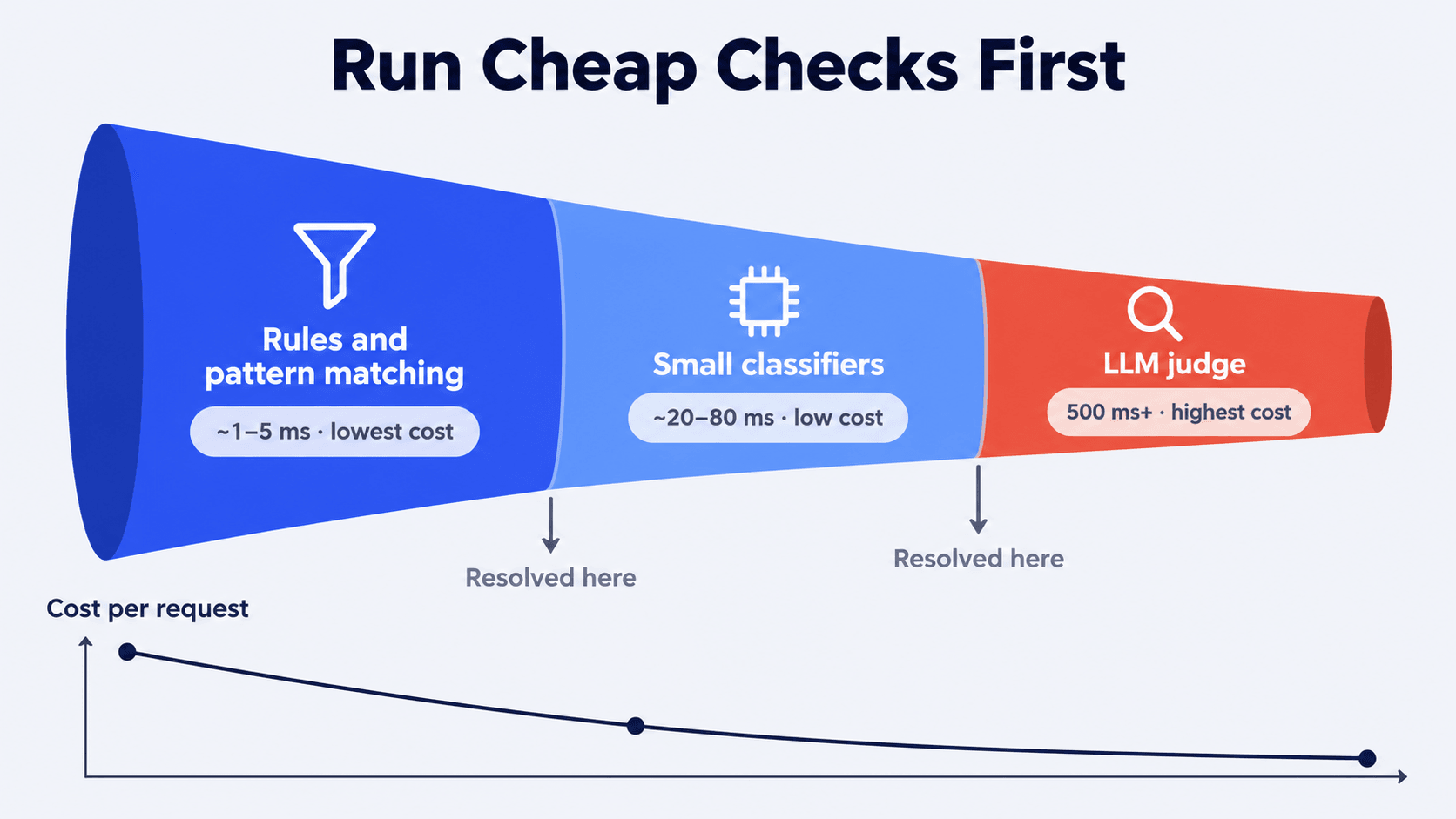
Each technique trades cost, latency, and accuracy differently. Production systems rarely rely on one. They layer cheap checks first and run expensive checks only when needed.
Prompt-engineered guardrail rules
This approach adds safety instructions to the system prompt. It looks free, but you pay in tokens on every request.
Illustrative example: This assumes 300 incremental input tokens per policy, 1 million requests a month, and $5 per million input tokens. Under those assumptions, each policy adds $1,500 a month, so ten policies add $15,000. Treat this as an illustration of how token overhead scales, not a benchmark.
Prompt caching can cut that, but it doesn’t fix the bigger problem: the model can ignore these instructions, and a successful prompt injection can override them.
Best for: tone and scope guidance. They don’t count as enforcement.
LLM-as-a-judge checks
A second model reviews the prompt, the response, or both against your policies. LLM judges can handle more nuanced policy evaluation than deterministic rules, but their accuracy must be validated against a labeled test set for the specific policy. Because the judge reads the full exchange, a frontier-class judge on every request can cost as much as the main model call or more, and it adds noticeable latency to each check.
Best for: high-risk flows, escalations, and sampled audits rather than every request.
Self-hosted open-source guard models
Safety models like Llama Guard 3 and ShieldGemma run on your own infrastructure, so prompts never leave your environment. The smaller variants run on mid-range GPUs, and a dedicated cloud GPU costs anywhere from several hundred to a few thousand dollars a month, depending on GPU class and provider. Per-request cost gets close to zero only when that GPU stays busy, because idle capacity is billed the same as active capacity.
Best for: high, steady volume and strict data residency requirements.
Small classifier and SLM guardrails
Purpose-built classifiers under 1 billion parameters handle narrow tasks like PII detection, toxicity scoring, and injection detection. Many can run on CPUs with low latency, which often makes them the cheapest accurate option for narrow tasks at scale. The trade-off is scope: each model does one job well, and custom categories need labeled training data.
Best for: high-volume, latency-sensitive checks that run on every request.
Deterministic rules and pattern matching
Regex, keyword lists, and format validators. Nearly free to run but brittle. Good for a first-pass filter before more expensive checks.
Technique | Cost tendency | Latency tendency | Best fit |
Deterministic rules | Very low | Very low | Exact patterns, first-pass filtering |
Prompt rules | Token overhead on every request | Minimal | Tone and scope guidance, not enforcement |
Small classifiers | Low | Low | Narrow, high-volume detection |
Self-hosted guard models | Infrastructure-driven | Moderate | High, sustained volume |
LLM judge | High | Highest | Nuanced, high-risk evaluation |
Real latency depends on hardware, model, batch size, network, deployment, and text length, so benchmark candidate checks on your own traffic before committing.
AI guardrails implementation cost breakdown
Implementation is where budgets usually overrun. Licensing is predictable, but the hours spent on policies, integrations, and testing rarely are. Here is where that effort goes.
Discovery and policy design
This phase builds an inventory of every AI use case, including tools teams adopted without IT approval, and gives each one a risk tier. Security, legal, and business owners then agree on what each policy allows, masks, or blocks. The output is a policy matrix that engineers can actually implement. For a mid-market company, we plan for 40 to 120 hours (Folio3 planning assumption).
Watch for: skipping the inventory step. Every AI app you miss here becomes an unprotected gap later.
Integration and engineering effort
This is where guardrails get wired into the request path, either centrally through an AI gateway or app by app through SDKs. Engineers also connect logging, alerting, and identity, so every check is tied to a user. Plan for streaming responses, too. Each app also needs a fail-open or fail-closed decision: whether it keeps running or stops when the guardrail service goes down. We plan for 80 to 300 hours per application for the first few (Folio3 planning assumption). That drops as reusable patterns emerge, and drops fastest when a gateway handles the integration once for every app.
Watch for: making the fail-open or fail-closed call app by app instead of once, centrally.
Testing, red teaming, and CI/CD checks
Start with an evaluation set of real user prompts mixed with known attacks. That one set measures two things: what gets through, and what gets blocked by mistake. Run it automatically in CI whenever a policy, prompt, or model changes, so regressions surface before release. For external red team engagements, we budget $25,000 to $150,000 each (Folio3 planning assumption). Schedule them around major model upgrades and new agent capabilities, not just fixed dates on the calendar.
Watch for: measuring only blocked attacks. A false positive rate nobody tracks gets paid for in support tickets and user workarounds.
Infrastructure and compute overhead
This line covers GPU capacity for self-hosted guard models, extra inference for judge models, and storage for logs and traces. For deployments built on small classifiers and tiered checks, it usually stays a modest share of base model spend. Running an LLM judge on every request pushes it much higher.
Watch for: idle GPU capacity. You pay for a provisioned GPU whether or not traffic is running through it.
Ongoing tuning and maintenance
Guardrails degrade over time. Model upgrades change how outputs look, new jailbreak techniques appear, and business rules shift. Keeping up means reviewing false positives, adjusting thresholds, and adding policies as new use cases launch. We budget 15% to 25% of the initial implementation cost every year (Folio3 planning assumption).
Watch for: having no named owner. Policies without an owner drift quietly until an audit or incident exposes them.
Most pricing calculators hide the math. Here is the formula we use when scoping guardrail budgets.
Monthly guardrail cost = (requests × text units × policies × per-unit rate) + infrastructure + people + platform fees
Worked example: 1 million requests per month
Illustrative example. A support chatbot handles 1 million requests per month. Average prompt plus response is 2,000 characters, or 2 text units of 1,000 characters each. You run 4 policies on each request at an illustrative rate of $0.40 per 1,000 text units per policy. That is deliberately conservative: the published rates for individual AWS Bedrock safeguards are lower.
Usage cost: 1,000,000 × 2 × 4 × $0.0004 = $3,200/monthPlatform subscription: $6,000/monthOne AI governance engineer: $15,000/month fully loadedInfrastructure and logging: $1,200/month
Monthly total: roughly $25,400, or about $305,000 per year.
Skip the custom build and its hidden costs
AI Guardian gives you prompt injection blocking, sensitive data masking, role-based policies, and a full audit trail out of the box, deployed inside your own Azure or AWS environment. Call +1 408 365-4638 or email contact@folio3.ai.
Explore AI Guardian
How the number changes at 10x volume
Scale that chatbot to 10 million requests and usage cost jumps to $32,000 per month. Platform fees might tier up to 12,000, and you probably need a second engineer (30,000 for two). Infrastructure and logging grow too, but even if they stayed flat, monthly cost reaches about $75,200, or roughly $900,000 per year. Usage-based pricing is the piece that scales fastest, which is why volume projections matter so much when you pick a vendor.
Hidden costs of AI guardrails
The vendor invoice is usually the smallest part of what guardrails really cost. The rest shows up in your LLM bill, your support queue, and your team’s calendar.
Token and inference overhead
Every safety instruction in a prompt adds tokens, and every judge model runs its own inference. With classifier-based, tiered checks, the overhead stays modest. With prompt-based rules or an LLM judge on every request, it can become a significant share of your base LLM bill. Our LLM cost optimization guide covers ways to keep it in check.
Where it hides: inside your model provider’s invoice, not your guardrail vendor’s.
Added latency per request
Every guardrail layer adds latency. Half a second of extra delay is noticeable in chat and unacceptable in voice. To stay within latency budgets, teams end up running checks in parallel, provisioning dedicated capacity, or moving some checks to run asynchronously after the response. Each of those workarounds costs money.
Where it hides: in infrastructure upgrades made to win back speed.
False positives blocking users
An over-strict guardrail blocks legitimate work. For example, at a 2% false positive rate, an app handling 1 million requests a month wrongly blocks 20,000 of them. Each one becomes a frustrated user, a support ticket, or an employee who quietly switches to an unapproved AI tool.
Where it hides: in support costs, lost productivity, and growing shadow AI.
Human review and escalation queues
High-risk outputs in lending, healthcare, or legal workflows often need human sign-off. As an illustration, one full-time reviewer at $40 an hour costs about $83,000 a year. If each reviewer clears roughly 200 items a day, 1,000 daily flags means five reviewers.
Where it hides: in headcount, which scales with flag volume.
Policy drift and retuning
Your model provider ships an update, and a policy that worked last month starts missing cases or blocking too many. You don’t control that timing, but you pay for every round of revalidation. We plan for 10 to 20 hours per policy per quarter (Folio3 planning assumption).
Where it hides: in unplanned engineering time after every model update.
Internal staff and training time
Engineers, product managers, legal, and compliance all need to understand what the guardrails do and how to respond when one fires. We plan for 100 to 300 hours of first-year training and enablement across teams (Folio3 planning assumption).
Where it hides: spread across departments, so no single budget owns it.
Build vs buy: comparing AI guardrails costs
Most teams end up choosing between four paths. What separates them is less the year-one price and more who carries the maintenance burden in year two and beyond. The figures below are illustrative scenarios from Folio3’s planning model, not market averages.
Building custom guardrails in-house
You own the roadmap, the policies, and the IP. In our illustrative scenario, year one costs $300,000 to $800,000 once you add up two dedicated engineers, infrastructure, and the research time spent defining what “safe” means for your use cases. Year two settles at $150,000 to $300,000. That ongoing cost never disappears, because new attack techniques and model updates keep coming.
Makes sense when: your use case is unusual enough that no vendor’s policy model fits.
A platform cuts deployment from months to weeks and moves threat research onto the vendor. In the same scenario, all-in cost for a mid-market team is $80,000 to $250,000 a year. The trade-off is flexibility: you work within the vendor’s policy engine and roadmap.
Makes sense when: you need coverage across several apps quickly, with audit-ready logs.
Using cloud-native guardrail services
AWS Bedrock Guardrails, Azure AI Content Safety, and Google Vertex AI safety filters are the fastest start if you already run on that cloud. Usage-based pricing stays cheap at low volume but grows with every request and every policy you enable. Policies also don’t carry over between clouds, which hurts in multi-cloud or multi-model setups.
Makes sense when: you run one cloud, one model provider, and moderate volume.
Hybrid approach cost profile
A hybrid architecture can combine:
- small classifiers or open-source guard models for high-volume checks
- a central platform or gateway for policy management and audit
- cloud-native filters for specific compliance needs
In our scenarios, total cost lands between buying and building. Coverage can be the strongest of the four, as long as one control layer keeps all the policies consistent.
Makes sense when: you run multiple apps, models, and risk tiers at the same time.
Total cost of ownership comparison
Illustrative TCO scenarios using Folio3 planning assumptions
Approach | Year 1 cost | Year 2 cost | Time to deploy | Flexibility |
Build in-house | 300K-800K | 150K-300K | 6-12 months | High |
Buy platform | 80K-250K | 80K-250K | 4-10 weeks | Medium |
Cloud-native only | 20K-150K | 20K-150K | 2-6 weeks | Low |
Hybrid | 120K-400K | 100K-300K | 6-16 weeks | High |
Your costs will vary with architecture, vendor, and compliance scope.
If you want to skip the build phase, our AI Guardrails Platform is designed to drop into an existing stack in weeks rather than months.
Per-app guardrails vs a central AI gateway: the cost of fragmentation
This is one of the most common and most expensive guardrail mistakes.
Why per-app guardrails multiply engineering cost
When each team bolts guardrails onto their own app, you pay for the same work over and over. Different policies, different logging formats, different vendors. Updates require touching every app.
Inconsistent policies and duplicate audit trails
Compliance teams cannot answer basic questions like “does every AI app in this company redact PII the same way?” Audits take longer, and inconsistent controls increase regulatory exposure.
How one gateway spreads the cost across every app and agent
A central gateway lets you write a policy once and apply it everywhere. New apps inherit guardrails on day one. Our guide on Kong AI Gateway alternatives walks through what to look for in a gateway layer.
AI guardrails cost examples by use case
Guardrail spend follows risk, not company size. Dollar figures vary too much by architecture and vendor to quote as typical, so here is what drives cost in four common deployments instead.
Use case | Main cost driver |
Employee assistant | Number of users, PII controls, access policy |
Support chatbot | High request volume, output checks |
Regulated workflow | Logging, evidence, human review |
Agentic system | Tool-call authorization and action tracing |
Internal employee AI assistant
Risk is low, and volume is moderate. Spend goes mostly to PII redaction, shadow AI visibility, and per-seat usage controls, because the main exposure is employees pasting sensitive data into prompts. Cost scales with headcount more than with traffic.
Customer-facing support chatbot
Risk is medium, and volume is high. Output moderation, brand safety, and grounding checks run on every response, so usage-based fees scale directly with conversation volume. This is where tiered checks and caching save the most.
Regulated finance or healthcare workflows
Risk is high, and volume is moderate. Here, cost is driven by compliance rather than traffic. Full PII and PHI controls, human review queues, long log retention, and regular external audits make up most of the bill.
Multi-agent and agentic AI systems
These systems carry the highest risk, because agents take actions rather than just generating text. Tool-call authorization, approval workflows, and step-by-step audit trails multiply both checks and logs. Our analysis of when AI can go rogue explains why agentic systems need thicker guardrails.
The cost of skipping AI guardrails
Guardrails are easier to justify once you compare their cost with a single serious incident.
Data breach exposure costs
IBM’s 2025 Cost of a Data Breach Report puts the average US breach at a record $10.22 million. AI widens that exposure. Organizations with high levels of shadow AI paid about $670,000 more per breach. And 97% of organizations that had an AI-related security incident lacked proper AI access controls.
Regulatory fines and penalties
Under the EU AI Act, prohibited AI practices carry fines of up to €35 million or 7% of global annual turnover. Breaches of most other obligations, including high-risk system requirements, reach €15 million or 3%. Our AI governance and compliance readiness guide explains what each tier means in practice.
Shadow AI and unmanaged usage
Employees paste customer data into public chatbots, and teams build tools on personal API keys. You can’t put guardrails on usage you can’t see. Network, endpoint, and SaaS discovery, combined with governed-access controls, can reduce that visibility gap. Our Shadow AI Detection Platform helps surface unmanaged usage, and AI Guardian provides the governed path for AI interactions routed through it. For background on the problem itself, see what shadow AI is and how to control it.
Reputational and operational damage
One public failure, like a biased screening tool or a chatbot leaking customer data, can cost more in lost trust than years of guardrail spend. It also usually forces an emergency rollback of the AI program behind it. Our AI Governance Software is built to catch these issues before they reach production.
How to reduce AI guardrails implementation cost
Spending less doesn’t mean protecting less. It means matching how strict each check is to the risk it covers.
Step 1: Map risks to use cases
Score each AI app on three questions: what data it touches, who sees the output, and whether it can take actions. An internal doc summarizer and a loan approval tool shouldn’t run the same policy set.
Step 2: Prioritize high-risk applications first
Assign each risk tier a fixed control set, for example, basic PII masking for internal tools and the full stack plus human review for regulated flows. New apps then pick up the right controls by tier instead of needing a fresh design project.
Step 3: Use tiered guardrail checks
Run checks in order of cost: rules first, classifiers next, and an LLM judge only for the uncertain or high-risk remainder. If most requests are settled in the first two tiers, the expensive judge runs on only a small slice of traffic.
Step 4: Apply lightweight classifier models
Narrow classifiers for PII, toxicity, and injection detection can often run on CPUs with low latency. Use them as the default layer, and save larger models for checks that need judgment, like grounding or policy nuance.
Step 5: Use graduated actions instead of hard blocks
Match the response to the severity: log it, flag it, redact it, warn the user, and block only as a last resort. Every unnecessary block creates a support ticket or pushes a user toward an unapproved tool.
Step 6: Centralize policies through one gateway
Write each policy once and enforce it for every app, agent, and model provider. Engineering effort, audit evidence, and policy updates then scale with the number of policies, not the number of apps.
Step 7: Cache, batch, and monitor cost per request
Cache results for repeated prompts and retrieved documents, and batch moderation for non-interactive workloads. Track guardrail cost per request and false positive rate side by side, because cutting one at the expense of the other isn’t real savings.
How Folio3 AI can help
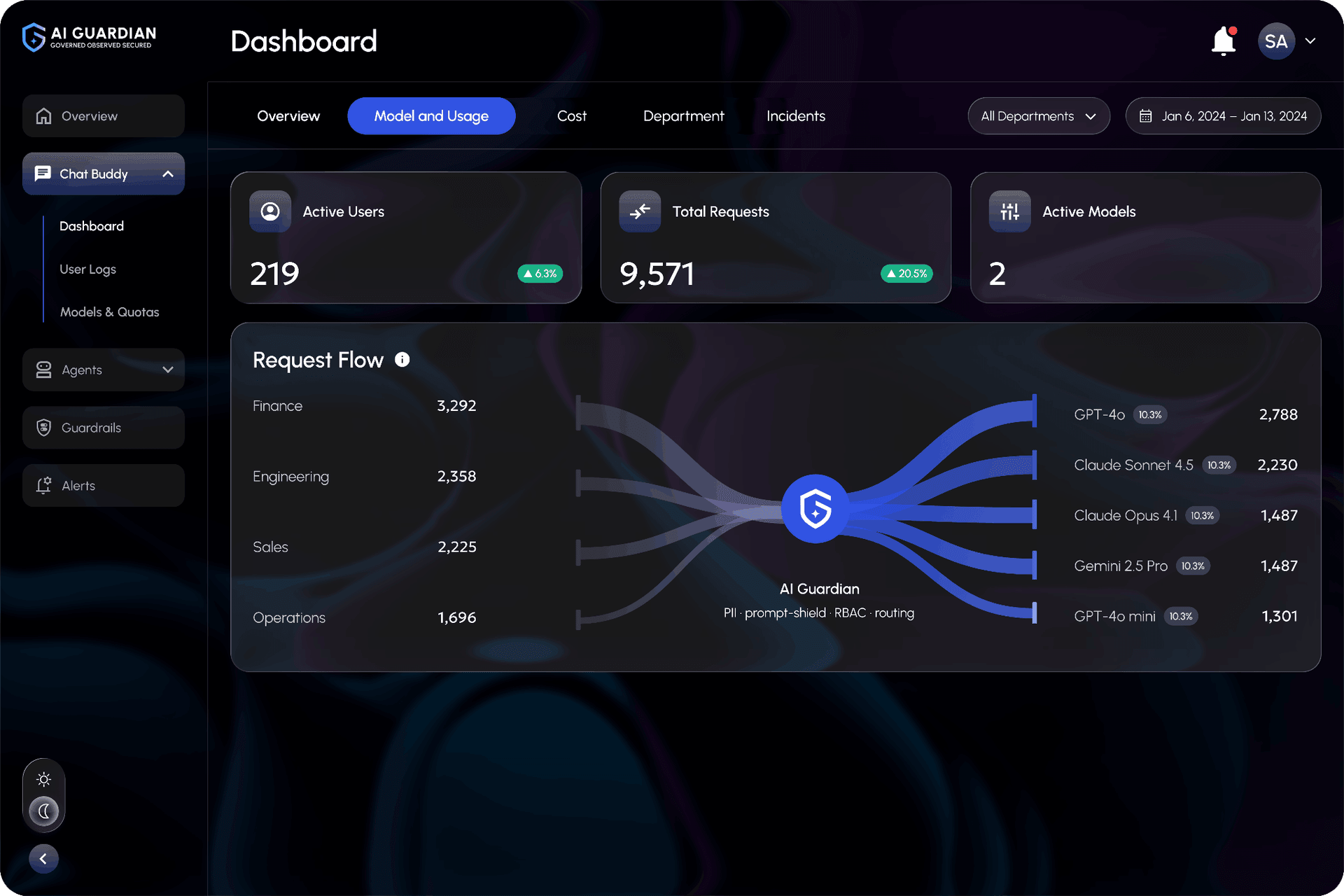
Our AI Guardian product gives you one control point for guardrails, shadow AI visibility, and cost controls across the AI apps and agents routed through it. Instead of stitching together six vendors and hoping your audit trail holds up, you get one policy layer, one dashboard, and one bill.
Expert insight
“The cost conversation around guardrails usually gets stuck on licensing fees, but the real driver is architectural. Teams that bolt safety onto each app individually end up paying three or four times more than teams that run everything through one policy layer. Before you compare vendor quotes, decide where guardrails live in your stack. That decision affects your bill more than any discount a vendor will offer.”
Abdul Sami, Head of AI Development
Budgeting for AI guardrails without overspending
The companies spending wisely on guardrails in 2026 share three habits. They start with a risk inventory before buying anything. They centralize policies through one gateway instead of letting each team pick a vendor. They treat guardrails as an operating cost tied to AI usage, not a one-time project. Do those three things and your budget will track your actual risk, not vendor marketing. Skip them, and you will find out what guardrails cost after you needed them, which is always the most expensive version of the answer.
Not sure whether to build or buy your guardrails?
A short conversation can save months of engineering effort. Our team will look at your AI use cases, compliance needs, and existing stack, and tell you honestly which approach costs less over time. Call +1 408 365-4638 or email contact@folio3.ai.
Book a Consultation
FAQs
How much do AI guardrails cost per month?
Based on Folio3’s planning estimates, startups spend roughly $1,250 to $6,000 per month, mid-market companies $12,000 to $30,000, and large enterprises $40,000 to $200,000 or more. Actual costs vary materially with volume, architecture, and compliance scope.
Are open-source AI guardrails really free?
The software is free. Running it is not. You still pay for GPU or CPU infrastructure, engineering time, maintenance, and any LLM calls the framework makes. In our planning model, that adds $50,000 to $200,000 per year (Folio3 planning assumption).
Do AI guardrails increase LLM costs?
Yes. Prompt-based rules add tokens to every request, and LLM-as-judge checks add a second inference call. The increase stays modest with classifier-based, tiered checks and grows sharply when a large judge model reviews every request.
How long does AI guardrails implementation take?
In our planning model, a cloud-native setup takes 2 to 6 weeks, a commercial platform rollout 4 to 10 weeks, and a custom build 6 to 12 months (Folio3 planning assumptions). Integration complexity and compliance scope move these timelines most.
Is it cheaper to build or buy AI guardrails?
In our illustrative scenarios, buying costs less over the first two years. Building tends to make sense only when your use case is unusual enough that no vendor’s policy model fits.
How much does Amazon Bedrock Guardrails cost?
Bedrock Guardrails charges per policy, per 1,000 text units, where one text unit is up to 1,000 characters. Content filters and denied topics cost $0.15 per 1,000 text units each. Sensitive information filters and contextual grounding checks cost $0.10 each, and Automated Reasoning checks cost $0.17 per policy. Because every policy you enable is billed separately, a workload running four policies pays for all four on every request.
Do AI guardrails pay for themselves?
For regulated industries and customer-facing apps, usually yes. IBM puts the average US breach at $10.22 million, which is many years of guardrail spend for most mid-market organizations under our planning estimates.