
Startups selling agent products
Here the agent is the product, so model spend is cost of sales and failed tasks hit margin. Sierra and Harvey sell this way.
Compare the AI agent startups setting the pace, the platforms small teams can run this week, and the development companies that build production agents when engineers, budget, and integration time are limited.
AI agent startups are young companies that either sell software agents or run their own work on them. Four common needs point to four routes.
| Need | Best route | Example |
|---|---|---|
| Track the market | Startup list | Sierra, Cognition, Harvey |
| Automate fast | No-code platform | Zapier, Lindy |
| Own the logic | Code-first framework | LangGraph, CrewAI |
| Ship production agents | Development partner | Folio3 AI, DappaSol |
AI agent startups are companies whose product or operations depend on software that plans steps, uses tools, and finishes multi-step work with limited human input.
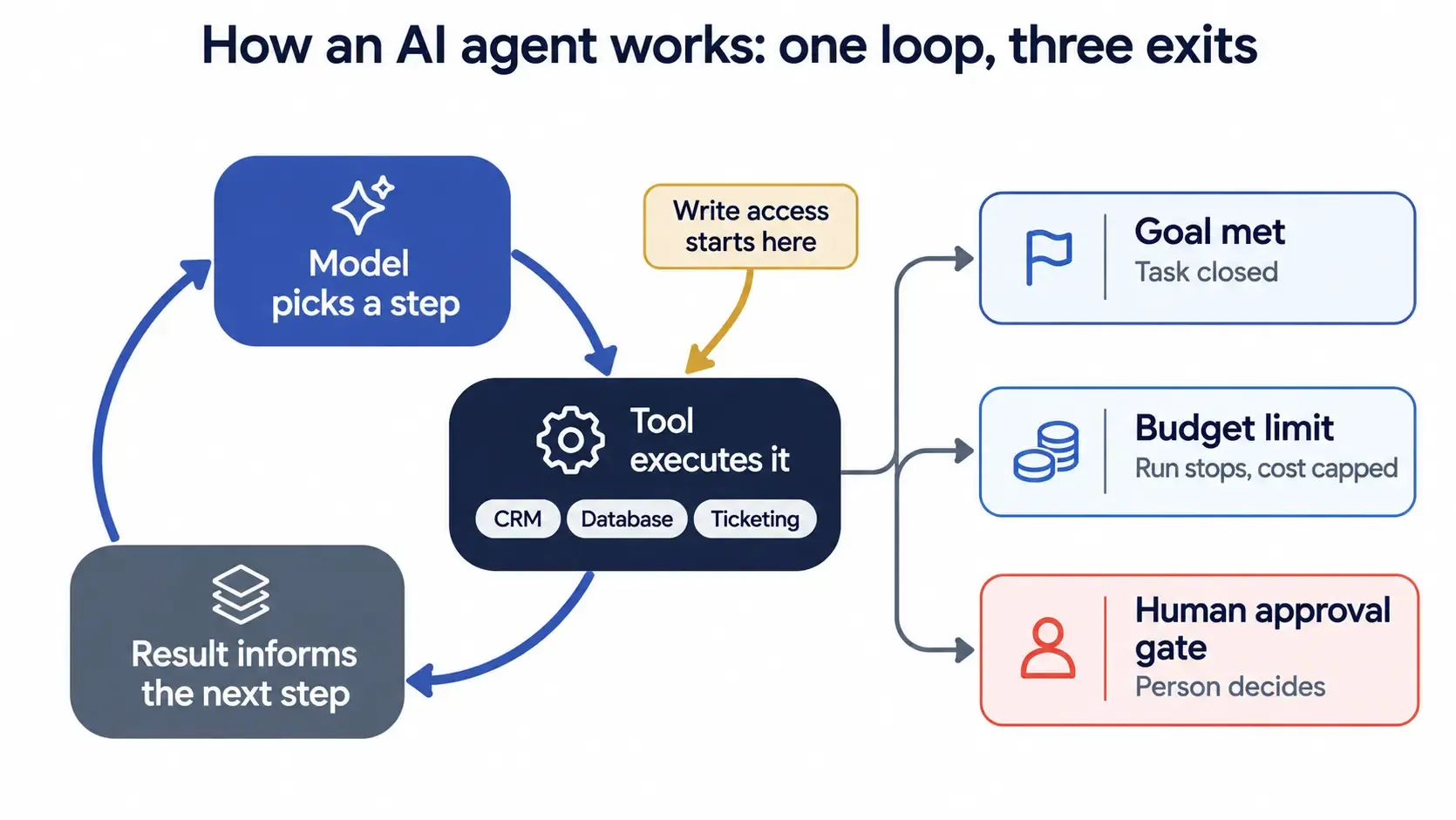
An AI agent runs a loop: the model picks a step, a tool executes it, and the result informs the next one. It stops at the goal, a budget limit, or a human approval gate. This guide to LLM agents explains the mechanics.
| Factor | Chatbot | AI agent |
|---|---|---|
| Output | An answer | A finished action |
| Access | Usually read-only | Read and write |
| Failure | Wrong reply | Wrong change in a live system |
Here the agent is the product, so model spend is cost of sales and failed tasks hit margin. Sierra and Harvey sell this way.
Here the agent saves labor, so compare cost per completed task with hours freed. A small SaaS team might run separate agents for ticket triage and invoice matching.
Agent washing is rebranding a chatbot, assistant, or RPA script as an agent. Three demo questions expose it:
Investment and market forecasts are growing faster than production adoption, so most buyers still ask for proof before they commit budget.
| Signal | Number | What it means for founders |
|---|---|---|
| Market size | $7.84B in 2025, projected at $52.62B by 2030, per MarketsandMarkets | Forecasts vary by definition |
| Startup count | 531 organizations in Crunchbase's agentic AI startups hub | Horizontal pitches face a crowded field |
| Production use | 57.3% of LangChain survey respondents | A developer-heavy sample, so treat it as a ceiling |
| Deployment at scale | 2% at scale and 23% in pilots, per Capgemini | Most buyers still need proof |
| Project risk | Gartner expects over 40% of agentic AI projects canceled by the end of 2027 | Set a baseline before you build |
| Vendor quality | About 130 vendors have real agentic capabilities, per Gartner | Test every "agent" claim in a demo |
For this list, we selected ten companies with a named workflow and a verifiable funding event, checked in November 2026.
| Startup | Category and buyer | Latest funding | Workflow owned | What it means for your build or purchase |
|---|---|---|---|---|
| Sierra | Customer service agents for large companies | $950M at above $15B, May 2026 | Resolving customer requests | Ask support vendors to price per resolved request |
| Decagon | Support automation for support teams | $250M Series D at $4.5B, January 2026 | Ticket resolution | Model per-conversation and per-resolution pricing against your ticket volume |
| Startup | Category and buyer | Latest funding | Workflow owned | What it means for your build or purchase |
|---|---|---|---|---|
| Cursor | AI coding agent editor for developers | $2.3B Series D at $29.3B, then bought by SpaceX for $60B, closed August 2026 | Writing and editing code | Win the tool developers open daily |
| Cognition | Autonomous software engineering for engineering teams | $2B+ Series E at $48B, September 2026 | Planning, coding, and testing a task | Sell a finished task |
| Replit | Prompt-to-app development for builders | $400M Series D at $9B, March 2026 | Prompt to running app | Own the deployment step too |
| Lovable | Prompt-to-app building for non-developers | $400M Series C at $13.3B, August 2026 | Idea to working app | Show results in minutes |
| Startup | Category and buyer | Latest funding | Workflow owned | What it means for your build or purchase |
|---|---|---|---|---|
| Harvey | Legal workflow agents for law firms | $550M at $15.5B, September 2026 | Legal research and drafting | Deep domain work earns premium pricing |
| Hippocratic AI | Healthcare communication for health systems | $126M Series C at $3.5B, November 2025 | Patient-facing calls | In regulated work, safety sells |
| Ambience Healthcare | Clinical documentation for health systems | $243M Series C at $1.25B, July 2025 | Visit notes | Live inside the record system |
| Glean | Workplace search for large companies | $150M Series F at $7.2B, June 2025 | Finding answers across apps | Connectors become the moat |
The startups on this list grew by owning one workflow from start to finish. Folio3 AI helps founders scope that workflow, test it on real data, and ship an agent customers can trust.
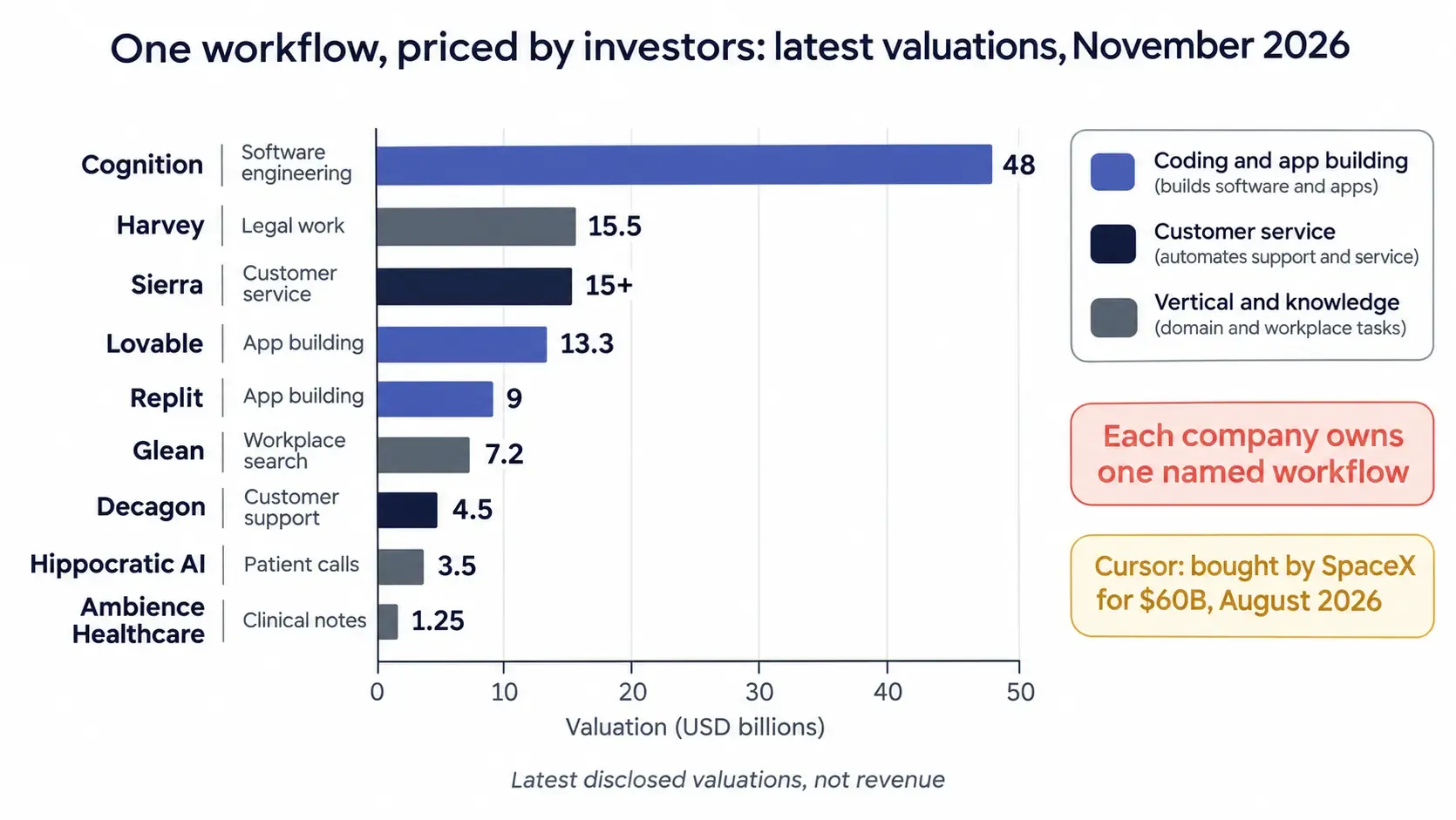
Successful AI agent startups narrow their scope, price on measurable results, and connect deeply to the systems their buyers already run.
The best first agent jobs sit in functions where work is high-volume, rule-bound, and easy to measure, such as support triage, sales follow-up, and invoice matching.
| Function | First agent job | Metric | Example tool |
|---|---|---|---|
| Sales | Prospecting and follow-up | Meetings booked | Zapier, custom GTM AI agents |
| Support | Ticket triage and resolution | Resolution rate | Lindy |
| Marketing | Content and campaigns | Hours per asset | Taskade |
| Engineering | Coding and review | Cycle time | Cursor, Devin |
| Research | Market and competitors | Hours per brief | Lindy, n8n |
| Finance | Invoices and reconciliation | Exception rate | Beam AI |
The right level of automation depends on your stage: automate little before product-market fit, then add integration and governance as proven workflows and agent count grow.
The best platform depends on your team and stage. Here we compare nine on speed to first value, pricing shape, integration reach, and maintenance burden, using list prices checked in November 2026.
| Platform | Best startup type | Technical skill required | Pricing shape | Main limitation |
|---|---|---|---|---|
| Lindy | Founder-led teams | None | Per user with credits, from $49.99 a month | Monthly credits don't roll over |
| Zapier | Teams with many SaaS tools | Low | Agents Pro $33.33 a month, billed annually | You design the steps |
| Taskade | Small teams wanting one workspace | Low | From $6 a month, billed yearly | Not meant for regulated data |
| Beam AI | Ops-heavy teams | Low to medium | Pro $50, Scale $3,990 a month | Steep jump between tiers |
| n8n | Technical teams wanting control | Medium | Free self-hosted, cloud from €20 a month, billed annually | You run and patch it |
| CrewAI | Developers shipping multi-agent features | High | Free framework, custom paid tier | No published mid-tier price |
| LangGraph | Teams with long-running agents | High | Free library, LangSmith Plus $39 a seat | Steeper learning curve |
| Microsoft Agent Framework | .NET or Azure teams | High | Free, plus cloud and model fees | Some features still in preview |
| OpenAI Agents SDK | Fast prototypes | Medium to high | Free SDK, plus model and tool fees | Hosted tools depend on OpenAI |
Five limits appear once a platform agent touches core work.
Platforms get a first agent live fast, then stall on exceptions, permissions, and deeper integrations. Folio3 AI builds custom agents connected to your CRM, data, and product, with human approval where it matters.
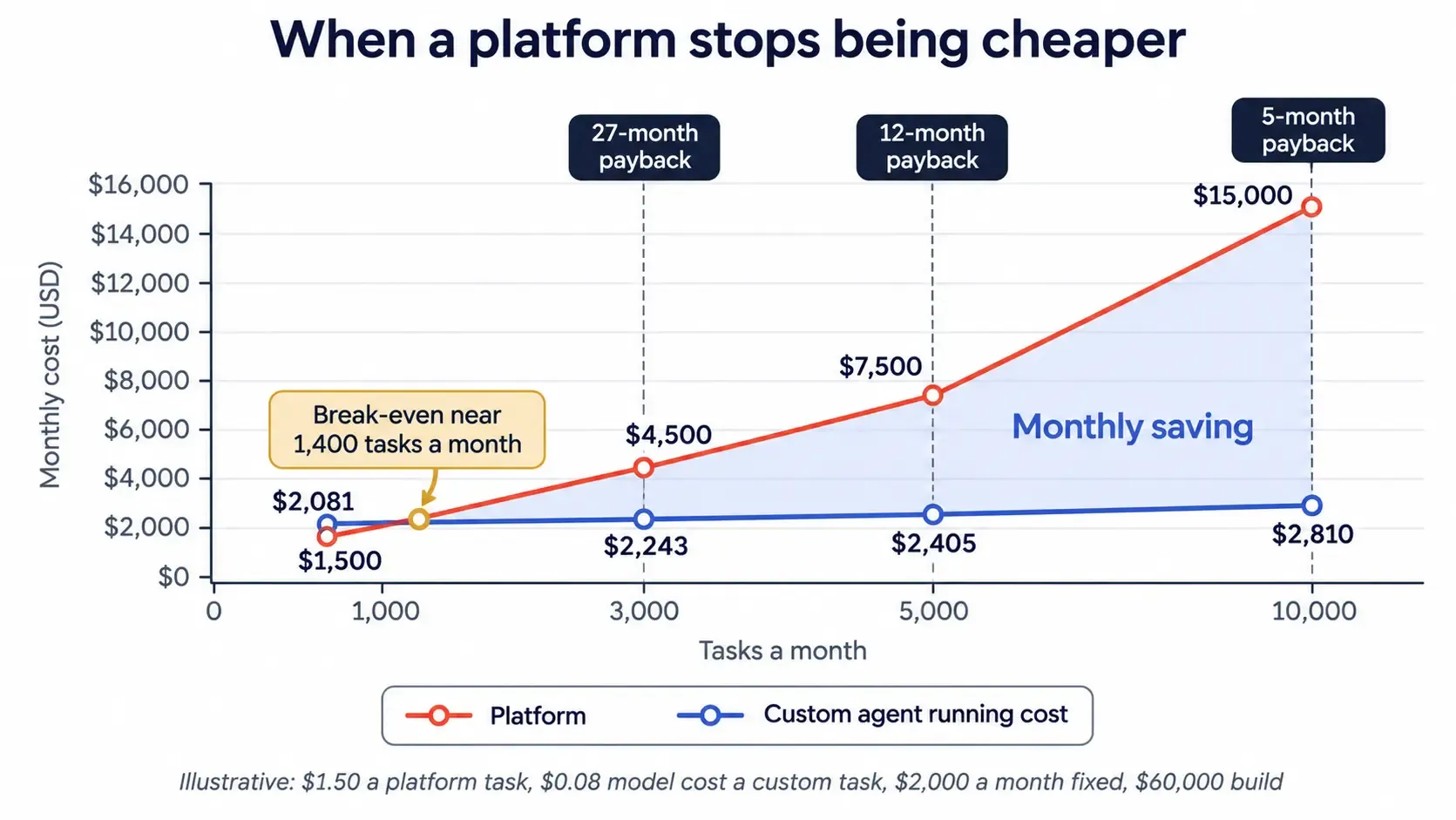
Platforms charge per run, and custom agents cost mostly up front. Three formulas show where those lines cross.
This worked example uses illustrative assumptions. The platform takes 150 credits per task at a published top-up rate of $10 per 1,000 credits, or $1.50. The custom agent makes five model calls per task at 3,000 input and 300 output tokens, priced at $3 and $15 per million tokens, with 20% retries, or about $0.08. It also carries $2,000 a month for hosting, monitoring, and upkeep, plus a $60,000 build.
| Tasks a month | Platform | Custom running cost | Monthly saving | Payback on build |
|---|---|---|---|---|
| 1,000 | $1,500 | $2,081 | None | Never |
| 3,000 | $4,500 | $2,243 | $2,257 | 27 months |
| 5,000 | $7,500 | $2,405 | $5,095 | 12 months |
| 10,000 | $15,000 | $2,810 | $12,190 | 5 months |
On running cost alone, the platform stays cheaper below about 1,400 tasks a month, even if the build were free.
Move sooner if the agent is your product, writes to a system of record under custom rules, or handles data that can't leave your cloud.
If customers pay for the agent, own it. If it supports a non-core task, rent it.
| Route | Best for | Speed | Control | Cost risk |
|---|---|---|---|---|
| Buy | Non-core back-office tasks | Days | Low | Usage bills climb |
| Build in-house | Strong AI team | Months | Full | Hiring and upkeep |
| Partner | Core workflows, limited engineers | Weeks to months | High with code handover | Scope creep |
| Staff augmentation | Gaps in skills | Weeks | High | Management time |
Disclosure: Folio3 AI publishes this list and ranks itself first. Details on other firms come from public sites and Clutch profiles, checked in November 2026.
Folio3 AI suits founders who need an agent wired into real systems.
DappaSol publishes fixed pricing from $8,900 and keeps code in client repositories, which suits a tightly scoped first build.
LeewayHertz builds custom agents and its own ZBrain platform, and it fits longer programs.
Markovate offers agent services, and its $50K+ Clutch minimum points to funded mid-market products.
Uvik supplies Python and AI engineers to existing teams, so you still own delivery.
| Company | Best fit | Engagement model | Published entry price | Code ownership | Shipped agent proof |
|---|---|---|---|---|---|
| Folio3 AI | Production agents on real systems | POC, MVP, staff augmentation | Scoped after discovery; GTM single agents $30K to $80K | IP transfers at delivery | Opsis Health six-agent system |
| DappaSol | Founder budgets | Fixed price | From $8,900 | Client owns 100% | Engineers' prior work at ShapeShift, CoinDesk |
| LeewayHertz | Large programs | Custom projects | $10K+ on Clutch | No public terms found | ZBrain, AdPerfect |
| Markovate | Mid-market products | Custom projects | $50K+ on Clutch | No public terms found | ERP agent, client unnamed |
| Uvik | Skill gaps | Staff augmentation | $25K+ on Clutch | Assigned under engagement terms | None named publicly |
Choose a partner that matches your stage and can show live agents, written code ownership, and security testing on systems like yours. Run these eight checks.
For multi-agent builds, also read how to choose a multi-agent systems company.
A POC sprint puts one workflow on real data, so your build decision rests on evidence instead of a demo. You see feasibility, integration needs, and likely business value before funding an MVP.
A scoped startup agent typically needs a five-figure build plus monthly run costs. Folio3 AI prices each build after discovery, so treat these as planning ranges.
| Stage | Planning range | Time |
|---|---|---|
| Platform subscription for testing | $20 to $1,500 a month | Days |
| POC sprint for validation | $15,000 to $60,000 for AI pilots | 2 to 4 weeks at Folio3 AI |
| MVP build for production | $30,000 to $80,000 for a scoped single GTM agent | 2 to 4 months |
| Managed optimization after launch | From $500 a month in cloud AI cost, rising with volume | Ongoing |
Ranges come from our cost guide and GTM AI agents page.
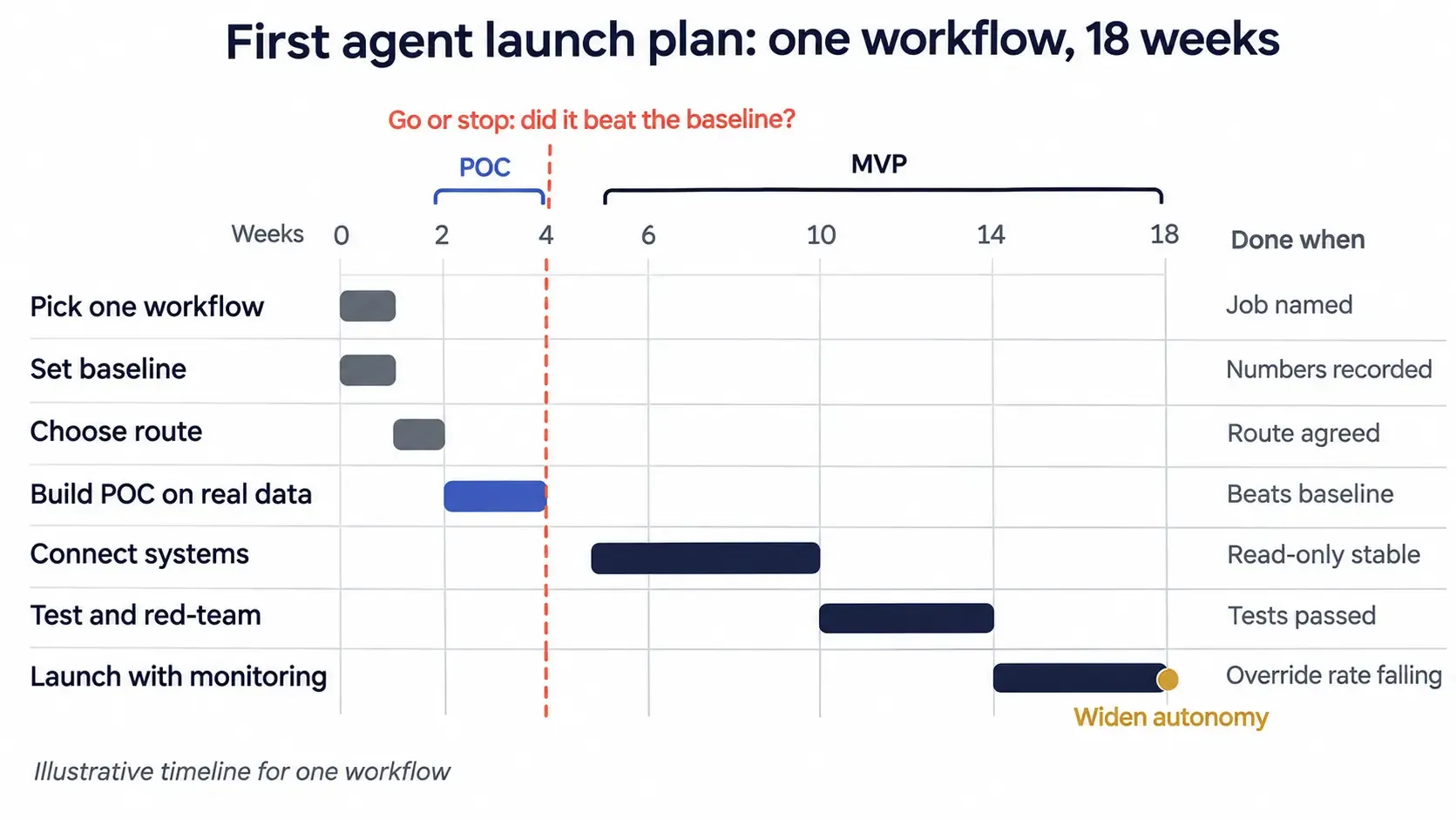
Launching a first agent takes seven steps, from choosing a workflow and measuring today's baseline to a monitored release with human approval on.
Choose the repetitive job taking the most founder hours. It should follow clear rules and run at least weekly, so you collect enough cases to judge results.
Record time per task, cost per task, and error rate today. These numbers become the target the agent has to beat, so the POC ends with a clear yes or no.
Use the break-even test above. Buy a platform if the job is non-core and low volume, and partner or build if it's core to your product.
Use last month's actual cases, including the ugly ones. Clean sample data hides the exceptions that break agents in production.
Give each tool the narrowest permission that works, starting read-only. Add write access one action at a time, once the agent's reads prove reliable.
Try prompt injection, bad inputs, outages, and unauthorized actions before users arrive. Fix each failure, then rerun the same tests after every model or prompt change.
Release with human approval on, then widen autonomy as override rates fall. Track completed tasks, errors, and cost per task daily, so you catch drift early.
Folio3 AI takes founders from one workflow to a governed production agent, backed by 20+ years of engineering and 950+ projects delivered. Choose the build method: either our team develops the solution, or forward-deployed engineers inside yours.
AI agent development services cover each stage:
"A demo shows the path where every tool responds, and the data is clean. Production is the ticket with a missing order number at 2 a.m. Before we design anything, we ask founders for last month's ugliest cases, because those cases decide the architecture."
"Founders often arrive with a list of ten agents, so we ask which single workflow cost them the most hours this month, write down today's number, and scope the sprint around moving it. A POC with no baseline ends in an opinion, and nobody funds an MVP on an opinion."
The startups on this list went narrow before they went big. Match your route to your stage, run the break-even math with real numbers, and prove one workflow before you fund a second.
They are young companies that sell software agents or run core work on them.
Sierra, Decagon, Cognition, Replit, Lovable, Harvey, Hippocratic AI, Ambience Healthcare, and Glean stand out. Cursor was acquired by SpaceX in August 2026.
No official list exists. The phrase usually means OpenAI, Google, Microsoft, and Anthropic, though some articles mean consulting firms' platforms.
Revenue is proven: Cognition reported a run rate near $900M in September 2026. Most private agent companies don't publish margins, so profit is harder to confirm.
Start with a repetitive, rule-bound task and follow the seven launch steps above, from baseline metrics to a monitored release.
No single platform wins. Non-technical teams lean toward Lindy or Zapier, and engineering teams lean toward LangGraph or CrewAI.
Not for no-code platforms. Frameworks need engineers, and agents writing to core systems need someone who owns failures.
Buy for non-core tasks and build where the agent is your product. Partner when the workflow is core and engineers are scarce.
Ask for live agents, written code ownership, evaluation results, and integration examples.
Scoped permissions, error handling, evaluations, cost limits, monitoring, and human approval on risky actions.
It depends on the contract. At Folio3 AI, architecture, code, and configurations transfer to your team at delivery.
Platforms run $20 to $1,500 a month. Scoped single-agent builds often sit near $30,000 to $80,000, plus model and hosting costs.
A platform agent can run in days. At Folio3 AI, a POC sprint takes two to four weeks, and an MVP takes two to four months.
Yes. Locked In Lacrosse is one example, and most teams begin with a POC sprint on one workflow.
Bring the workflow taking up the most founder hours. Folio3 AI will map it, identify the systems it touches, and show what a two-to-four-week POC sprint could prove.
By the Folio3 AI Editorial Team · Technically reviewed by Abdul Sami, Head of AI Development