
Agent Engineering Services
Most AI agents pass the demo and break in production. Folio3 engineers the harness around your models (context, tools, evals, guardrails, observability) so agents stay accurate, fast and auditable.
Global brands trust our engineering
Companies in automotive, banking, energy, retail and education trust Folio3 engineering teams with the systems that run their daily operations every day.






Why AI agents stall between pilot and production
Most stalled pilots share the same few engineering gaps. None of them sits in the model, and every one can be fixed.
Inconsistent output quality
The same question gets a different answer each week, so no team is willing to put the agent in front of customers.
Latency users won't tolerate
Multi-step agents chain model and tool calls until a simple request takes long enough for users to give up and leave.
Tool calls that fail silently
An API times out, the agent carries on as if the call worked, and the error reaches a customer before your team.
No evals, no trust
Without test sets and scores, nobody can prove a change made the agent better, so the production rollout never gets approved.
Agent sprawl across teams
Each department builds its own agent on its own framework, with separate permissions, no shared logging and no clear owner.
Costs that grow with usage
Token spend rises with every new user and retry loop, and nobody can show what one completed task actually costs the business.

What are agent engineering services?
Agent engineering services turn a working AI model into a production system your business can rely on, measure, audit and scale.
Agent = Model + Harness
The model makes decisions. The harness controls what it knows, what it can do and how all its work gets checked.
From agent prototype to production engineering
An agent working in a demo proves little. What matters is the engineering around it once it meets real systems and users.
| Agent prototype | Custom agent build | Production agent engineering | |
|---|---|---|---|
| Goal | Prove an idea quickly | Deliver a working workflow | Run the workflow reliably in production |
| Typical scope | Prompt, model, basic tools | Business logic, integrations, UI | Integrations, permissions, failure handling, evaluation, operations |
| Testing | Manual checks | Functional and integration testing | Automated evals, regression tests, red-teaming, failure testing |
| Observability | Minimal | Application logs | Traces, tool-call monitoring, cost and task metrics |
| Governance | Usually limited | Added as required | Designed into identity, permissions, approvals and audit |
| Best for | Exploration | Defined use cases | Business-critical production workflows |
Do you need an AI agent?
Agents earn their cost on judgment-heavy, multi-system work. For simpler workflows, a lighter option is faster, cheaper and easier to govern.
| If your workflow... | Best starting point | Why | Example |
|---|---|---|---|
| Follows the same fixed steps every time | Rules-based automation or RPA | Predictable, cheaper and easier to audit, with no model decisions needed | Invoice routing by amount and approver |
| Needs answers from documents, without taking action | Knowledge assistant (RAG) | Cited answers from approved content cover it, with no tool access or autonomy | Staff Q&A on policies and SOPs |
| Is already covered by software you use | Built-in copilot from your vendor | Faster to switch on, with no custom build or upkeep | CRM email drafts, ticket summaries |
| Requires judgment, tool use and exception handling | Custom AI agent | Steps cannot be scripted in advance, so the agent picks the next action within guardrails | Claims triage, supplier dispute handling |
| Spans several systems with custom approvals and rules | Custom agent integrated with your systems | Needs scoped access to ERP and CRM, approval chains and a full audit trail | Order exceptions across ERP and email |
| Takes high-impact actions with little room for error | Agent-prepared work with human approval | The agent gathers evidence and drafts the action, and a person signs off first | Payouts, credit decisions, refunds |
Agent engineering services we deliver
Hire one AI agent engineering service to close a specific gap, or combine several into a full engagement with one accountable team.
Agent architecture and design
Single or multi-agent, supervisor and sub-agent roles, autonomy levels and model routing are chosen per workflow, keeping agents fast and affordable.
Context engineering
RAG grounding, memory, state and context graphs keep agents answering from approved, current business data while holding down cost per request.
Tool and protocol integration
MCP servers, A2A messaging, APIs and browser automation connect agents to ERP, CRM and legacy systems, with failed calls validated and retried.
Agent evaluation engineering
Offline test sets, online evals and LLM-as-judge scoring with human review run on every release, proving quality with numbers, not demos.
Agent observability and AgentOps
Step-level tracing, latency and cost dashboards, and drift alerts trace every failure back to its root cause and keep spend predictable.
Guardrails and agent security
Scoped tool permissions, prompt injection defense and output validation set clear limits on what agents can do, with every action audited.
Agent audit and rescue
Failing agents, built in house or by a vendor, get a build review, reliability gap report, re-architecture plan and a hardening sprint.
Agentic software engineering enablement
Coding agent workflows, review and CI guardrails, and playbooks for agent-written code help engineering teams ship faster without piling up untested code.
The Folio3 agent harness framework
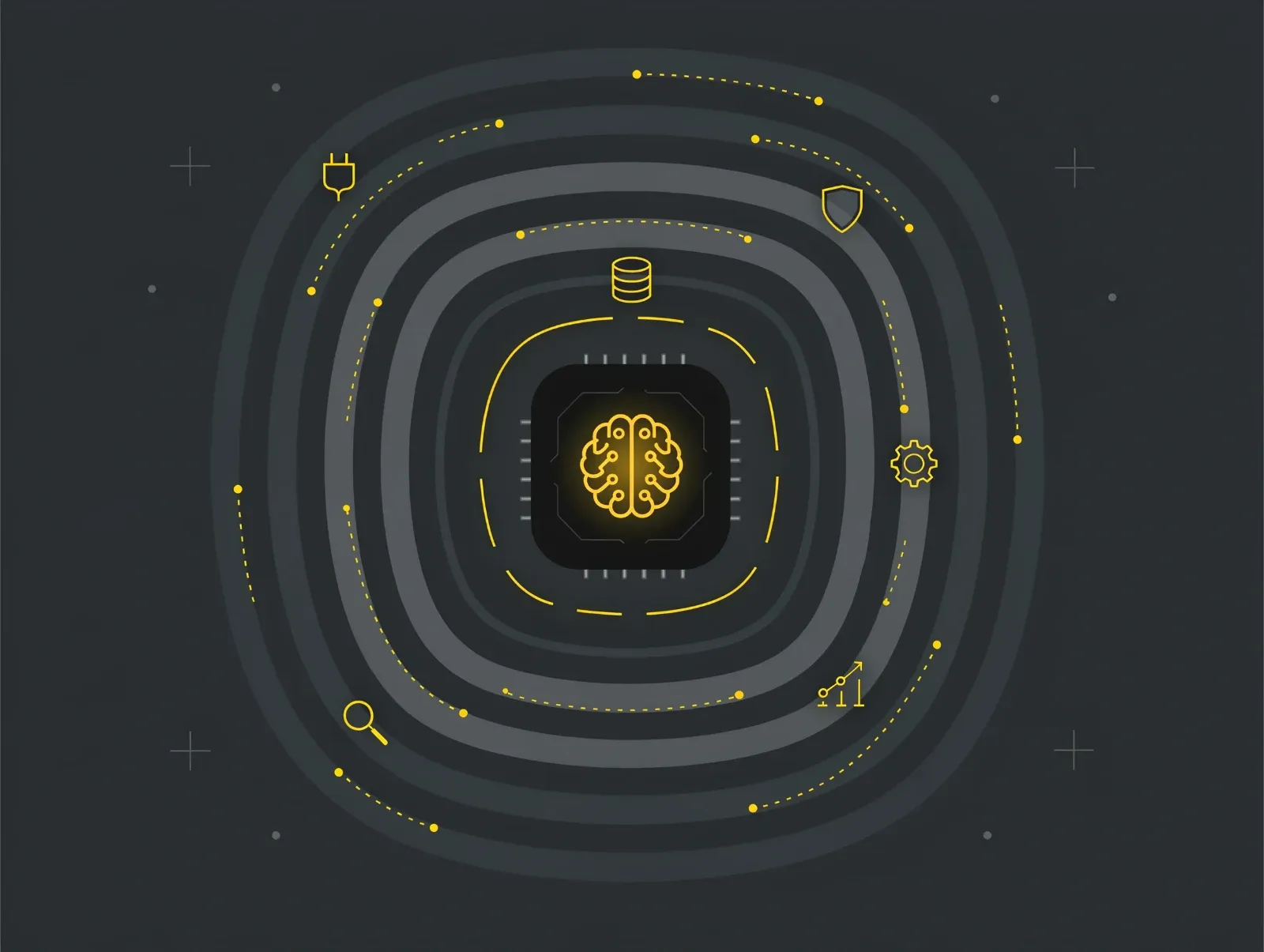
Six layers sit between the model and production. A gap in any one of them shows up as errors, delays or overspend.
Model layer
Selects the right model for each step, routes requests by cost and accuracy, and falls back safely when a provider fails.
Context layer
Retrieves approved data, keeps memory and state across steps, and trims what the model sees so answers stay accurate and fast.
Tool layer
Connects agents to APIs and MCP servers with scoped permissions, validating every call and retrying cleanly when a connected system fails.
Guardrail layer
Applies policies, validates inputs and outputs, and routes high-risk actions to a human approver before anything changes in your systems.
Evaluation layer
Scores the agent on offline test sets before release and on live traffic after launch, catching regressions before customers notice them.
Observability layer
Traces every step, tool call and token, with cost and latency dashboards that show exactly where a run slowed down or failed.
Agent architecture patterns and when to use each
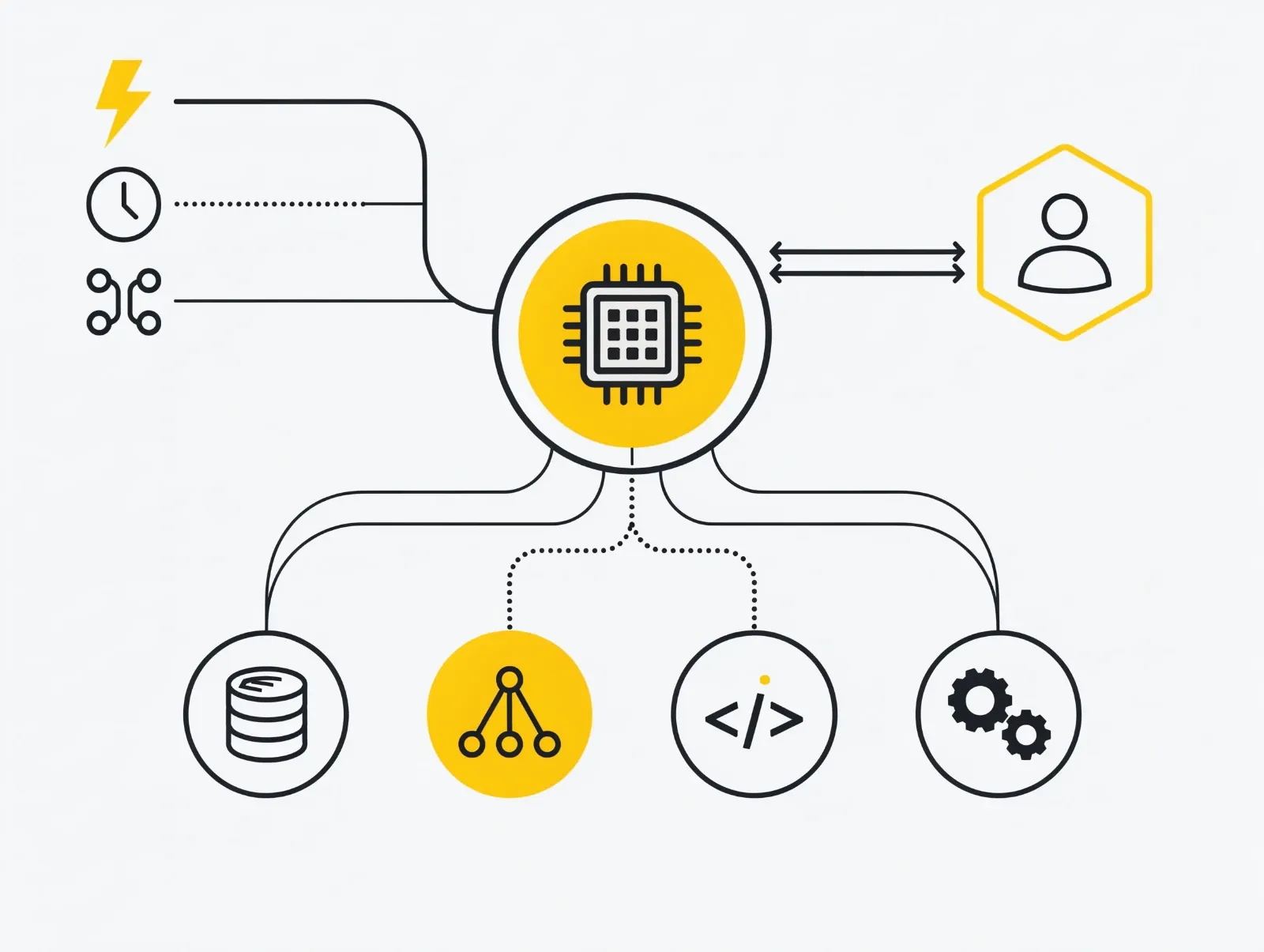
The right pattern keeps an agent easy to test, quick to respond and affordable to run, so the simplest fit usually wins.
| Pattern | Best for | Trade-off |
|---|---|---|
| Single-agent with tools | Narrow, well-defined tasks | Struggles with multi-skill work |
| Supervisor with sub-agents | Multi-step workflows with routing | More calls, higher latency |
| Multi-agent collaboration | Research and analysis tasks | Hardest to test |
| Human-in-the-loop handoff | High-risk or regulated decisions | Slower per case |
| Event-driven agents | Background and trigger-based work | Relies fully on alerts |
How we prove agents work before scaling
Six metrics are recorded at baseline and reported on every release, and budget for scale is approved only when the numbers hold.
Task success rate
The share of tasks the agent completes correctly from start to finish, scored against test cases built from your own real work.
Tool-call accuracy
How often the agent picks the right tool, passes the right inputs and gets a valid result back from your connected systems.
Hallucination and grounding rate
The share of answers backed by an approved source, so leadership knows how often the agent states something it cannot prove.
p95 latency per task
The time within which 95 percent of tasks finish, which is the response speed your customers and employees actually feel.
Cost per completed task
Model, retrieval and tool spend divided by successful outcomes, not attempts, so finance sees the true cost of every task.
Escalation-to-human rate
How often the agent hands work to a person, tracked so escalations drop for the right reasons and never hide real errors.
The agent engineering process
Six stages, each ending with a go or no-go decision, so scope grows only after measured results justify the next investment.
Discovery and system review
Review goals, workflows, current agents, and the data and systems involved, such as ERP, CRM and email, before any build starts.
Architecture and harness design
Select the architecture pattern, map every tool the agent will call and agree on the eval criteria that define success upfront.
Proof of concept
Build one workflow on real data and measure it against a recorded baseline within two to four weeks, before committing more budget.
Build and eval hardening
Add guardrails, test sets and step-level tracing for production, with a working MVP usually delivered within two to four months.
Deploy and integrate
Roll out to production with monitoring in place, typically over six to twelve months depending on integrations and security review.
Operate and improve
Online evals, prompt and model tuning, and cost control continue after launch, with every result reported against the original recorded baseline.
Engagement models
Choose how Folio3 works with your team: a full build, embedded engineers or a fixed-scope audit of the agents you already run.
Build Method
Folio3's team engineers, launches and documents the full agent system, giving you one accountable partner all the way from discovery to production.
Forward Deployed Engineers
Folio3 engineers join your sprints and build the harness alongside your developers, so the skills and know-how stay in house.
Agent Audit Sprint
A fixed-scope review of your existing agents that ends with a reliability gap report and a clear, prioritized fix plan.
Agent engineering tech stack
Your model, your cloud, your framework. Tools are chosen per project to fit your stack, and nothing locks you into one vendor.
Models
Models are chosen per task based on accuracy, cost and data rules, and the harness lets you switch models without a rebuild.
- Claude: tool use and long documents
- GPT: wide availability through Azure
- Gemini: Google Cloud workloads
- Llama: private and on-premise deployments
- Mistral: high-volume, low-cost steps
Orchestration
Orchestration frameworks control how agents plan, hand off and retry, so every branch of a workflow can be tested before release.
- LangGraph: testable state flows
- CrewAI: role-based agent teams
- AutoGen: multi-agent collaboration
- Semantic Kernel: Microsoft and .NET stacks
Retrieval
Retrieval tools ground agents in your documents and databases, so answers come from approved sources that respect existing access rules.
- LlamaIndex: document parsing pipelines
- Pinecone: managed vector search
- Weaviate: hybrid keyword and vector search
- pgvector: vectors in your existing Postgres
Protocols
Standard protocols connect agents to tools, data and other agents, so new systems plug in without custom code for each one.
- MCP: standard tool and data access
- A2A: agent-to-agent task handoffs
- REST APIs: older and legacy systems
Observability and evals
Tracing and eval platforms record every step, score every release and show exactly where quality, latency or cost started to slip.
- LangSmith: tracing for LangGraph projects
- Langfuse: open-source, self-hosted tracing and evals
Cloud
Agents, data stores and logs deploy inside your own cloud account, under your existing identity, network, security and key management controls.
- AWS
- Azure
- Google Cloud
Governance and security built into every agent
Engineering services for agentic AI must stand up to an audit, so controls are part of the architecture from the first sprint.
- ISO 27001 certified processes: delivery follows Folio3's certified processes for access control, change management and incident handling.
- Runs in your cloud tenant: agents, data stores and logs run in your AWS, Azure or Google Cloud account.
- EU AI Act readiness mapping: each agent is mapped to its risk category, with the documentation and oversight it requires.
- Action logs for audits: every action records what triggered it, what data it used, what changed and who approved it.
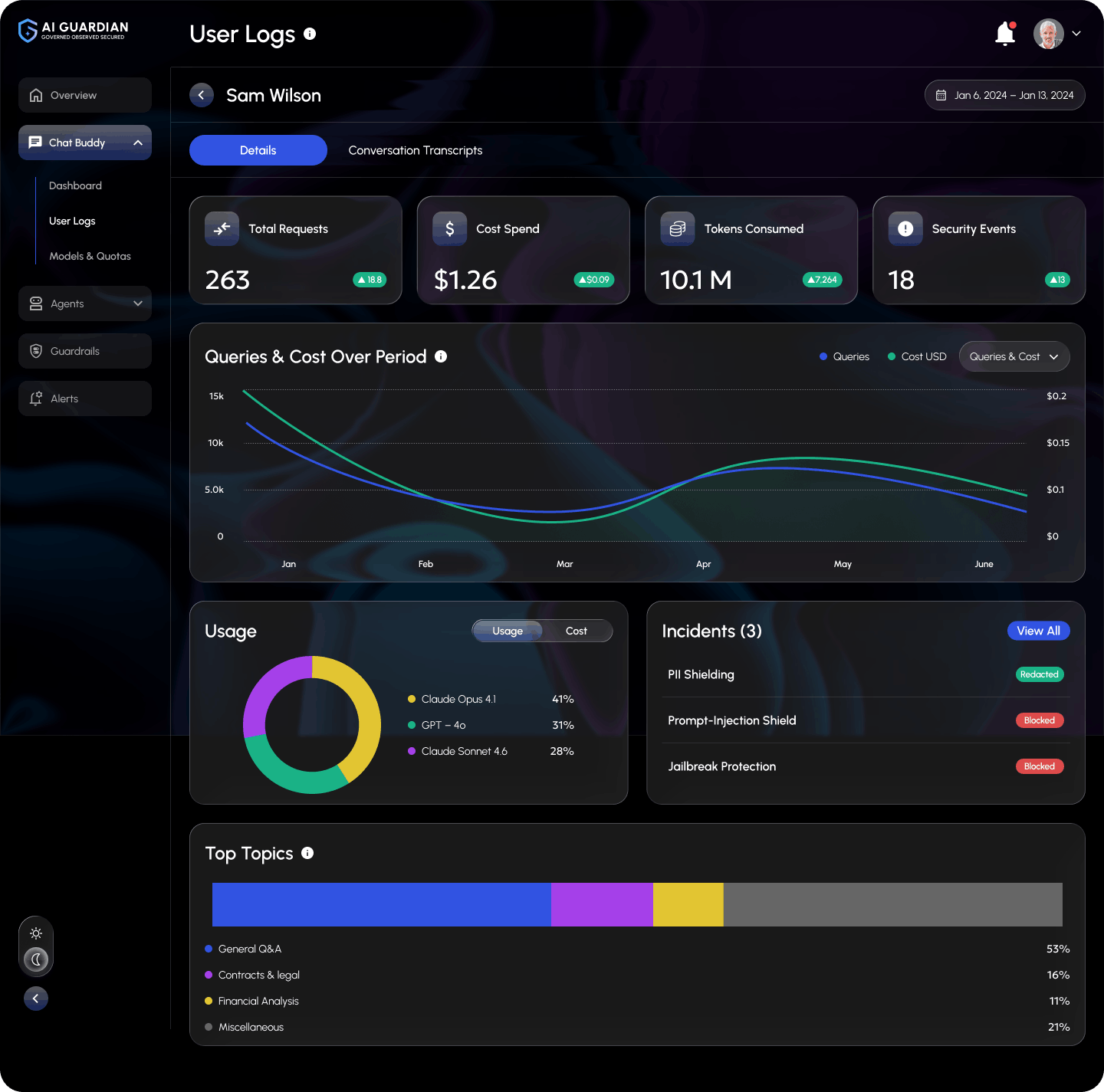
- AI Guardian for agent oversight: sits between agents and models, checking identity, redacting sensitive data, capping spend and logging every request.
Where agent engineering delivers impact
Any workflow where an agent touches customers, money or internal data needs the same production discipline, testing and audit trail.
Customer-facing
Service, sales and booking agents, where every delay or wrong answer is visible to customers and directly affects revenue and trust.
Operations
Claims, procurement and finance agents, where a wrong action costs real money and every decision needs a complete audit trail.
Employee support
HR policy, IT help desk and knowledge agents that answer staff questions while respecting who is allowed to see what.
Data
Talk to Your Data agents that answer business questions from your databases in plain language, with every query logged and checked.
Explore Talk to Your DataAgent engineering by industry
The same harness applies in every sector. What changes is the regulation, the systems involved and who must approve each agent action.
Insurance
Claims intake, policy validation, fraud scoring and payout agents, engineered with human handoff for edge cases and a complete audit trail.
Healthcare
Prior authorization, claim scrubbing and patient intake agents that keep clinicians in control, with minimum-necessary data access and every action logged.
Banking
KYC onboarding, loan document review and customer service agents, with scoped data access, explainable decisions and approval steps for risky actions.
Hospitality
Booking changes, guest questions and review response agents that work across channels, with staff approving anything that affects a guest's stay.
Education
Admissions, student services and staff knowledge agents that answer from approved policies and hand complex cases to the right team quickly.
Agent engineering in action: case study
Two agent systems running in production, each measured against how the same work ran before Folio3 engineered and launched it.

Insurance claims orchestration for a P&C insurer
Only 10% of claims ran without human input. A supervisor now routes intake, policy, fraud and payout agents, with human handoff.
HR policy agent for a Saudi petrochemical company
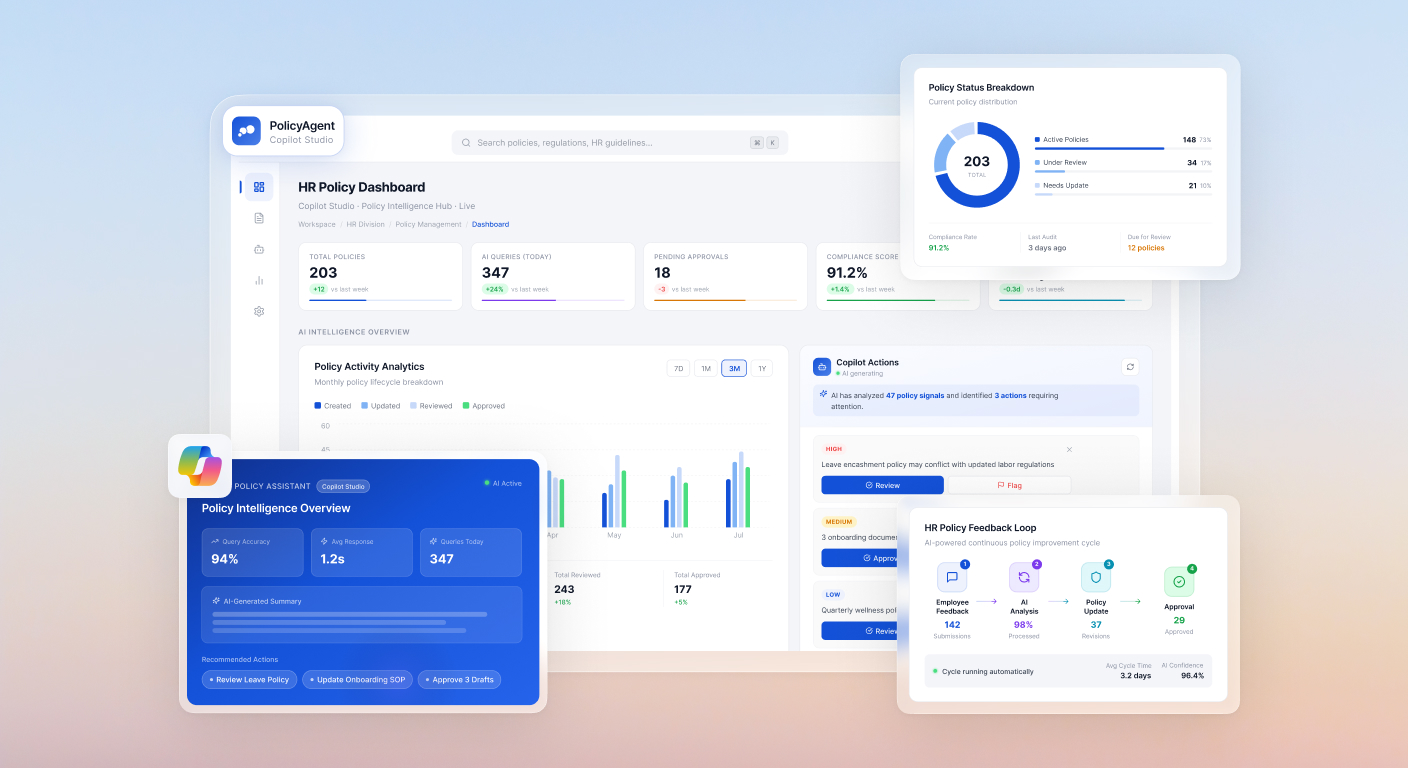
A Copilot Studio and Azure agent answers policy questions, collects feedback and drafts updates for 3,000+ employees, with HR approving changes.
Results come from individual projects. Your outcome depends on your workflow, data, and systems.
Why teams choose Folio3 for agent engineering
Five reasons leadership teams trust Folio3 to take AI agents from pilot to production and keep them reliable after launch.
Production-first engineering
Approvals, integrations and failure handling are planned before any build starts, so the agent is designed for production from day one.
Eval-driven delivery
Every release is scored against your own test set, so progress is measured in numbers your leadership can verify, not claimed.
Model and vendor neutral
Models are chosen per task on accuracy, cost and data rules, and switching providers later never means rebuilding the whole agent.
Governance from day one
Permissions, approvals and audit logs ship with every agent, backed by AI Guardian for central control of models, data and spend.
Two flexible delivery models
Hand the full build to Folio3, or embed Folio3 engineers in your sprints to grow agent engineering skills inside your own team.
Is your agent ready for real users?
Get a review of your harness, evals and guardrails, with every gap ranked by risk and a clear plan to close it.
Meet the engineers behind your agents
The people who scope your agent also build it, test it and support it after launch, so accountability never changes hands.
Scroll sideways to meet the full team
Agent engineering services FAQs
What is agent engineering?
Agent engineering is the work of making AI agents reliable in production, covering architecture, context, tool access, evals, guardrails and monitoring.
What do agent engineers do?
They design agent structure, connect tools, build test sets and monitor live performance, keeping accuracy, speed and cost per task within agreed targets.
How are agent engineering services different from AI agent development?
AI agent development builds new agents. Agent engineering makes new and existing agents reliable through evals, guardrails, monitoring and fixes.
What is an agent harness?
The harness is everything around the model: context, tools, permissions, guardrails, evals and tracing. A strong harness lets you change models without rebuilding.
What is context engineering for AI agents?
Context engineering controls what information an agent sees at each step, so answers stay accurate while response time and cost stay low.
How do you evaluate AI agent reliability?
Agents are scored on real test cases before release and on live traffic after launch, tracking task success, accuracy, latency and cost.
Can you fix or audit agents we already built?
Yes. An Agent Audit Sprint reviews existing agents, built in house or by a vendor, and delivers a gap report and fix plan.
Which models and frameworks do you support?
Claude, GPT, Gemini, Llama and Mistral, with LangGraph, CrewAI, AutoGen or Semantic Kernel. Existing agents can usually keep their current framework.
How much do agent engineering services cost?
Cost depends on workflows, connected systems, data readiness and compliance needs. Audit sprints are fixed scope; builds are priced after discovery.
How long does an agent engineering engagement take?
A proof of concept takes 2 to 4 weeks, an MVP 2 to 4 months, and a wider rollout 6 to 12 months.
How do you keep AI agents secure and compliant?
Scoped permissions, injection defenses, human approval for high-risk actions, action logs and deployment in your cloud, under ISO 27001 certified processes.
Partners and certifications across Folio3
One company with specialist practices across AI, ERP, CRM, commerce and digital health, backed by the partnerships and security standards they hold.
 Oracle NetSuite Alliance Partner
 Microsoft Solutions Partner
 AWS Partner
 Salesforce Consulting Partner
 Shopify Plus Partner
 Certified BigCommerce Partner
 Epic Vendor Services Program Member
 HIMSS Member
 ISO/IEC 27001 Certified
Turn your agent pilot into a system you can trust
Agents that pass a demo still need evals, guardrails and tracing before real users. Folio3 engineers find the gaps and close them.

